


How Smart Lockers Reduce Costs for Property Managers and Owners
A practical look at labor, interruptions, delivery exceptions, and operating value in multifamily communities
Package volume has turned routine mailroom work into a recurring labor cost for multifamily communities. A smart parcel locker system can move package intake, resident notification, pickup, and status tracking into a controlled self-service workflow. The savings opportunity is clearest when the system also resolves common delivery and pickup errors automatically, so property staff are not pulled into routine troubleshooting.
For a community receiving 40 to 100 packages a day, even a few minutes of staff handling per parcel can add up quickly. Package Nexus combines indoor and outdoor smart lockers with patented On-Auto-Pilot technology designed to correct common workflow errors as they occur, helping managers recover time for leasing, resident service, and property operations.
Manual package handling can consume hours each day
The labor burden is not limited to carrying parcels. A manual process may require staff to accept deliveries, sort and log items, identify residents, send notices, respond to pickup requests, and investigate missing or misplaced packages. Each handoff can interrupt leasing tours, maintenance coordination, resident requests, or other time-sensitive property work.
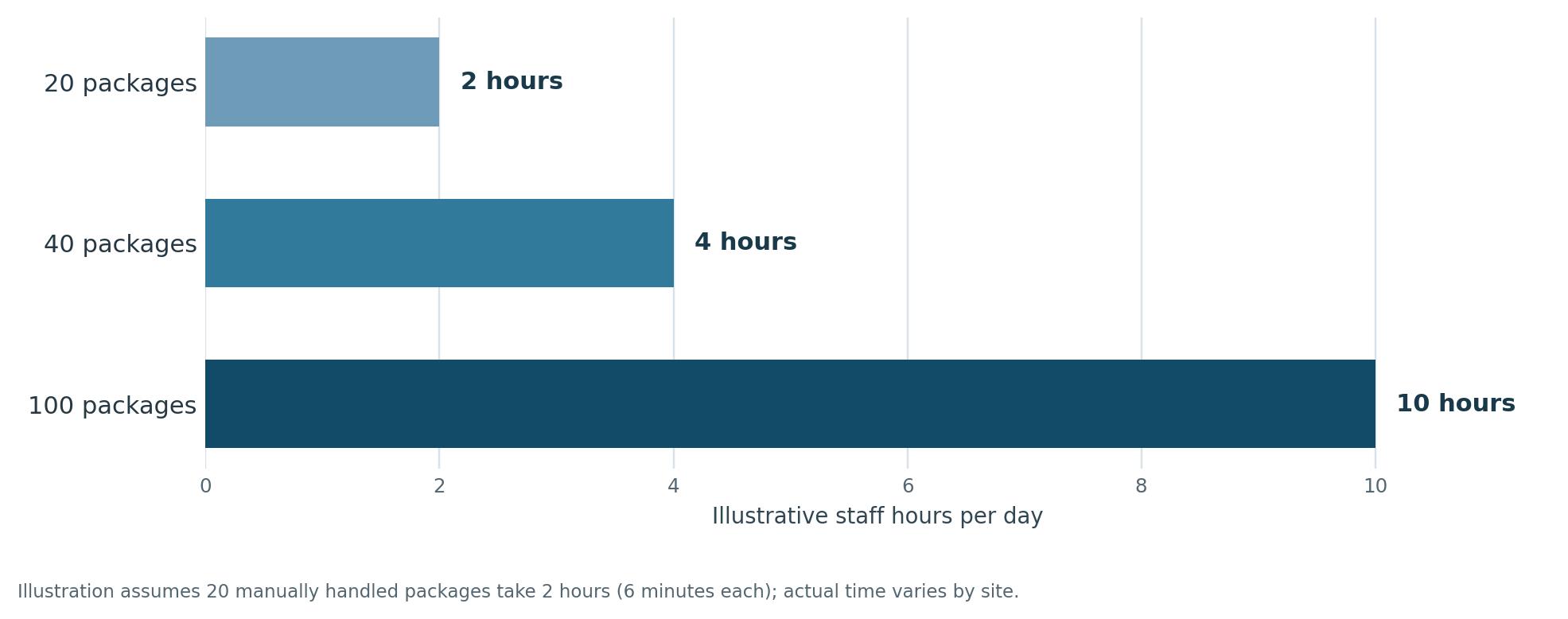
Use this site-level benchmark as an illustrative starting point: if staff spend two hours processing 20 packages manually, that is about six minutes per package. At the same rate, 40 packages represent roughly four staff-hours a day, while 100 packages represent roughly ten. The chart translates that benchmark into a simple comparison; actual time depends on package size, staffing, delivery pattern, logging method, and resident pickup behavior.
Automating the delivery-to-pickup workflow can reduce those repetitive touches. Carriers deposit packages in assigned compartments; the system records the transaction and sends pickup information; residents retrieve parcels when convenient. Staff still oversee community operations, but they no longer need to personally receive, log, and distribute every routine package.
On-Auto-Pilot technology reduces the hidden cost of troubleshooting
A locker system saves labor only when its day-to-day workflow is dependable. If a failed scan, incorrect compartment selection, incomplete delivery, empty-compartment pickup attempt, or open door routinely becomes a staff ticket, package handling has shifted into a different queue rather than gone away.
Package Nexus patented On-Auto-Pilot technology is designed to detect and recover from common delivery and pickup deviations in real time. Depending on the event and configuration, the system can help resolve unregistered deliveries, timed-out transactions, empty-locker attempts, and door-open events. This is intended to eliminate routine staff involvement in these common troubleshooting steps, while preserving a support path for unusual cases that require human review.
The cost impact reaches beyond the minutes spent on a single ticket. Repeated package questions create interruptions, follow-up calls, resident frustration, and uncertainty about who has the parcel. When the system tracks package activity and can correct common workflow errors, staff have fewer routine investigations to manage and residents have clearer self-service pickup information.
Where smart locker systems can reduce operating costs
| Cost lever | How automation helps |
|---|---|
| Staff time | Automated intake, resident alerts, and self-service pickup reduce repetitive receiving, logging, sorting, and handoffs. |
| Interruption costs | Fewer front-desk questions and package searches protect time for leasing, renewals, maintenance coordination, and resident care. |
| Exception handling | On-Auto-Pilot recovery is designed to resolve common user and workflow errors before they become staff tickets. |
| Package accountability | Electronic transaction records and package-status sensing support faster answers to delivery and pickup questions. |
| Space and overflow | Configurable compartment sizes, optional overflow workflows, and package-room options can help properties plan around peak demand and oversized parcels. |
| Amenity value | Convenient pickup outside office hours supports resident experience and can help properties differentiate their service offering. |
A property-specific payback calculation
A credible cost case starts with a before-and-after baseline. For two to four weeks, record package volume, staff minutes spent on intake and distribution, package-related interruptions, exception tickets, and average time to resolve each issue. Then compare those figures after the locker workflow is established and residents and carriers have been trained.
A simple annual labor value estimate is: (hours saved per day × operating days per year × loaded hourly labor cost). Add separately measured changes in overtime, temporary coverage, package-related service requests, and space used for staging. Compare those savings with the system’s purchase, installation, connectivity, and ongoing service costs. Using site data turns the discussion from a generic ROI claim into an ownership-level decision.
The 40–100-package example should be treated as a workload scenario, not a universal market average. A property with different volume, staff process, or pickup patterns should replace the example with its own measurements.
Hardware and configurations that support long-term value
Package Nexus offers smart parcel lockers for multifamily buildings in indoor and outdoor configurations. Current product materials describe an industrial-grade computer, a 15-inch touchscreen kiosk, barcode scanning, electronic locks, package-status sensors, secure cloud connectivity, activity records, and recipient-specific pickup information. 12-gauge galvanized steel construction is available in the listed multifamily specification; final hardware and materials should be confirmed for the project.
Communities can select compartment mixes for expected parcel sizes, with oversized storage or a managed package-room workflow considered for parcels that do not fit. Temperature-controlled compartments may be specified for refrigerated, freezer, or heated use cases. Equipment placement and configuration can be planned around available floor area, access control, weather exposure, expected peak volume, connectivity, and resident pickup patterns.
For multifamily owners and operators, the value case is the combined effect of less routine handling, fewer interruptions, more accountable package records, and lower dependence on staff to repair common user errors. Package Nexus smart parcel lockers for apartment communities are designed to make that daily workflow more consistent while giving residents a secure, convenient pickup option.
Frequently asked questions
How do smart lockers reduce costs for property managers?
They automate routine package intake, delivery logging, resident notification, and self-service pickup. That can reduce staff hours spent receiving and sorting parcels, answering routine package questions, and searching for items. The actual savings depend on the property’s delivery volume, labor cost, configuration, and how consistently carriers and residents use the system.
How much staff time can a property save?
Start with a local time study. As an illustration, if a team takes two hours to handle 20 packages manually, that equals about six minutes per package. At the same rate, 40 packages would represent four hours and 100 packages ten hours of manual work per day. A smart locker workflow can reduce many of those touches, but the property should measure its own before-and-after results rather than assume every minute disappears.
What does On-Auto-Pilot do when a package delivery goes wrong?
Package Nexus On-Auto-Pilot technology is designed to detect and help resolve common workflow deviations, such as missed or failed scans, incomplete or timed-out delivery sessions, empty-locker pickup attempts, and door-open events. The response varies by event and system configuration. Unusual situations can still require staff or support review.
Will smart lockers eliminate all package-related staff work?
No system should be treated as a replacement for all property oversight. Smart lockers can remove many routine receiving, notification, and troubleshooting tasks, while staff remain responsible for site policies, resident support, special deliveries, and exceptional cases. The strongest operational gains come from automating predictable workflows and measuring the exceptions that remain.
Can one system work indoors and outdoors?
Package Nexus offers indoor and outdoor configurations. The suitable option depends on the property layout, weather exposure, access rules, available power and network connectivity, package volume, and resident circulation. A site assessment should confirm the configuration, installation requirements, and any weather-protection needs.
How should a property size a parcel locker system?
Review average and peak daily deliveries, resident count, package-size mix, seasonal surges, pickup timing, available space, and the plan for oversized deliveries. A mix of compartment sizes and an overflow or package-room option can help accommodate changing demand. Final sizing should use actual property delivery data and a site-specific layout.
How can owners measure whether a locker system is paying off?
Track staff minutes per package, package-related interruptions, issue tickets, time to resolve exceptions, overtime or temporary coverage, package dwell time, and resident feedback before and after deployment. Compare the annual value of measured labor and operating changes with the system’s full lifecycle costs, including installation and service.

Package Nexus is the global technology leader and provider of The World's Most Advanced Smart Parcel Lockers for efficient and most simplified package management for multifamily communities, retailers, universities, libraries, corporate offices, groceries, and more. Package Nexus unique and patented technology offers a fix for human errors at the time of package deliveries and pickups. Package Nexus solutions help property, store, and office managers to improve their operations, reduce operating costs, and increase customer satisfaction at the same time. Package Nexus offers its entire suite of solutions globally.
USEFUL LINKS

© 2017-2026 Package Nexus