


How secure are outdoor smart parcel lockers
Outdoor smart parcel lockers can provide strong protection against opportunistic package theft and everyday weather exposure when the enclosure, electronic locks, pickup credentials, and installation are designed together. They secure parcels inside assigned compartments and create a record of delivery and pickup. Package Nexus adds patented On-Auto-Pilot technology that senses package activity and addresses common transaction errors before they become a site manager’s troubleshooting task.
For property owners, that combination matters. A parcel needs protection from unauthorized access and rain, but residents also need a dependable way to retrieve it. A locked compartment with an inaccurate delivery record can still trigger a missing-package complaint. A well-designed outdoor solution protects the physical parcel and keeps the handoff understandable.
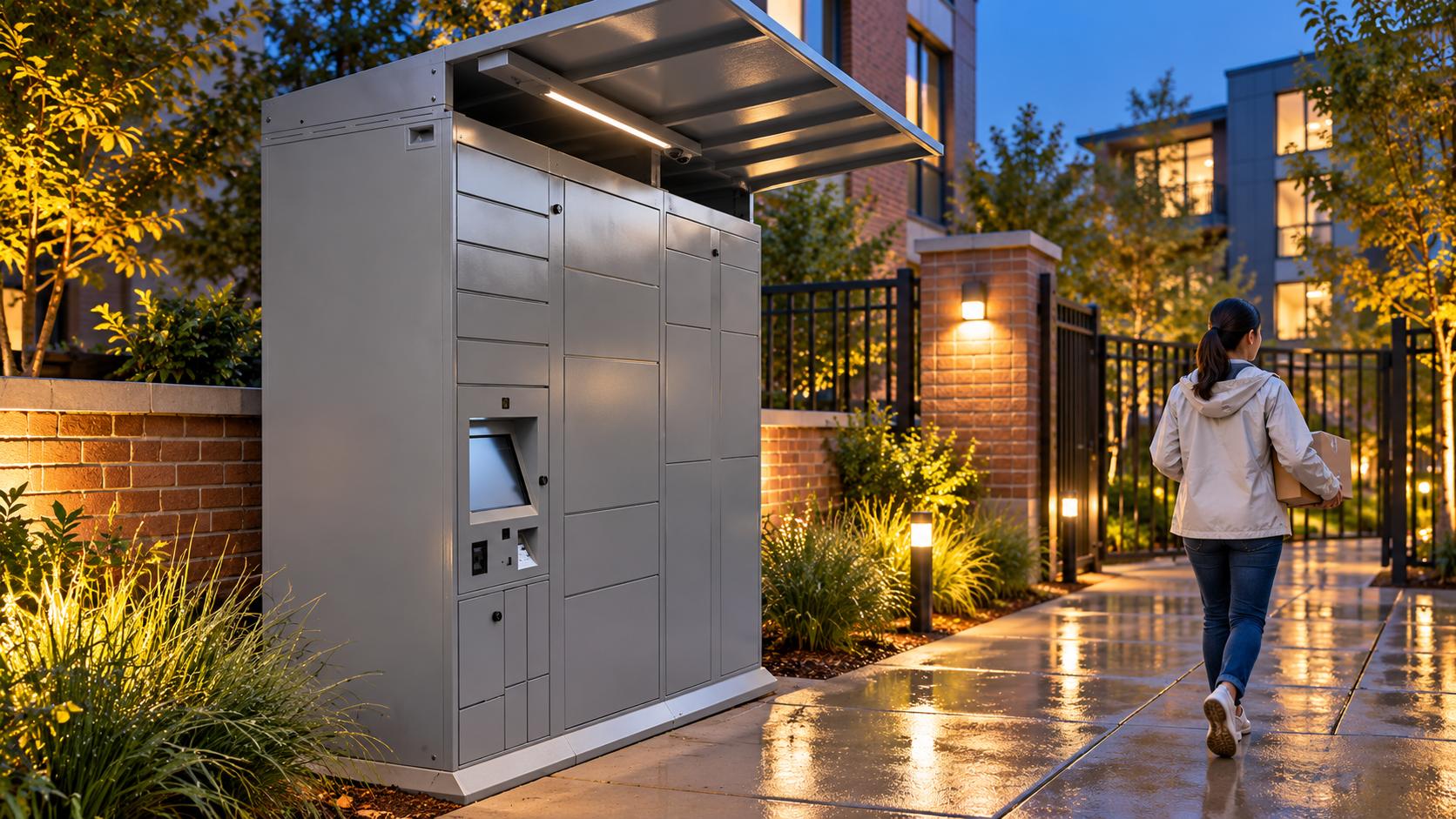
What makes an outdoor parcel locker secure
Security comes from coordinated safeguards: a durable enclosure, controlled compartment access, accurate package-status information, useful activity records, and a suitable outdoor location. No locker is theft-proof or immune to every storm. The practical goal is to reduce exposure, prevent avoidable mistakes, and give authorized recipients a reliable pickup experience.
Package Nexus outdoor smart parcel lockers combine weather-oriented construction with electronic access and automated delivery workflows. When couriers can reach the lockers without entering residential corridors, a property can also keep routine deliveries outside its private interior areas.
Physical construction protects the parcel
Steel compartments place a physical barrier between a package and anyone passing by. Package Nexus lists heavy-duty 12-gauge steel and galvanized construction among its hardware capabilities, together with an industrial powder-coat finish. These features support durability and corrosion resistance. Confirm the enclosure, doors, electronic locks, anchoring, and finish for the configuration being quoted.
Steel thickness alone does not establish a forced-entry rating. Door fit, lock attachment, hinges, cabinet assembly, and mounting all contribute to resistance. A properly installed locker bank should be assessed as a complete system, including how exposed it is to vandalism and vehicle contact.
Pickup credentials control which compartment opens
A resident uses the supported pickup code or barcode to access the compartment assigned to the delivery. Automated text or email notifications provide the pickup instructions, helping residents collect packages without waiting for the leasing office to open.
This limits casual access compared with an open shelf. It also reduces the need for staff to locate a box and decide whom to hand it to. Residents should keep pickup credentials private, and property teams should maintain accurate resident records so notifications reach the right person.
Cameras and records make activity easier to review
Package Nexus describes embedded cameras and transaction records that provide context around delivery and collection. Its comparison materials identify two fish-eye cameras; the final camera arrangement, recording settings, coverage, and retention should be confirmed for the installation.
Footage and event records can help a team reconstruct what happened when a parcel is questioned. They do not replace a working lock or prove the contents of a sealed box. Outdoor lighting and camera sightlines should be reviewed together so the pickup area remains useful and visible after dark.
How patented On Auto Pilot technology reduces package issues
One of the most valuable security features is an accurate account of whether a parcel is actually inside the locker. A workflow that depends only on a courier or resident pressing the correct confirmation button can create a mismatch between the screen and the compartment.
Patented On-Auto-Pilot technology combines Package Nexus sensors with automated transaction logic. The system is designed to detect package placement and removal, including small and flat items, and respond to common unfinished or incorrect delivery and pickup actions. This helps avoid the manual investigation that an inaccurate transaction record can cause.
For common user-error scenarios that On-Auto-Pilot detects and corrects automatically, site managers do not need to troubleshoot the transaction. The practical benefit is fewer interruptions to leasing, resident service, maintenance coordination, and other work that requires a person.
| Common Transaction Problem | Why Staff Can Get Pulled In | Package Nexus Approach |
|---|---|---|
| A delivery is indicated but the compartment is empty | Someone must reconcile the notification with the physical locker | Package-presence sensing helps verify an actual deposit |
| A parcel is deposited but the user misses the final confirmation | The package may lack a completed delivery record | Sensor feedback and automated workflows help complete supported unfinished transactions |
| A pickup is indicated while the parcel remains inside | A resident may need help restoring a usable pickup path | Removal sensing helps align transaction status with actual retrieval |
| A user walks away or a door remains open | Staff may be asked to investigate a session or door exception | Configured timeout and door-status workflows detect the condition and guide or automate the next step |
These are workflow examples, not measured failure rates for every locker system. The most useful comparison is a demonstration: deposit a small item, leave a session unfinished, and ask what the system records and who must act. Then test the corresponding pickup sequence. Reducing delivery and pickup errors is valuable because preventing an exception can save more effort than simply making a support number available.
Automation does not mechanically close a door that someone leaves open, repair impact damage, or correct every wrong-address delivery. Those events need an appropriate response. Package Nexus’s operational advantage is the removal of avoidable manual work from supported delivery and pickup scenarios, with smart locker support and operations planned for issues outside that scope.
Weather protection is part of outdoor package security
A parcel can be inaccessible to a passerby and still be damaged by water or unsuitable temperatures. Outdoor equipment therefore needs environmental protection as well as controlled access.
Package Nexus describes outdoor lockers with UV-resistant materials, industrial powder coating, sealed seams, and drainage features. Those features help protect the equipment and packages from ordinary outdoor exposure. A canopy can also shelter users and the operating interface, depending on the installation design.
Rain, wind-driven moisture, snow accumulation, salt air, irrigation, direct sunlight, and freeze-thaw conditions place different demands on a site. Review the selected equipment’s documented temperature limits and environmental protection, then plan drainage and shelter around the actual location. Weather-resistant construction should not be treated as permission to install a locker in a flood-prone depression or directly in a sprinkler’s spray.

Weather resistance and refrigerated storage serve different needs
Protecting electronics from outdoor conditions does not establish a safe storage temperature for groceries or other temperature-sensitive goods. Choose temperature-controlled smart lockers when the delivery requires refrigerated, frozen, or heated storage, and confirm the required temperature range and handling procedure. An ordinary outdoor compartment should not be presented as a refrigerator.
Package Nexus features to review for an outdoor project
The following published capabilities provide a starting point for a project specification. Confirm the final equipment schedule, included options, and site requirements in the proposal.
| Published Feature or Capability | Practical Benefit | Confirm for the Project |
|---|---|---|
| 12-gauge steel and galvanized construction | Durable compartment protection and corrosion resistance | Exact cabinet and door construction, anchoring, finish |
| Powder coating, UV resistance, sealed seams, drainage | Protection against outdoor wear and moisture exposure | Applicable ratings, drainage detail, coastal suitability |
| Industrial fanless computer with SSD | Hardware selected for sustained operation | Environmental limits and service arrangement |
| Industrial touchscreen and outdoor monitor options | A usable interface for deliveries and pickup | Screen size, sunlight performance, heating or cooling requirements |
| Dedicated Honeywell barcode reader; comparison identifies 3320G | Scanning without using a general-purpose camera as the only reader | Installed scanner and supported credentials |
| Sensors for package placement and removal | More accurate compartment status, including small or flat parcels | Supported item types and exception workflows |
| Embedded cameras and electronic activity records | Context for delivery and pickup review | Coverage, event detail, recording and retention |
| Braille keypad, audio prompts, compartment lighting | Additional ways to interact and see stored items | Accessible placement, reach, path and user requirements |
| Secure locker-to-cloud connection and encrypted database described in technology materials | Protection of communications and stored information | Current controls, administrator permissions and maintenance policies |
| Connectivity redundancy and selected offline functions | Potential continuity during network interruption | Included connection options and exact offline behavior |
The standard hardware comparison describes an industrial touchscreen; other options should be specified in the quote. The Package Nexus locker technology overview provides additional context. Screen size, a steel gauge, or a patent does not by itself establish the security of the complete installation.
Can outdoor smart lockers be hacked
Connected equipment needs ongoing cybersecurity management. Package Nexus publishes information about an encrypted database and a secure connection between the locker and the cloud. Buyers should also review administrator account protection, software updates, remote-service access, data retention, and incident response for the proposed system.
Ask which staff roles can view records or issue overrides, how access is removed when a staff member leaves, and what controls protect sensitive management actions. Confirm whether multi-factor authentication is available for administrator access. These are procurement questions, not assumptions that every feature is included in every configuration.
Treat pickup codes as credentials, secure the property network, and keep the vendor’s supported software current. Compiled software or a particular programming platform is not proof of immunity from attack. A dependable security program combines maintained software, controlled access, protected data, and a clear response process.
Placement can strengthen or weaken outdoor security
Place the locker where residents and couriers can find it easily and approach it comfortably. A visible, well-lit location close to normal pedestrian routes supports both use and oversight. A secluded corner can undermine otherwise capable equipment.
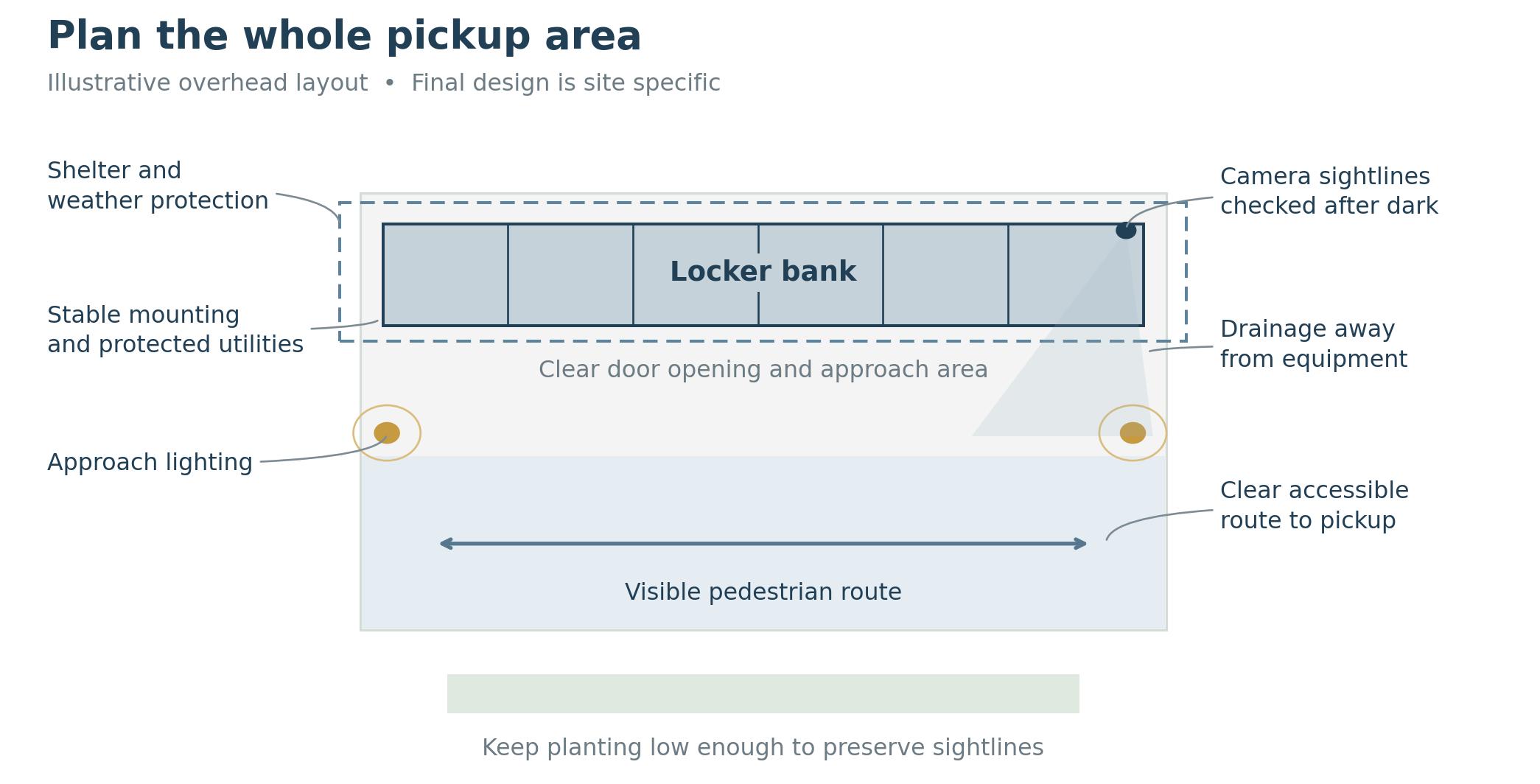
Plan a stable mounting surface, drainage away from the equipment, protected utility connections, and clear access around opening doors. Keep the route accessible and avoid obstructing emergency exits or routine circulation. Separate the pickup area from moving vehicles where the site requires it.
Review the entire nighttime journey, including the path from parking or building entry to the locker. Lighting inside a compartment helps a resident see a parcel; it does not illuminate an entire approach. Position cameras so landscaping, open doors, glare, or a canopy do not unintentionally block important views.
Before launch, confirm carrier directions, resident notifications, capacity, overflow handling, and the response to outages. Test the system under the site’s actual access conditions. Residents should be able to follow a clear pickup route without repeatedly calling the office for help.
When a Package Room is the better fit
An outdoor locker bank works well for parcels that fit individual compartments and for properties that need an exterior pickup point. Package Nexus Package Room solutions provide a complementary option when an existing room can accommodate oversized items or peak delivery volume.
The standalone Package Room uses an exterior access computer. The carrier follows the delivery flow, selects a storage zone, and places the parcel there. The recipient receives a unique pickup code and enters to retrieve the delivery. The exterior camera captures an entry photo; optional interior cameras and large monitors can extend visibility within the room.
| Property Need | Outdoor Smart Parcel Lockers | Package Nexus Package Room |
|---|---|---|
| Individual parcel separation | Assigned, electronically controlled compartments | Shared storage behind a controlled room entrance |
| Bulky or irregular packages | Limited by the selected compartment dimensions | Flexible shelving and oversized-item zones |
| Outdoor pickup without opening a lobby | A strong fit with suitable site access | Depends on where the room entrance is located |
| Accurate compartment occupancy | Package sensing supports locker transaction status | Room entry and zone records support organization; shared shelves are a different model |
| Holiday or move-in overflow | Add appropriate capacity and pickup reminders | Can complement lockers when approved space is available |
A controlled room reduces casual entry and avoids a staff-managed handoff for routine pickups. It does not isolate every package from every other authorized room user. Plan entry control, camera coverage, shelf labels, clear paths, and procedures for misplaced items accordingly. The patented compartment-sensing benefit of the lockers should not be assumed to apply identically to shared shelves.
For some communities, the most practical arrangement is an outdoor locker bank for everyday parcels plus a controlled Package Room for items that do not fit. Both should be sized and operated as one delivery plan so overflow does not return to an unsecured hallway.
Where outdoor lockers can deliver the greatest benefit
Apartment and condominium communities
Garden-style properties, exterior-corridor buildings, and communities with limited lobby space can add a designated pickup point without converting an indoor amenity area into package storage. Residents collect on their schedules, subject to site access hours, while leasing teams spend less time handling routine deliveries. Apartment and condominium package solutions can be planned around the community’s routes, package mix, and resident needs.
Workplaces and student housing
An accessible exterior pickup point can serve people arriving outside reception or mailroom hours. It may also keep delivery traffic away from work areas or residential corridors. Specify who is authorized to receive parcels and how employee or resident records stay current.
Libraries and retail pickup locations
Outdoor lockers can extend pickup access beyond a staffed counter’s hours. Package Nexus’s outdoor product page describes a library deployment in Sedro-Woolley, Washington, for collecting books and media. The broader use case is a controlled handoff for items prepared by an organization, with the operating schedule and access rules defined for that location.
Properties modernizing manual package handling
A property that currently accepts, sorts, stores, and hands out deliveries can shift routine work to carrier deposit and recipient self-service. The potential gains include fewer office interruptions, less open package clutter, clearer records, more consistent service during staff absences, and fewer user-error investigations. A dependable amenity can also support resident satisfaction and the property’s leasing story, without assuming a guaranteed increase in rents or asset value.
How to assess the operational value
Measure both handling time and exception time. Sorting packages is visible work; investigating an empty compartment report, finding an unregistered delivery, or fixing a prematurely completed pickup can be less visible but equally disruptive.
A simple planning calculation is annual staff hours recovered = avoidable staff minutes per day × operating days per year ÷ 60. For illustration, eliminating 20 minutes of daily work over 365 days recovers about 122 hours per year. This is a planning example, not a Package Nexus customer result. Use the property’s own baseline and compare performance after installation.
Track missing-package complaints, staff-assisted transactions, average time until pickup, capacity pressure, and service requests. Include hardware, site preparation, connectivity, software and support, and maintenance when comparing total costs. How smart lockers reduce property management costs explains the broader operating case.
Choose a secure handoff that fits the property
A strong outdoor solution combines secure compartments, suitable environmental protection, recipient access, reliable transaction records, and a location people can use comfortably. Package Nexus adds patented automation aimed at common package-handling errors, helping properties avoid routine troubleshooting while offering convenient self-service pickup.
Review electronic parcel locker security for the broader safeguards, then request an outdoor locker assessment from Package Nexus. Share the site layout, climate exposure, delivery volume, package sizes, and current staff workload so the proposed locker or Package Room configuration addresses the actual problem.
Frequently asked questions
Are outdoor smart parcel lockers safer than leaving packages at an entrance
They can substantially reduce casual access by placing deliveries inside electronically controlled compartments. Recipients use assigned pickup credentials, and activity records provide context for delivery questions. The strongest results come from combining the locker with appropriate lighting, placement, maintenance, and credential practices. Security should be assessed against the property’s actual conditions.
Can someone break into an outdoor parcel locker
No physical enclosure should be described as impossible to break into. Durable construction, reliable locks, proper anchoring, visibility, and camera coverage can make unauthorized access harder and less attractive. Request the selected model’s construction details and any verified test information; steel thickness alone does not establish a burglary-resistance rating.
Are Package Nexus outdoor lockers waterproof
Package Nexus describes weather-protection features such as sealed seams, drainage, powder coating, and UV-resistant materials. Confirm the environmental rating and permitted exposure for the quoted configuration. Weather protection does not mean the equipment can be submerged, installed where water ponds, or used outside its specified operating limits.
Will an outdoor locker keep packages safe in extreme heat or cold
The equipment must be specified for the local climate, including direct sunlight, wind, moisture, and temperature swings. Request documented operating limits and any required heating, cooling, or shelter. The kiosk’s operating range is different from a parcel’s storage requirement; temperature-sensitive deliveries may need dedicated temperature-controlled compartments.
What does patented On Auto Pilot technology do
Package Nexus combines package sensors with automated delivery and pickup workflows to address common user mistakes. Sensing helps verify that a parcel was deposited or removed, while transaction logic can respond to unfinished sessions and other supported exceptions. The benefit is a more accurate handoff with less dependence on users remembering every confirmation step.
Does On Auto Pilot eliminate the need for site manager troubleshooting
For supported user-error scenarios that the system resolves automatically, site managers do not need to troubleshoot the transaction. This is a meaningful reduction in routine package work. Physical damage, incorrect recipient selection, outages, shared credentials, or situations outside the configured workflows may still need support or a property response. Ask for a demonstration of the specific exceptions your team encounters.
What happens if a courier leaves a locker door open
Package Nexus describes door-status detection and configured workflows that can guide the user or address the transaction exception. A detected open door is not the same as a mechanically self-closing door. Confirm the prompt, alert, and escalation behavior for the selected system, and make sure the property has a response for a door that remains physically open.
Can sensors detect small envelopes and flat packages
Package Nexus describes sensing that covers small and flat parcels as well as larger packages. This matters when a thin envelope could otherwise be overlooked during transaction verification. Demonstrate the actual items your property receives during evaluation and confirm the approved placement and operating conditions for the selected compartments.
Do outdoor smart lockers have cameras
Package Nexus lists embedded cameras, and additional site coverage can be planned where needed. Confirm the final configuration and what each camera can see during delivery and pickup, particularly at night. Also define who can access images, how long records are retained, and how camera practices are communicated under the property’s policies and applicable requirements.
What happens during an internet or power outage
Network loss and power loss are different events. Package Nexus describes redundant connectivity and selected local functions during internet interruptions, but the exact supported actions should be demonstrated. Confirm how notifications and records synchronize after reconnection, what power backup is included if any, and how authorized access is handled during a longer outage. Do not assume every function remains available.
Can someone collect a parcel using a shared pickup code
A pickup credential should be treated like a key. Someone who receives a valid code may be able to use it under the system’s access rules, so residents should share it only when intentionally authorizing a trusted person. Confirm how exposed credentials can be handled and which records are available if a pickup is questioned.
Is a Package Room as secure as an individual locker
They provide different forms of control. A locker isolates a parcel in an assigned compartment, while a Package Room controls entry to a shared storage area. The room can be a good fit for bulky items and overflow, especially with suitable camera coverage and organization. Choose based on the package mix and the level of separation the property needs.
Do outdoor lockers require ongoing maintenance
Yes. Routine inspections help preserve the benefits of the installation. Follow the vendor’s service guidance for doors, locks, coatings, drainage, electronics, and software, and keep paths and sightlines clear. Automation can reduce daily transaction troubleshooting while equipment and site maintenance remain part of dependable long-term operation.
Can residents use outdoor lockers at any hour
Outdoor lockers can support around-the-clock self-service pickup when the site permits continuous access. Confirm gate schedules, lighting, quiet-hour policies, and the route from the residence or parking area. If a gate closes overnight, the property should communicate the actual pickup hours rather than advertise unrestricted 24-hour access.
How should a property choose between outdoor lockers and a Package Room
Start with delivery volume, parcel dimensions, pickup timing, available space, climate, and the desired level of individual parcel separation. Outdoor lockers suit controlled exterior pickup, while a Package Room offers flexible storage behind an access-controlled door. A combined plan can handle everyday deliveries and oversized items while keeping routine handoffs away from the leasing desk.

Package Nexus is the global technology leader and provider of The World's Most Advanced Smart Parcel Lockers for efficient and most simplified package management for multifamily communities, retailers, universities, libraries, corporate offices, groceries, and more. Package Nexus unique and patented technology offers a fix for human errors at the time of package deliveries and pickups. Package Nexus solutions help property, store, and office managers to improve their operations, reduce operating costs, and increase customer satisfaction at the same time. Package Nexus offers its entire suite of solutions globally.
USEFUL LINKS

© 2017-2026 Package Nexus