
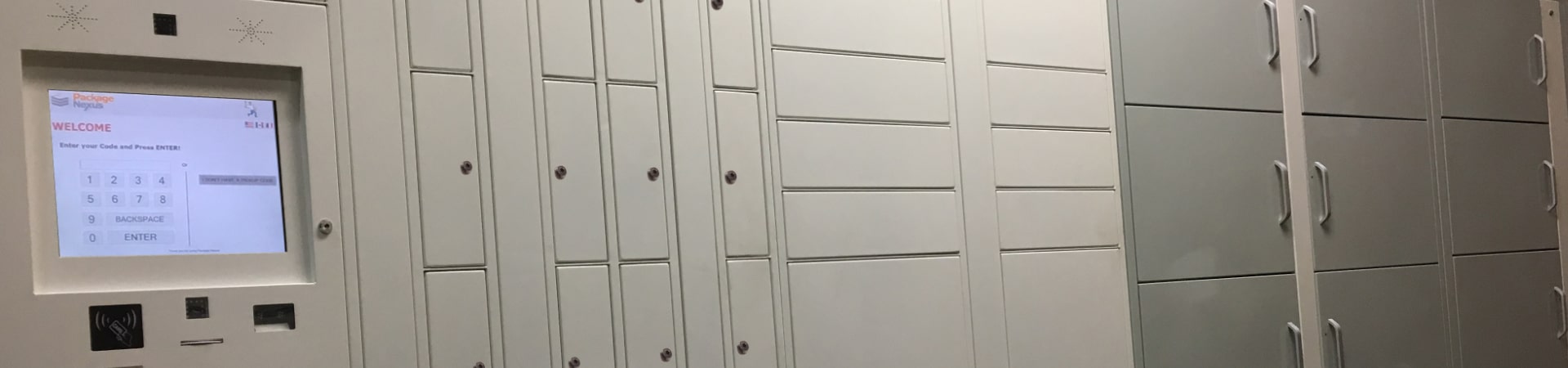

Smart Parcel Lockers vs Package Rooms and Manual Staff Handling
How to choose a package management model that protects deliveries and reduces daily work
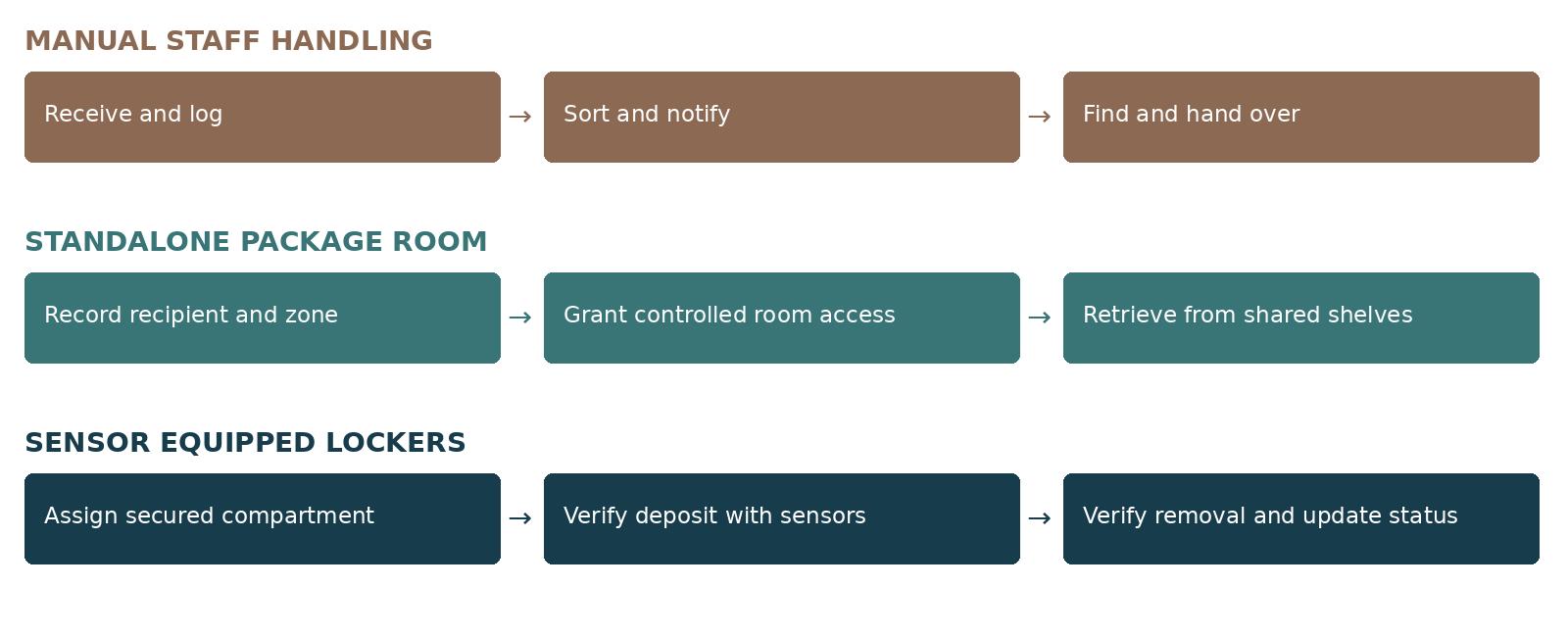
Smart parcel lockers are the strongest fit when a property wants individually secured packages and technology that verifies delivery and pickup. A Standalone Package Room offers flexible shared storage, controlled entry, and a more organized alternative to staff handling. Manual handling can serve very low volumes or special services, but every routine handoff continues to consume staff time.
For builders, owners, and operators, the decision is about the operating model the building will inherit. Package Nexus offers Patented On-Auto-Pilot Smart Parcel Lockers, Standalone Package Rooms, and Integrated Package Rooms so the solution can match the property’s package mix, space, budget, and growth plans.
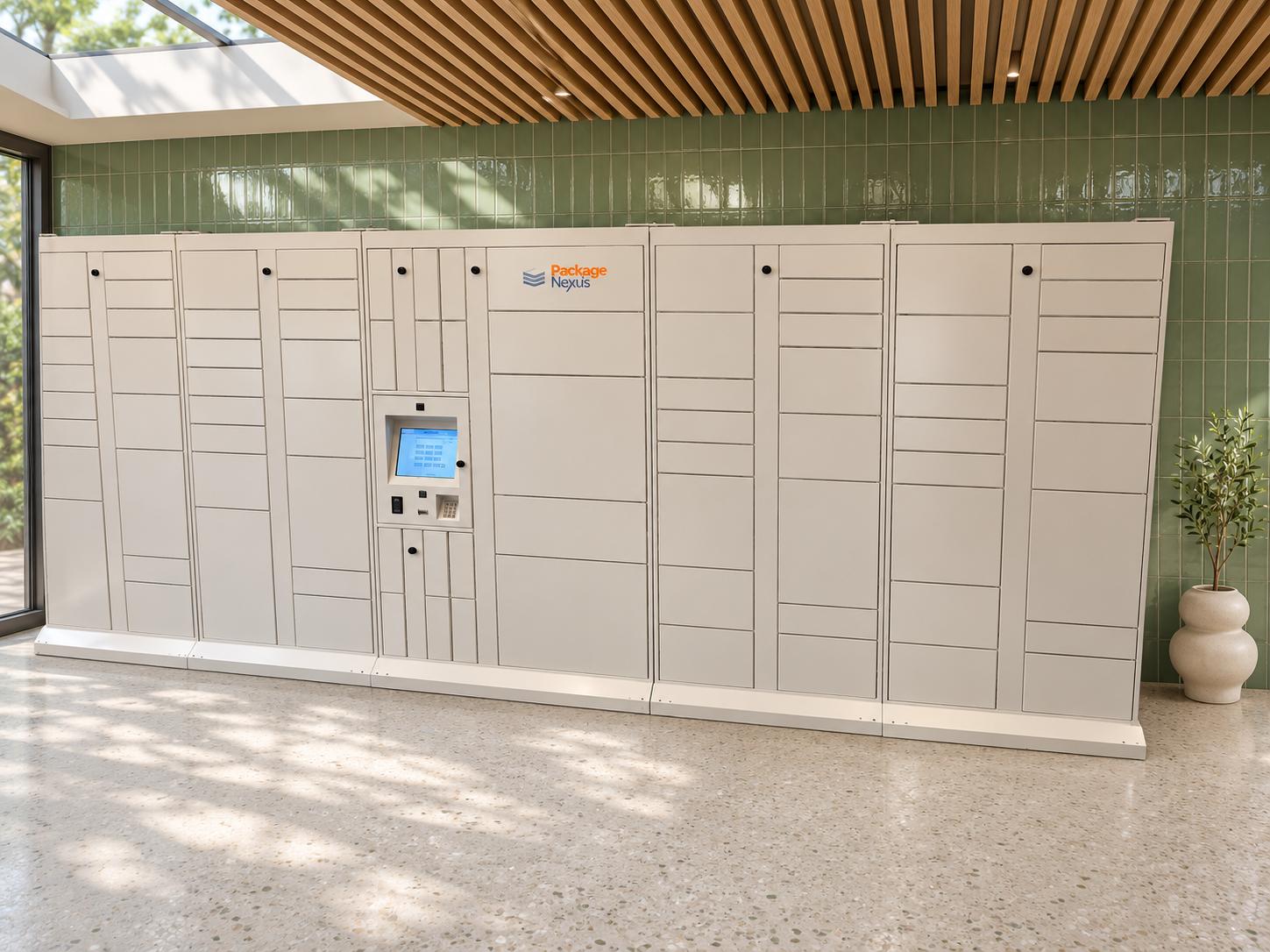
The practical recommendation: prioritize verified, individually secured storage for everyday deliveries; add an access-controlled room for bulky items and overflow when the building needs both.
Compare the three operating models
A package room is not automatically a staffed mailroom. This comparison treats the Standalone Package Room as a computerized, self-service space, while manual handling means staff receive, organize, and release parcels. The locker column describes sensor-equipped Package Nexus workflows rather than assuming every electronic locker offers identical verification.
| Decision Factor | Smart Parcel Lockers | Standalone Package Room | Manual Staff Handling |
|---|---|---|---|
| Storage security | Recipient-assigned locked compartments | Controlled room with shared shelves | Depends on staff custody and storage controls |
| Deposit and pickup evidence | Sensor events linked to supported transactions | Access logs and entry photos; room records do not inherently verify each item | Logs, scans or signatures if consistently captured |
| Everyday staff workload | Routine self-service; exceptions and maintenance remain | Self-service with periodic organization and exception review | Receiving, logging, locating and handoff remain staff tasks |
| Pickup availability | Outside office hours if site access permits | Outside office hours if room access permits | Generally tied to staffed service hours |
| Oversized packages | Limited by usable compartment dimensions | Flexible within door, shelf, floor and circulation limits | Flexible within storage and handling limits |
| Capacity planning | Door mix, dwell time and peak occupancy | Usable shelving and safe floor area | Storage space plus staff throughput |
| Initial investment | Equipment and installation | Room conversion and access equipment; may be lower with suitable existing space | Often modest equipment cost; recurring labor continues |
| Best fit | Security, verified status and fewer routine handoffs | Bulky deliveries, constrained budget or usable existing room | Low volumes or services requiring human inspection |
Choose by workflow rather than floor area alone
A large room can hold more packages but still leave residents searching. A well-sized locker bank can make collection straightforward but fill up when pickups slow. Evaluate the time from arrival to collection, the proportion of oversized items, and how exceptions are resolved before comparing equipment prices.
Why verified package status matters
Opening a door does not prove that a package was deposited. Closing it does not prove that a package was removed. When software treats a button press as evidence of a physical transfer, an incorrect or missing answer can separate the electronic record from reality.
Consider a courier who deposits a small envelope and walks away before completing the screen prompts. The item is physically present, but an input-dependent workflow may leave the transaction unfinished. In the opposite case, a recipient can open a compartment, leave a parcel inside, and accidentally confirm pickup. Staff then have to reconcile a record that no longer matches the compartment.
How On Auto Pilot changes the workflow
Package Nexus’s 3rd Generation Smart Parcel Lockers combine patented sensing with automated delivery and pickup logic. The operational purpose is to establish package presence or absence, use that evidence to update supported transactions, and recover from common incomplete interactions. The resulting benefit is fewer routine mismatches for managers to investigate. Package Nexus describes its system as the only smart parcel locker solution worldwide with its patented On-Auto-Pilot verification and error-handling approach, backed by U.S. and international patent protection. This is the company’s product-positioning claim, rather than an independently established comparison of every system.
What the 10 to 20 percent estimate means
Package Nexus estimates that user inputs may be incorrect or missing in 10–20% of relevant confirmation interactions. That is a company-supplied estimate, not an independently measured industry error rate. At 100 required confirmations, it would represent 10–20 unreliable responses—not necessarily lost parcels or staff tickets. The buying question is which mistakes the system recognizes and resolves before a person needs to intervene.
Ask for a live demonstration using flat mailers, small boxes, interrupted sessions, and a package left inside after the door opens. Validate the quoted configuration against your actual deliveries rather than assuming any sensor can verify every item under every condition.
Transparency and accountability at the right level
Package Nexus positions its 3rd Generation lockers around complete transparency and accountability within the supported locker transaction: a recipient assignment, a controlled compartment, physical package-state evidence, and an activity record. This is a stronger basis for reviewing a handoff than relying solely on a person’s confirmation. It does not identify the contents of a sealed box or prove that the carrier selected the correct recipient.
Package rooms inherently lack the same individual compartment boundary and automatic item-level verification unless additional technologies establish them. Room access logs show entry; cameras provide context; a shelf-zone record indicates the intended location. None of those facts alone establishes that a particular parcel was actually placed on that shelf or removed by its intended recipient. A room still provides meaningful access accountability, so it would be inaccurate to describe every package room as having none.
A sophisticated standalone alternative to staff handling
The Package Nexus Standalone Package Room uses an exterior access computer, controlled entry, carrier-selected shelf zones, and unique recipient pickup codes. An embedded entry camera captures a photo; optional interior cameras and monitors can extend visibility. Clearly labeled zones help residents go to the intended storage area instead of searching the entire room.
For clients without the space or budget for a full locker configuration, a suitable existing room can become a cleaner, computerized delivery destination. Staff no longer need to conduct every routine handoff. The tradeoff is shared access to packages and continued dependence on correct placement and room procedures. Plan shelf labels, a bulky-item area, periodic housekeeping, and an exception process from the outset.
Combine the strengths in an Integrated Package Room
An Integrated Package Room brings ambient smart lockers, refrigerated smart lockers, other temperature-controlled smart lockers, and room access into a coordinated solution managed through a centralized computer system. Use individual compartments for parcels that fit and the room for oversized deliveries or overflow. Specialized temperature zones should be selected for the intended contents and holding conditions.
Centralized control reduces the need to operate disconnected intake processes, but it does not turn shared shelving into sensor-verified compartments. Confirm which records, notifications, access permissions, and integrations are included in the proposed design. The benefit is one planned package management environment with storage appropriate to each delivery type.
Reduce intervention without ignoring exceptions
On-Auto-Pilot is designed to remove the need for managers to stay engaged in common supported delivery and pickup errors. It can eliminate routine troubleshooting for those automated scenarios. Staff or support may still be needed for wrong-recipient selections, damaged packages, outages, vandalism, maintenance, or deliveries outside the configured process. Measure those exceptions separately rather than treating “automated” as a promise of zero work.
Why heavy duty construction matters
Software can improve the handoff, but the physical enclosure must withstand repeated use. Package Nexus specifies heavy-duty 12-gauge galvanized steel. For comparable steel grades, panel geometry, and reinforcement, thicker sheet offers greater resistance to bending and denting than 16- or 18-gauge sheet. That matters around carts, bulky boxes, frequent door operation, and high-traffic pickup areas.
| Gauge | Nominal Galvanized Thickness | 12 Gauge Thickness Advantage |
|---|---|---|
| 12 | 0.1084 in / approximately 2.753 mm | Reference |
| 16 | 0.0635 in / approximately 1.613 mm | Approximately 71% thicker |
| 18 | 0.0516 in / approximately 1.311 mm | Approximately 110% thicker |
Nominal gauge-chart comparison; actual thickness depends on specification and tolerances. Thickness advantage is calculated as 0.1084 divided by the comparison thickness, minus one. These percentages are not forced-entry ratings or whole-cabinet strength measurements.
Evaluate the complete enclosure
Twelve-gauge steel is a compelling durability choice, but gauge alone cannot establish security. Door seams, hinges, lock engagement, fastening, cabinet reinforcement, anchoring, and installation all matter. Ask vendors to identify which components use the stated gauge, specify decimal thickness, and provide applicable test evidence. Do not assume every competing system uses thinner material.
Why galvanized steel earns its place
A zinc coating gives steel both a barrier against exposure and sacrificial corrosion protection. This is valuable outdoors and in indoor locations exposed to moisture, wet deliveries, or cleaning. Finish quality, cut edges, damaged coatings, drainage, and local conditions still affect performance; galvanized construction does not remove the need for inspection and appropriate care.
Technical details to confirm in the quotation
| System Detail | Package Nexus Published Description | Project Confirmation |
|---|---|---|
| Controller and interface | Industrial-grade fanless PC and industrial touchscreen | Model, screen option, environment limits and service access |
| Package verification | Patented sensing and supported automated workflows | Small and flat items; incomplete delivery and pickup tests |
| Peripheral equipment | Cameras, barcode scanner, Braille keypad and compartment lighting described | Included hardware, accessibility layout and options |
| Expansion | 100% modular locker design | Compatible modules, future footprint and utility capacity |
| Temperature options | Ambient, refrigerated and other temperature-controlled storage | Specified range, ventilation, monitoring and holding use |
Why builders should work with Package Nexus
A builder’s package decision continues to affect operating costs after construction ends. Selecting only the lowest installed price can leave the future property team with repeated intake work, an undersized storage area, or avoidable investigations. Working with a supplier that offers lockers and room solutions allows the design to follow the building’s needs rather than forcing every project into a single format.
Plan the operating model before the drawings are final
Bring package management into design coordination early. Confirm the carrier approach, resident route, delivery doorway, usable storage dimensions, power and data locations, anchoring, and service access. For refrigerated equipment, coordinate ventilation and electrical requirements. Resolve accessible routes, reach ranges, door swings, and required clearances through the project’s design team.
Package Nexus solutions for architects and construction firms can support this discussion across new construction and retrofit projects. Indoor smart parcel lockers can fit a planned delivery area, while outdoor smart parcel lockers may preserve valuable interior floor space where an appropriate exterior location is available. The final selection should reflect exposure, resident convenience, and the actual access route.
Build for phased occupancy and future demand
Package Nexus lockers are 100% modular and can be expanded as the community or package volume grows. Reserve space for compatible modules at the beginning, even when the first phase needs fewer compartments. Expansion remains subject to available space, utilities, system compatibility, and installation requirements; it should be planned rather than assumed to be physically unlimited.
For a phased development, this approach can align initial spending with occupancy while retaining a defined route to more capacity. Pair the expansion plan with pickup reminders and an oversized-delivery strategy. Increasing door count is less effective when the real constraint is packages remaining uncollected for long periods.
Choose a clear long term supplier relationship
Package Nexus is 100% U.S.-owned and operated. For buyers that prefer a U.S.-owned partner, this is a meaningful procurement distinction. Ownership is separate from country of manufacture, component origin, or a project-specific domestic-content requirement; confirm those separately when relevant.
Before handover, require an agreed commissioning test, resident-data setup, carrier instructions, staff training, support contacts, warranty scope, and escalation responsibilities. Ask the demonstration to include both a successful transaction and common mistakes. A supplier should show how the building operates on an ordinary busy day, not only how a compartment opens.
Connect the amenity to measurable outcomes
Track staff minutes per parcel, interventions per 1,000 transactions, peak occupied compartments, time to pickup, room searches, and notification-related inquiries. These measures help builders and operators assess whether the chosen design delivers usable capacity and reduced daily work. Claims about rent premiums, renewals, or guaranteed savings should follow project evidence rather than assumptions.
Compare lifecycle cost and practical fit
Manual handling often looks inexpensive because the labor is absorbed by existing staff. Count receiving, logging, sorting, notifications, resident handoffs, searches, and investigations. Automated systems substitute equipment and service costs for much of that routine work, while leaving a smaller exception workload to manage.
An illustrative labor model
Assume 80 parcels a day, three staff minutes per parcel, and a fully loaded labor value of $30 per hour. Those assumptions produce four hours of work daily, or $43,800 a year across 365 days. This is a planning example, not a Package Nexus customer result. The table varies the reduction to show sensitivity rather than predicting a particular solution’s performance.
| Reduction in Routine Labor | Hours Released per Year | Annual Value of Time |
|---|---|---|
| 50% | 730 | $21,900 |
| 75% | 1,095 | $32,850 |
| 90% | 1,314 | $39,420 |
Released time is not automatically payroll savings. If staffing stays the same, the benefit may be more time for leasing, maintenance coordination, or resident service. Subtract subscriptions, support, utilities, maintenance, and remaining exception work before estimating net annual benefit. Compare installation, room conversion, and future expansion costs on the same time horizon.
Match each application to the handoff
| Application | Strong Starting Configuration | Reason to Consider It |
|---|---|---|
| Multifamily and student housing | Sensor-equipped lockers plus room where needed | Independent pickup with a path for bulky deliveries and peaks |
| Retail and libraries | Configured pickup lockers | Scheduled orders or holds can be released without a desk handoff |
| Corporate mailrooms | Lockers with a managed receiving process | Separate staff intake from employee collection |
| Hotels | Lockers or controlled room with guest procedures | Support irregular arrival times while validating recipient identity |
| Warehouses and facilities | Configured lockers for internal handoffs | Useful for controlled transfers; freight and special inventory need separate planning |
These are planning applications, not promises that one configuration meets every sector’s requirements. Confirm the relevant integration, item restrictions, access policies, and custody records before deployment.
Choose the configuration that fits your building
Explore Package Nexus package room solutions and temperature-controlled smart lockers alongside your everyday parcel needs. To request a smart locker quote, share your floor plan, daily and peak volume, package sizes, pickup patterns, and future growth. Ask Package Nexus to demonstrate the exact delivery and exception workflows your property needs.
Frequently asked questions
Which is better for apartments smart lockers or a package room
Smart lockers are usually the stronger choice when individual parcel security and verified delivery and pickup are the main priorities. A package room can be a practical choice for bulky deliveries, an adaptable existing room, or a constrained initial budget. Many properties benefit from both, with everyday parcels in lockers and oversized items in controlled room storage.
Can a Standalone Package Room replace manual staff handling
It can replace routine staff receiving and handoff when carriers follow the computerized delivery process and residents collect independently. Package Nexus adds carrier-selected shelf zones to help organize the shared space. Staff may still need to address incorrect placement, uncollected items, room organization, or access exceptions.
Do room cameras prove that a specific package was picked up
Not by themselves. Cameras and access records can help reconstruct events, but entry into a room is different from verified removal of a specific parcel. Visibility depends on camera coverage and the recorded workflow. Individual sensor-equipped lockers provide a more direct link between the compartment’s physical state and the transaction.
What makes Package Nexus lockers different from basic electronic lockers
An electronic lock controls a door. Package Nexus’s On-Auto-Pilot approach also uses package sensing and automated logic to complete supported workflows and address common errors. The useful distinction is whether the system verifies the physical handoff and handles an incomplete interaction, rather than merely recording a screen response.
Does the 10 to 20 percent estimate mean packages are lost
No. It refers to Package Nexus’s estimate of incorrect or missing user inputs in relevant confirmation interactions. An unreliable input may resolve without loss or staff involvement. Measure input errors, support incidents, and actual losses separately; treating them as the same metric would misstate the problem.
Will automated lockers eliminate every staff intervention
No system can guarantee that result for every event. Automation can remove routine handling and resolve supported mistakes without continuous manager involvement. Wrong-recipient selections, connectivity problems, damage, maintenance, and unusual delivery situations can still require support. Specify ownership of those exceptions before installation.
Frequently asked questions continued
Why use 12 gauge galvanized steel instead of 16 or 18 gauge
Within the same gauge convention, 12 gauge is thicker and offers a stronger basis for resisting denting and bending when other design factors are comparable. Galvanizing adds corrosion protection. Complete enclosure design still matters, so examine hinges, locks, reinforcement, anchoring, finish, and the exact components covered by the material specification.
What is an Integrated Package Room
It is a coordinated configuration combining room access with smart locker storage. Package Nexus can bring ambient, refrigerated, and other temperature-controlled lockers together with a Smart Package Room under centralized computer control. Individual lockers and shared room storage retain their different levels of physical isolation and package verification.
Can the locker system grow after installation
Yes. Package Nexus describes its lockers as 100% modular and expandable as demand grows. The expansion plan should identify compatible modules, available footprint, utilities, access clearances, and commissioning needs. Reserving future space during design makes expansion more practical and can avoid unnecessary relocation.
Can residents collect packages outside office hours
Self-service lockers and access-controlled rooms can support collection outside leasing-office hours. Actual availability depends on the building’s access policies and the route to the equipment. A locker inside a locked office does not create unrestricted pickup simply because its software is available.
Is Package Nexus a United States owned company
Package Nexus states that it is 100% U.S.-owned and operated. This is useful for buyers that prioritize supplier ownership and an ongoing U.S. business relationship. It should not be interpreted as a separate claim that every component is manufactured domestically.
What should builders provide when requesting a proposal
Provide a plan showing the proposed location, access route, door openings, power and network provisions, plus expected occupancy and parcel demand. Include oversized and temperature-sensitive deliveries, desired pickup hours, project timing, and future phases. Request a configuration-specific proposal with installation, support, warranty, and integration responsibilities clearly identified.

Package Nexus is the global technology leader and provider of The World's Most Advanced Smart Parcel Lockers for efficient and most simplified package management for multifamily communities, retailers, universities, libraries, corporate offices, groceries, and more. Package Nexus unique and patented technology offers a fix for human errors at the time of package deliveries and pickups. Package Nexus solutions help property, store, and office managers to improve their operations, reduce operating costs, and increase customer satisfaction at the same time. Package Nexus offers its entire suite of solutions globally.
USEFUL LINKS

© 2017-2026 Package Nexus