


Why a Parcel Room Is Essential to Rental Properties?
A parcel room gives a rental property a controlled, organized destination for deliveries and allows residents to collect packages without waiting for leasing-office hours. It becomes especially valuable when deliveries interrupt staff, overflow into common areas, or include bulky items that require flexible storage. The strongest package management plan also establishes what actually happened to each delivery, so access, alerts, and inventory records remain useful.
Package Nexus combines access-controlled package rooms with smart parcel lockers for apartments and condos. Properties can choose a standalone room, patented On-Auto-Pilot lockers, or an integrated system that brings room access and multiple locker types under centralized computer control. The right choice depends on the building, its package mix, and the level of package-by-package verification the owner wants.
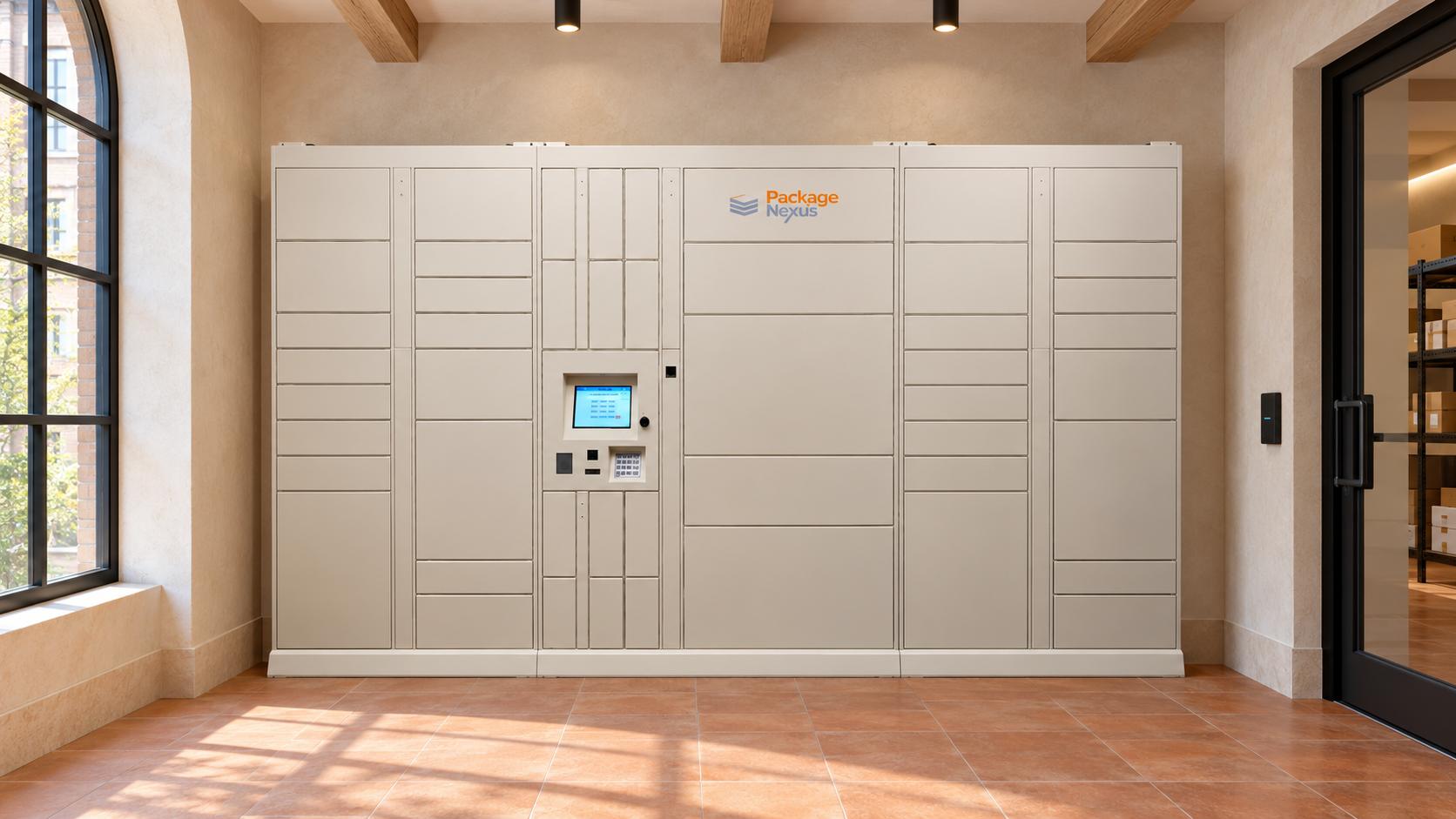
What a parcel room does for a rental property
A parcel room, also called a package room or delivery room, is a designated space for receiving and storing parcels until residents collect them. A computerized room adds controlled entry, delivery records, resident notifications, and an organized retrieval process. A room with shelves alone provides storage; a managed workflow makes that storage usable.
For apartments, build-to-rent communities, student housing, and mixed-use rental buildings, the practical objective is to move routine deliveries away from the front desk. Carriers need a clear place to deliver, residents need to know where to go, and the property team needs a reliable record when a question arises.
Why rental communities benefit from a parcel room
Residents can collect deliveries around their schedules
A resident working late should not have to leave work early to collect a parcel. Self-service access can extend pickup beyond office hours, including around-the-clock availability when building access policies permit it. This convenience matters to shift workers, commuters, caregivers, and anyone who cannot plan their day around a delivery window.
Packages have a defined destination
A dedicated room gives carriers a consistent delivery location and reduces the temptation to leave cartons beside mailboxes, in corridors, or at the leasing counter. Organized shelving and a separate oversized-item area make packages easier to locate. Clear circulation also helps prevent delivery piles from taking over shared spaces.
Controlled entry improves security and accountability
A secured room restricts casual access compared with an open lobby. Individual pickup credentials, entry photos, access records, and appropriately configured cameras can help staff investigate a missing-package report. Residents still share the interior storage area, so individual lockers provide an additional physical barrier around each delivery. Selecting the right combination is central to a credible security plan.
Property staff regain uninterrupted time
Every manual handoff creates work: accepting a box, recording it, contacting a resident, finding it again, and answering follow-up questions. Automated access and notifications remove much of that routine coordination. The greatest operational gain comes when the system also prevents the record errors that would otherwise send staff back to the room or locker bank.
Oversized deliveries and seasonal peaks become easier to manage
A room can accommodate a changing mix of large cartons, flat items, and multi-box orders. Clearly defined zones help absorb holiday peaks and move-in surges without abandoning organization. Capacity still has physical limits; shelf loading, clear aisles, doorway dimensions, and average pickup time all matter.
A visible amenity strengthens the rental experience
Package pickup is a recurring interaction with the property. A clean, easy-to-use parcel area demonstrates that the building has planned for residents’ everyday needs. Owners can include the service in leasing tours and resident onboarding, then monitor satisfaction and package-related complaints. Its financial value should be measured locally rather than assumed to guarantee higher rent or renewals.
Why automatic verification matters more than a completed screen prompt
A reliable delivery record must reflect a physical event. A carrier can press the wrong button, a resident can close a door before removing a parcel, or a session can time out. If the software treats those inputs as proof that the package moved, its digital record can diverge from the actual contents of the compartment.
Consider an illustrative workflow in which 10–20% of required confirmations are wrong or missing. For every 100 confirmation prompts, 10–20 responses would be unreliable. That is a planning scenario, not an independently measured industry error rate, and it does not mean 10–20 packages are lost. It shows why a process built around confirmations needs a stronger source of evidence.
| Event | Risk When User Input Is Treated as Proof | Value of Physical Verification |
|---|---|---|
| Delivery confirmed without a parcel | Resident receives a pickup alert for an empty compartment. | Check occupancy before completing the delivery record. |
| Parcel deposited but final input omitted | The parcel may lack a completed record or notification. | Use sensor feedback within the recovery workflow. |
| Pickup confirmed while parcel remains | The access code may be retired or the compartment marked available too early. | Check that the compartment is empty before releasing it. |
| Parcel removed but pickup not confirmed | An empty compartment may remain unavailable. | Update availability from the verified physical state. |
This is particularly important for thin envelopes, small boxes, soft mailers, and irregular packages. Detection must work across the property’s actual parcel mix and across supported positions inside the compartment. An impressive demonstration with one large carton does not establish that a small flat mailer will be recognized.
How Package Nexus uses sensing to keep workflows accurate
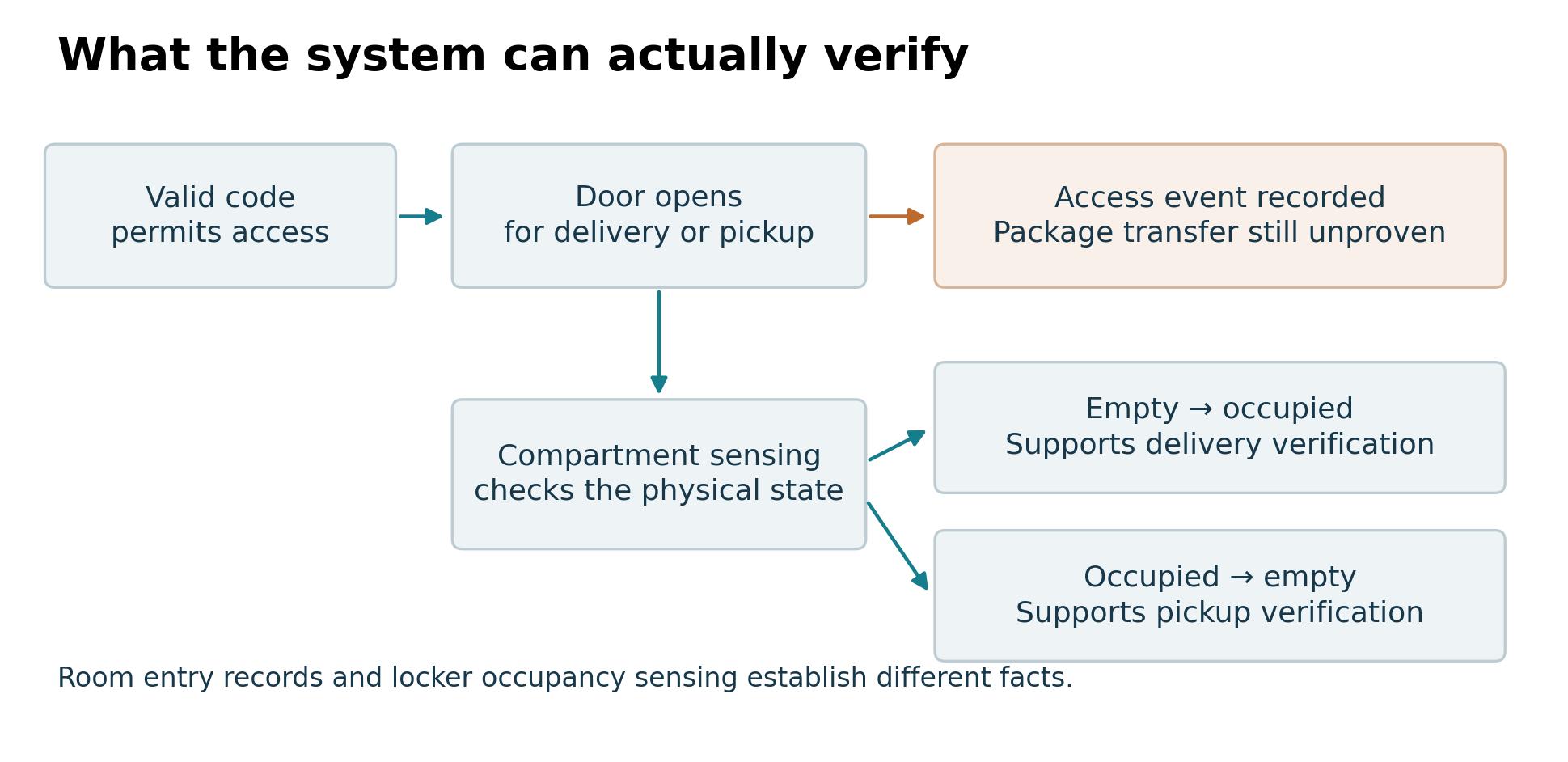
Patented On-Auto-Pilot Smart Parcel Lockers combine compartment sensing with software that monitors delivery and pickup activity. Package Nexus states that its technology detects package presence or absence across large, small, thin, and flat items, allowing the workflow to verify completion without asking the user to confirm whether a parcel was deposited or removed.
Package Nexus describes its system as the only smart parcel locker solution with worldwide patented technology that combines this package detection capability with autonomous correction of common delivery and pickup errors. The company reports patent protection in the United States, Australia, and 18 European countries. This is the company’s stated differentiation and international patent coverage; it is not a claim that one patent applies in every country.
The operational value lies in what the system does with the sensor information. A package still inside should not be treated as collected merely because someone entered a code. A completed deposit should not be lost from the workflow because a carrier missed the final prompt. Package Nexus publishes recovery capabilities for unfinished and timed-out transactions, helping the physical and digital records stay aligned.
This approach targets the recurring reasons site managers become involved after a locker installation. By preventing or automatically resolving common confirmation errors, On-Auto-Pilot is designed to eliminate the corresponding routine troubleshooting and help staff focus on residents and property operations. Systems that rely on manual confirmation can leave those exceptions for staff or support teams to reconcile. Actual intervention rates depend on the installed system and operating conditions.
A practical strategy for reducing delivery errors therefore evaluates error prevention and recovery, as well as door locks, screens, and notifications. Ask for live demonstrations using a thin mailer, a small item near the edge of a compartment, an interrupted delivery, and a pickup where the door closes while the package remains inside.
Package presence alone does not identify the intended recipient or prove that the correct item was deposited. Reliable recipient selection, transaction records, and access controls remain part of the complete workflow. Similarly, an access log or entry photo in an open-shelf room should not be described as automatic proof that a particular parcel was collected.
Three Package Nexus options for rental properties
The standalone room makes existing space easier to use
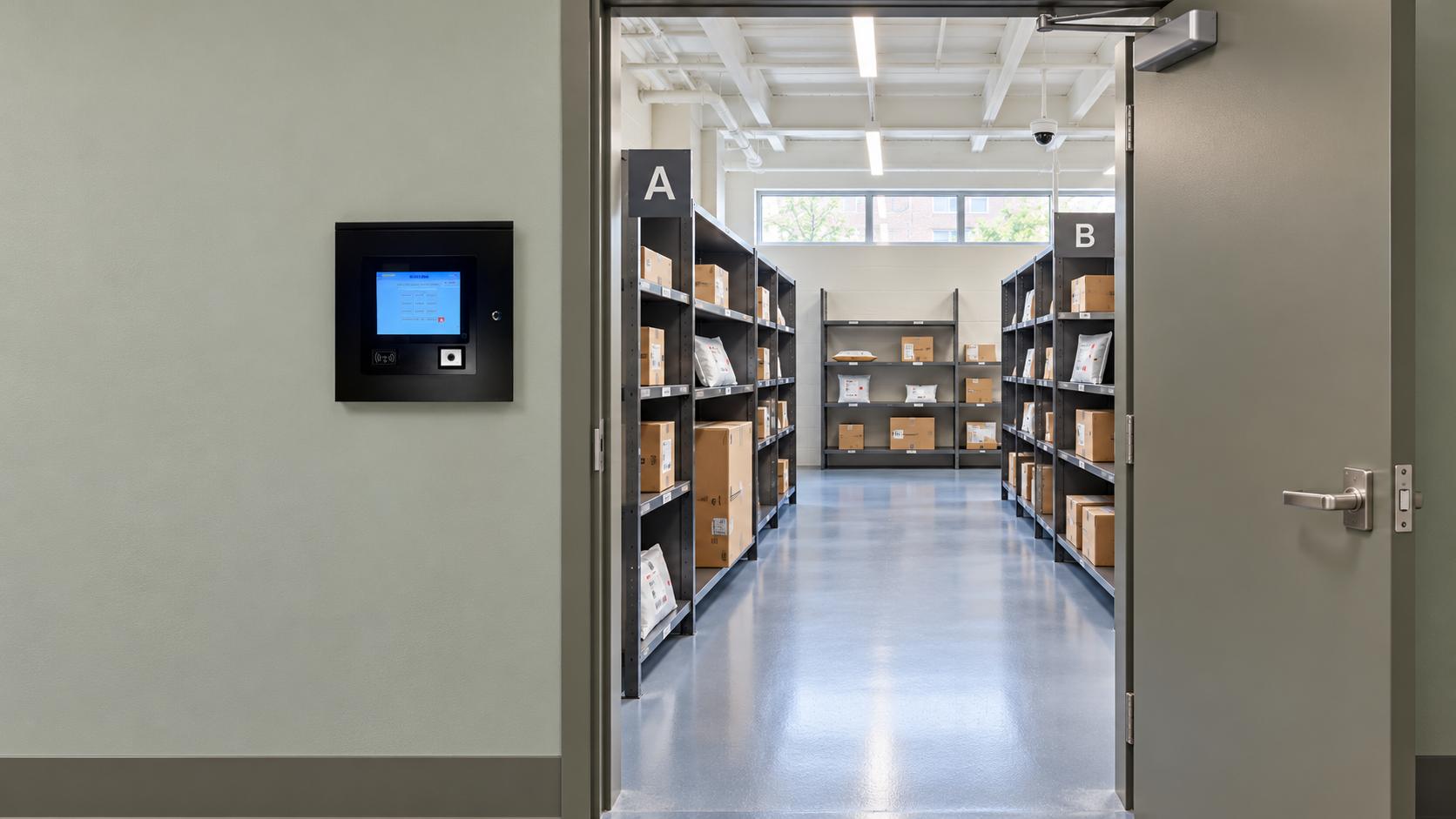
The Package Nexus Standalone Package Room gives properties a computerized, access-controlled delivery area without requiring a locker bank as the main storage system. It is particularly useful where a suitable room already exists and the available footprint or budget does not support the desired locker installation.
Carriers start at the computer installed outside the room near the entrance. During the delivery workflow, they choose a specific shelf-zone and place the parcel in that labeled area. The resident receives a unique pickup code, enters through the controlled doorway, and goes to the recorded zone. Matching digital zone names to visible shelf labels reduces searching and makes the process easier to follow.
The exterior computer includes an embedded security camera that captures a photo of the person entering. Optional interior cameras and large monitors can extend visibility. These features support room access and investigation; automatic item-by-item sensing on ordinary shelves is not assumed. The property should define the pickup-recording process for its selected room configuration.
Smart lockers add individual storage and automatic verification
Package Nexus indoor smart parcel lockers place deliveries in individually secured compartments and add On-Auto-Pilot verification to the delivery and pickup process. They suit properties that prioritize controlled access to individual packages, accurate compartment availability, and fewer routine workflow exceptions. Compartment sizes can be selected around the actual mix of small, flat, standard, and larger parcels.
An integrated system coordinates the complete package area
The Package Nexus Integrated Package Room brings ambient smart lockers, refrigerated smart lockers, other temperature-controlled lockers, and a smart package room under a centralized computer system. A property can route regular deliveries into lockers and use the room for bulky items or overflow, while managing the overall solution through one coordinated platform.
For properties receiving groceries and other suitable perishables, refrigerated and temperature-controlled lockers provide dedicated storage instead of leaving those deliveries on ambient shelves. Select the appropriate storage mode, monitoring, holding period, and resident instructions for the intended contents. Refrigeration does not make every product suitable for unattended storage.
The integrated design preserves the distinction between storage types. Locker compartments can use package sensing to verify their occupancy; shared room storage uses its configured access and recording workflow. Centralized control should make the experience consistent without presenting room entry as equivalent to locker-level verification.
| Solution | Strongest Fit | Key Distinction |
|---|---|---|
| Standalone room | An adaptable existing room, varied parcels, or a constrained hardware budget. | Shared shelving with controlled entry and carrier-selected zones. |
| On-Auto-Pilot lockers | Individual parcel access and verification of compartment occupancy. | Patented sensing and recovery logic support automated workflows. |
| Integrated room and lockers | Mixed deliveries, oversized items, and optional refrigerated or other temperature-controlled storage. | Centralized control combines different storage workflows. |
Features and specifications that support daily operations
Package Nexus’s published product materials describe the following features. Match the final equipment schedule to the property’s selected configuration, installation environment, and support agreement.
| Element | Published Feature or Configuration | Practical Value |
|---|---|---|
| Locker construction | Heavy-duty 12-gauge galvanized steel with powder-coated finish. | Durable storage for repeated daily use. |
| Locker computing | Industrial-grade fanless PC; published configurations include a 15-inch industrial touchscreen. | A dedicated interface for delivery and pickup. |
| Scanning | Separate industrial Honeywell 1D/2D barcode reader; the comparison document names the 3320G. | Code scanning without depending solely on a tablet camera. |
| Occupancy sensing | Patented package sensing, including small, thin, and flat items. | A physical input to delivery and pickup verification. |
| Resident interface | Code or barcode access; published options include Braille keypad, audio prompts, and compartment lighting. | Multiple ways to interact with the system. |
| Room security | Exterior access computer, unique pickup codes, entry photo capture, optional interior cameras and monitors. | Controlled entry and records for review. |
| Notifications and integration | Published email/text notifications and API capabilities. | Connect resident records and pickup information; confirm platform and channel scope. |
| Storage and expansion | Ambient, refrigerated, freezer, and heated options; modular locker towers and room storage. | Plan for varied deliveries and future demand. |
Plan capacity around the packages waiting for pickup
Daily delivery volume alone does not determine storage needs. A property must accommodate the packages that remain on site while new ones arrive. As a starting estimate, multiply average daily arrivals by average days to pickup, then add capacity for peak periods and oversized deliveries. Validate the result against real delivery and collection patterns.
For example, 60 arrivals per day with an average 1.5-day pickup interval imply approximately 90 packages on hand in a steady-state planning model. Adding a 30% planning allowance gives 117 package positions. These are illustrative assumptions, not a locker quote: compartment sizes, multi-package rules, room shelving, and holiday surges change the final design.
Package Nexus lockers are 100% modular and can be expanded as the community or package volume grows. Owners can phase investment and add towers over time, subject to installation planning, available space, power, and system compatibility. Reserve expansion space early so future capacity is easier to add.
Combine this analysis with oversized package planning. Record the largest routine parcel dimensions, doorway and elevator clearances, shelf capacities, and the safe route residents use to carry bulky items out. A room only adds useful capacity when packages can enter, remain organized, and leave without blocking circulation.
Evaluate the financial value through staff time and reliability
The purchase price is only one component of total cost. Compare equipment, installation, subscriptions, support, room preparation, energy for temperature-controlled storage, and the staff time that remains after installation. A less expensive system can become costly if employees repeatedly investigate empty compartments, incorrect pickup records, or misplaced deliveries.
A simple internal example makes the labor question measurable. If a property handles 60 packages a day and spends three minutes per package on combined intake, resident communication, and handoff, that equals three staff-hours daily. Over 22 staffed days, the total is 66 hours. Multiply the hours actually avoided by the property’s loaded hourly labor cost, then subtract ongoing system costs. Do not count all released time as payroll savings unless staffing expense actually changes.
Track package-related interruptions, staff minutes per 100 deliveries, unresolved delivery records, average pickup time, overflow events, and resident complaints before and after installation. These measures show whether automation improves the building’s operations and help justify future expansion.
Choose a system with clear ownership and a workable rollout
Package Nexus is 100% US-owned and operated. For rental property owners seeking a US-owned technology partner, this provides a clear company relationship for product planning and ongoing coordination. Ownership is a useful procurement consideration alongside demonstrated performance, service scope, and contractual accountability.
A successful rollout starts with a floor plan and a practical delivery policy. Review the carrier route, room door and latch, network and power requirements, lighting, reachable controls, and accessible circulation with the project team. Define shelf-zone labels, current resident records, move-out access removal, overflow handling, and support escalation before residents begin using the system.
A parcel room deserves consideration whenever package handling consumes staff time or spills into the building’s shared spaces. Package Nexus offers a way to match that need to the property: an organized standalone room, individually secured On-Auto-Pilot lockers, or an integrated combination. Share your layout, package volume, peak demand, and storage requirements to request a package management proposal.
Frequently asked questions
Why is a parcel room essential to a rental property?
A parcel room gives deliveries a defined destination and lets residents collect them through an organized process. It is especially valuable when packages interrupt the office, accumulate in common areas, or include bulky items. The best solution adds controlled access, useful records, and notifications. Some properties achieve these goals with lockers or an integrated room-and-locker system rather than a room alone.
What is the difference between a parcel room and a mailroom?
A traditional mailroom may focus on mailboxes and manual parcel storage. A computerized parcel room focuses on carrier entry, package registration, storage zones, resident notification, and pickup. The terms sometimes overlap in building descriptions. Owners should evaluate the actual workflow and storage controls rather than the room’s name.
Is a package room as secure as an individual parcel locker?
They provide different layers of protection. A room controls entry to a shared storage space, where authorized entrants may be able to reach multiple parcels. An individual locker restricts access to its compartment. Cameras and logs improve accountability in a room, while lockers add physical separation. A combination can address different package types and security priorities.
How does a resident find a package in the Package Nexus standalone room?
The carrier chooses a delivery zone during the computerized workflow and places the parcel in the corresponding labeled area. The resident receives a unique pickup code, enters the room, and retrieves the parcel from the recorded zone. Clear shelf signs and consistent carrier placement are essential to keeping retrieval straightforward.
Does entering a room prove that a particular package was picked up?
No. An entry record establishes access, not the removal of a specific item. An entry photo provides additional context but does not change that distinction. Locker occupancy sensing can verify whether a compartment is occupied or empty. A standalone room must use the pickup-recording and verification capabilities included in its own configuration.
Why should delivery and pickup verification work without user confirmation?
A mistaken response or missed prompt can create an inaccurate record even when the door and access code work correctly. Using physical sensor feedback reduces dependence on those responses. The software can then decide whether to complete the transaction, keep a compartment occupied, or guide recovery based on the actual package state.
Can Package Nexus detect thin and small packages?
Package Nexus states that its patented locker sensing supports small, thin, flat, and larger parcels. This matters because a detection system must work with more than large cartons to support reliable automation. During selection, demonstrate the property’s smallest and most irregular routinely accepted items across the supported placement conditions.
What does the worldwide patent claim mean?
Package Nexus describes On-Auto-Pilot as its exclusive worldwide patented smart locker technology. The company reports protection in the United States, Australia, and 18 European countries. For a procurement review, request the applicable patent numbers, jurisdictions, and a demonstration of the claimed functionality. International patent coverage and the performance of an installed system are different matters.
Will staff still have responsibilities after installation?
Yes. Package Nexus automation is intended to remove routine package handling and prevent or resolve common delivery and pickup errors. Staff still manage resident information, property policies, maintenance coordination, and unusual incidents. The key measure is how often routine transactions require intervention, rather than whether every conceivable task disappears.
Can a standalone room be used when space or budget is limited?
Yes, when the property has a suitable room that can be adapted. A standalone room can use that existing space without installing a full locker bank. The total cost still depends on the door, access hardware, shelving, power, network, and optional cameras. If no suitable room exists, a compact locker configuration may be more practical.
Can the same system manage oversized packages and refrigerated deliveries?
An integrated Package Nexus solution can combine a smart package room with ambient, refrigerated, and other temperature-controlled lockers under centralized computer control. Bulky parcels can use planned room zones, while suitable perishables use the appropriate temperature-controlled compartments. The exact storage modes and operating policies should be specified in the project design.
Can the locker system expand as the community grows?
Yes. Package Nexus lockers are 100% modular and designed for expansion as package demand or the resident population increases. Plan the initial layout around likely additional towers and service access. Review power, network, and space needs before adding capacity so expansion preserves a clear, convenient delivery and pickup route.
How much space does an apartment package room need?
There is no universal room size. Package volume, time to pickup, parcel dimensions, shelving, and circulation determine the requirement. Start with packages likely to be waiting simultaneously, then allow for peaks and oversized items. Doorway access and safe movement through the room are as important as the number of shelves.
Is Package Nexus a US-owned company?
Yes. Package Nexus is 100% US-owned and operated. Owners can consider that alongside the company’s patented technology, available room and locker configurations, modular expansion, and the service terms for their property. Request a proposal that identifies the equipment, integration scope, support, and responsibilities included.

Package Nexus is the global technology leader and provider of The World's Most Advanced Smart Parcel Lockers for efficient and most simplified package management for multifamily communities, retailers, universities, libraries, corporate offices, groceries, and more. Package Nexus unique and patented technology offers a fix for human errors at the time of package deliveries and pickups. Package Nexus solutions help property, store, and office managers to improve their operations, reduce operating costs, and increase customer satisfaction at the same time. Package Nexus offers its entire suite of solutions globally.
USEFUL LINKS

© 2017-2026 Package Nexus