

Can locker systems scale as our community grows?
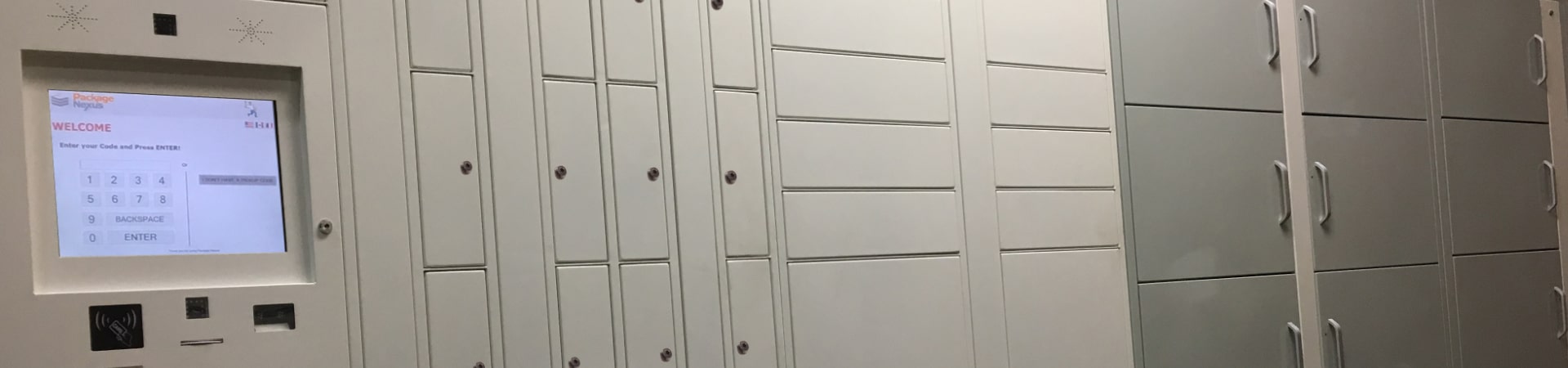
Yes. Package Nexus smart parcel lockers are 100% modular and can be expanded at any time as your community, occupancy, or package volume grows. You can begin with capacity that fits current demand, add compatible locker modules later, and plan for oversized or temperature-sensitive deliveries with a Package Nexus Package Room and specialized lockers.
For a growing community, the strongest package management investment combines expandable storage with dependable automation. More compartments should mean more capacity for residents, while supported delivery and pickup errors are handled automatically instead of becoming additional troubleshooting work for the property team.
Package Nexus is 100% US-owned and operated. Its patented On-Auto-Pilot Smart Parcel Lockers, Integrated Package Room, and Standalone Package Room give apartment communities and condominium associations several ways to expand service within their available space and budget.
What scalable package management means for a community
A scalable locker system accommodates increasing deliveries without requiring the community to replace its entire installation whenever demand changes. Physical expansion is one part of that capability. Package sizes, collection habits, access routes, resident records, and the amount of work left for staff also determine how well the solution grows.
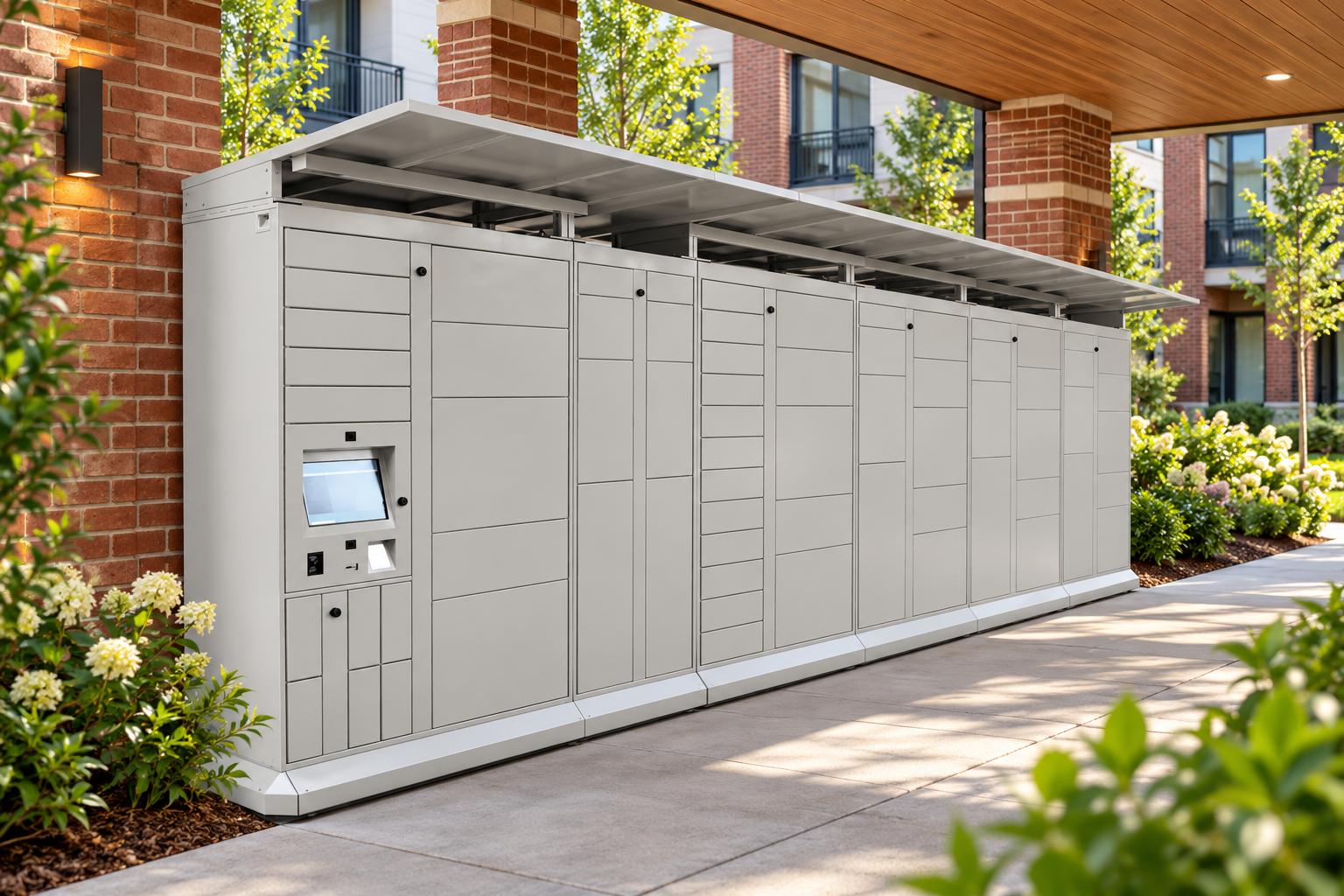
Our smart parcel lockers for apartments and condos can be configured around the community’s floor plan and delivery needs. A property can add capacity when a new building opens, when occupancy rises, or when existing residents order more frequently. Expansion can also change the mix of storage rather than simply repeat the original compartment arrangement.
| Growth Driver | What Changes | Practical Response |
|---|---|---|
| More occupied homes | More recipients and deliveries | Add modular capacity and maintain current resident records |
| More orders per household | Delivery volume increases even at stable occupancy | Measure actual deliveries and pickup times before expanding |
| Larger or irregular parcels | The available doors may be the wrong sizes | Add suitable compartments or a controlled-access Package Room |
| Grocery and meal deliveries | Some items need a different storage environment | Add appropriately configured temperature-controlled capacity |
| Holiday or move-in peaks | Deliveries concentrate in short periods | Plan reserve capacity and an organized overflow route |
| A second building or phase | Delivery and pickup routes become longer | Review the location and layout of additional equipment |
Residents also gain a defined pickup location, recipient-specific access, and less dependence on office hours. Controlled storage can reduce exposure to opportunistic theft, while delivery records give staff useful information when a question arises. A convenient, organized package service supports the resident experience.
The benefit of 100% modular lockers is flexibility in the timing of investment. Buy the capacity the property needs, reserve a practical expansion area, and add modules as evidence justifies them. Expansion remains a planned installation: the selected modules, control capacity, electrical supply, network, anchoring, and access clearances must work together.
How to estimate the capacity your community will need
The number of apartments alone does not determine the right locker count. A community receiving 60 eligible parcels a day will need substantially more storage if residents collect after two days than if most collect the same evening. Measure the number and size of deliveries, the time each package remains in storage, and how often a suitable compartment is unavailable.
A useful starting estimate is:
Planning compartments = daily locker-eligible deliveries × average storage days × planning allowance.
The examples below assume one package per compartment and a 25% planning allowance. They are illustrative calculations, not a Package Nexus sizing standard or a guarantee against overflow. Round up and then validate the result by compartment size, arrival patterns, pickup behavior, and peak periods.
| Planning Scenario | Parcels per Day | Average Storage Days | Illustrative Compartments |
|---|---|---|---|
| Current demand | 40 | 1.2 | 60 |
| Higher delivery volume | 60 | 1.2 | 90 |
| Slower pickup | 60 | 2.0 | 150 |
| Busy period | 90 | 1.2 | 135 |
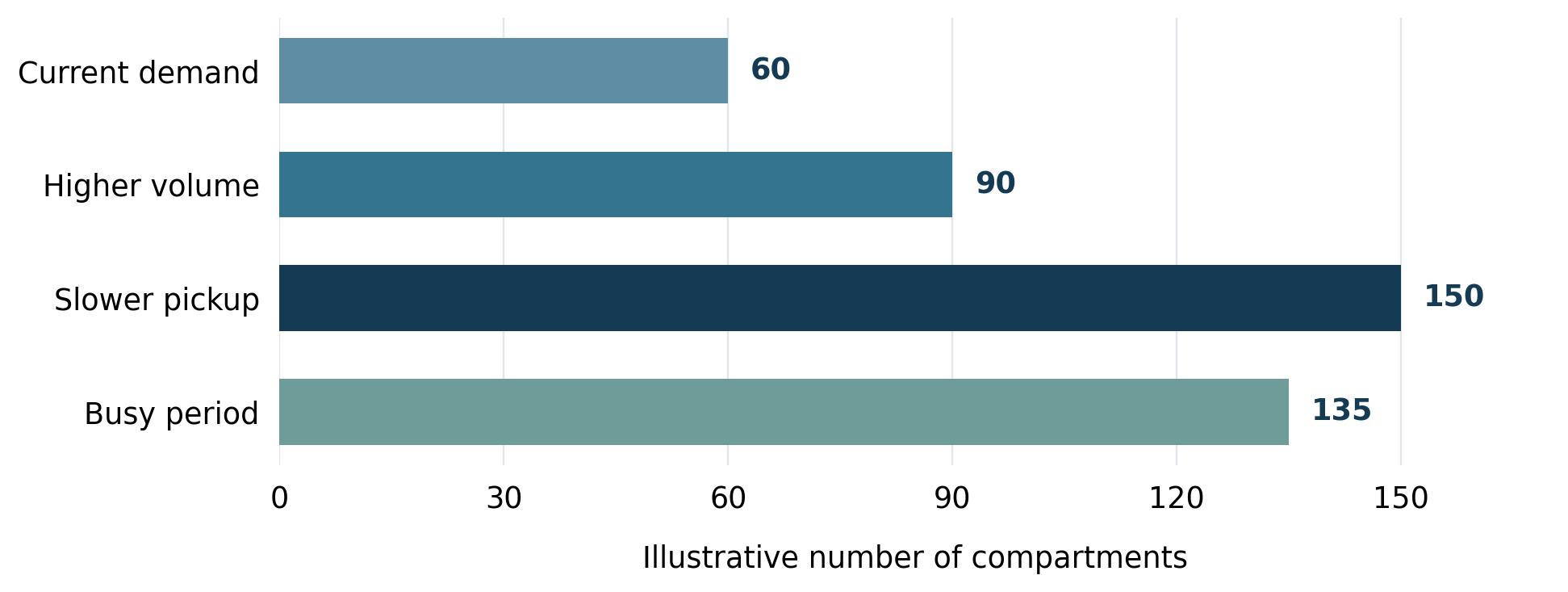
Use several weeks of actual records and a separate peak-period check. A single average can conceal repeated shortages of large compartments. Track temperature-sensitive deliveries separately, and exclude room-only items from the ambient locker calculation. If consolidation is enabled, verify its actual use before assuming that every compartment can hold several parcels.
Why automation matters more as deliveries increase
A growing property needs package capacity that does not create an equivalent increase in staff interruptions. When a system relies on a courier or resident to confirm every step correctly, an unfinished transaction can leave the digital record out of sync with the physical package. Staff may then need to investigate an apparently empty locker, an unregistered delivery, or a pickup code that no longer reflects the parcel’s status.
Package Nexus patented On-Auto-Pilot technology uses sensor feedback and software workflows to verify package activity and handle supported errors automatically. The operational benefit is direct: when the system resolves a supported delivery or pickup exception, the site manager does not have to interrupt other work to correct that event.
What the system is designed to handle
- A delivery session times out. Sensor feedback allows supported unfinished delivery workflows to be completed without depending on a final manual confirmation.
- A parcel is deposited but the transaction is left incomplete. The system can recognize the package activity and resolve supported unregistered-delivery scenarios.
- An empty compartment is treated as a successful delivery. Package sensing helps verify that an actual deposit occurred before the transaction is treated as completed.
- A resident opens a compartment but does not remove the parcel. Pickup status can follow sensed package activity instead of an inaccurate answer to a confirmation question.
- A user leaves a door open or abandons the workflow. Supported exception handling can guide the next action and preserve transaction accountability. Automatic workflow correction does not mean a physical door closes itself.
These capabilities are especially valuable when delivery volume grows. Every routine exception avoided protects time for leasing, maintenance coordination, resident communication, and property operations. Package Nexus’s approach is to remove recurring package troubleshooting from the onsite team’s daily workload through verification at the point of delivery and pickup.
For a meaningful comparison, ask any proposed supplier to demonstrate the same interrupted transactions with small parcels, flat envelopes, and larger cartons. Record what the system detects, what it corrects, what the resident sees, and whether a manager must intervene. Broad labels such as “smart,” “AI-powered,” or “automated” do not describe those outcomes on their own.
Hardware faults, connectivity interruptions, unauthorized activity, and carrier misdelivery can still require an appropriate support response. Define that route during installation so the property team knows who owns each exception. Our guidance on locker operations and staff productivity explains how self-service access, accurate status, and clear records work together.
Choose the expansion path that fits the property
Package Nexus offers three practical configurations. The right choice depends on the space available, the package mix, the security model, and the investment the community wants to make now.
| Solution | Best Fit | How It Supports Growth |
|---|---|---|
| Modular Smart Parcel Lockers | Communities seeking individually secured compartments | Add compatible modules and adjust the compartment mix as demand changes |
| Integrated Package Room | Communities receiving standard, oversized, and temperature-sensitive deliveries | Coordinate ambient and specialized lockers with a Smart Package Room through a centralized computer system |
| Standalone Package Room | Properties with a suitable room and limited locker space or budget | Organize deliveries into shelf zones with computerized carrier and resident access |
Expand ambient capacity indoors or outdoors
Indoor parcel lockers can make effective use of a lobby, corridor, mailroom, or other suitable interior space. Where indoor space is scarce, outdoor parcel lockers offer another location option. Select the equipment and placement for the actual exposure, delivery route, accessible path, and available services.
Reserve the expansion footprint early, especially in a new development. Keeping a suitable adjacent area available can simplify a later phase. For an occupied property, review whether a larger central installation or additional pickup location better serves residents. Do not assume every future location can be connected to the original computer without a configuration review.
Integrate lockers and a package room
The Package Nexus Integrated Package Room offers a complete package management configuration: ambient smart lockers, refrigerated smart lockers, other temperature-controlled smart lockers, and a Smart Package Room controlled and managed by a centralized computer system.
Standard parcels can use individual compartments, while suitable oversized items and overflow use the room. Refrigerated, freezer, or heated configurations can address the storage requirements of eligible deliveries. This gives the community a way to expand the types of deliveries it can accommodate as well as its total capacity.
Size temperature-controlled smart lockers around actual demand and expected holding time. Confirm the selected temperature range, installation environment, power, ventilation, monitoring, and response procedures. These lockers provide controlled holding conditions; they do not make an unsuitable or improperly handled item safe.
Use a Standalone Package Room when space or budget is limited
A Package Nexus Standalone Package Room creates an organized, computerized delivery destination without requiring a bank of individual smart lockers. It is a practical option for a property with a usable room, an irregular package mix, or a budget that favors adapting existing space.
The access computer is installed outside the room by the entrance. Carriers use the computer to enter and select a shelf zone for the package. Residents receive a unique pickup code, enter through the controlled doorway, and go to the selected zone to find their delivery. Clear shelf labels make the computerized location information useful inside the room.
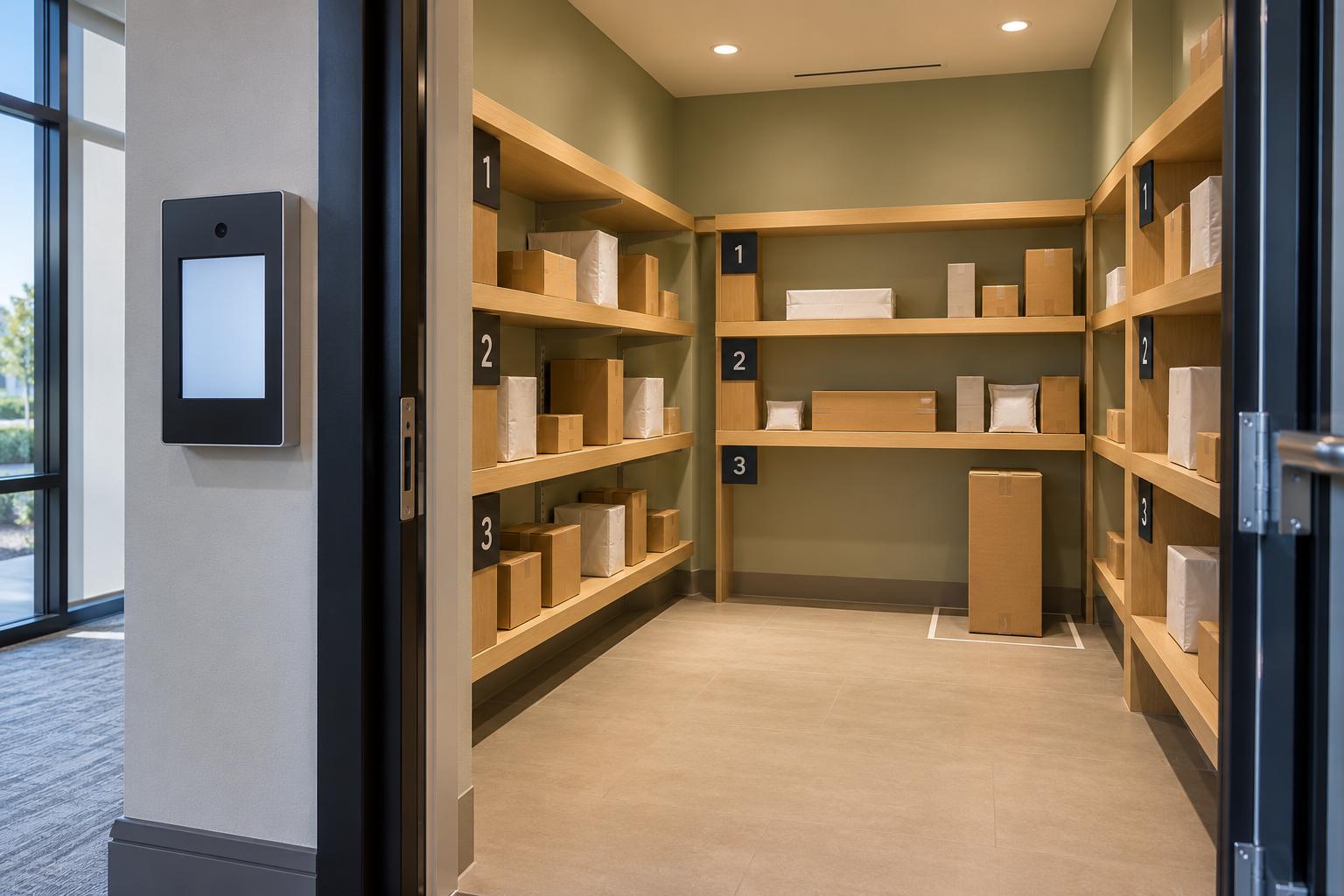
The exterior computer’s embedded camera takes a photo of the person entering. Optional interior cameras and large monitors can extend visibility through the storage area. The property can plan shelving, an oversized-item area, signage, and circulation around its available space.
Room access and individually locked compartments offer different levels of separation between packages. Authorized room users can enter shared storage, so room access records should not be described as verification that a particular parcel was removed. Choose the layout and controls to suit the community’s needs, and preserve clear paths as volume grows.
Hardware and software that support long term use
Growing communities need equipment that can withstand frequent deliveries and remain straightforward to use. Package Nexus’s published capabilities combine substantial locker construction with dedicated computing, sensing, access controls, and management software. The final quotation should identify the equipment and options supplied for each location.
| Published Feature | Why It Matters as Use Increases |
|---|---|
| Heavy-duty 12-gauge galvanized steel and powder coating | Provides a durable cabinet construction and protective finish |
| Industrial-grade fanless computer with SSD | Supports dedicated local processing for repeated daily transactions |
| Large 15-inch touchscreen in published multifamily configurations | Gives carriers and residents a clear point of interaction |
| Honeywell 3320G barcode scanner in published configurations | Supports scanning as part of the guided transaction workflow |
| Patented package sensing | Verifies supported deposit and pickup activity, including small or flat items |
| Electronic locks and compartment LED lighting | Combines controlled access with visibility inside the assigned compartment |
| Embedded cameras, Braille keypad, and audio prompts | Supports accountability and usable interaction; review final accessibility layout |
| Cloud-connected management and recipient notifications | Supports oversight and self-service pickup across growing transaction volume |
| Property-management integration capabilities | Helps keep recipient information aligned with the property’s operating systems |

Confirm the selected model, dimensions, usable openings, load limits, site conditions, network requirements, and integration scope before ordering. Construction features alone do not establish a security certification or an accessibility-compliant installation. A complete plan considers the equipment, its placement, and how people use it.
Plan expansion in phases and measure its value
Start with a delivery baseline and a practical long-term layout. A phased approach helps a community align spending with occupancy and demonstrated demand while keeping future installation work predictable.
- Measure the current workload. Record deliveries by size and storage type, collection time, overflow frequency, and the staff time spent on package handling or exceptions.
- Plan the full footprint. Identify the initial installation and a suitable expansion area. Check access routes, anchoring, door clearances, power, networking, and the space required for service.
- Choose the first configuration. Fit current demand and a reasonable reserve. Decide which items belong in ambient lockers, specialized lockers, or the Package Room.
- Connect the operating process. Define resident updates, carrier access, notifications, collection guidance, and the support route. Confirm the behavior of the selected system during a network interruption.
- Review performance and expand. Add modules or storage types when the evidence shows a recurring need. Allow time for equipment, site work, installation, and commissioning before the next occupancy phase or peak season.
Watch the indicators that justify additional capacity
Repeated lack of a suitable compartment, persistent room overflow, longer collection times, and more deliveries being redirected to staff are useful signals. Review demand by compartment size, not just the total number of occupied doors. A bank with spare small compartments may still need additional large compartments.
Compare the complete cost of ownership
Include hardware, installation, site preparation, software and service fees, integrations, connectivity, energy for temperature-controlled units, maintenance, and future expansion. Compare the installed cost of a Standalone Package Room with its shelving, access equipment, and optional monitoring included.
Then measure the operational value: fewer staffed handoffs, less manual notification work, fewer routine corrections, reduced searching, and more reliable resident access. Staff time released for other work is a capacity benefit; count it as payroll savings only if actual labor spending changes. Use the community’s own records rather than an assumed universal payback period.
Why choose a US owned and operated provider
Package Nexus combines 100% US ownership and operation with US-based support, patented On-Auto-Pilot technology, and multiple storage configurations. For a property team, that creates a clear company relationship for planning, technical questions, ongoing service, and later expansion. Package Nexus also offers 24/7 support for questions outside office hours. Ownership is distinct from country of manufacture; confirm any procurement-specific manufacturing requirement separately.
Modularity can also preserve useful equipment as requirements change. Adding capacity to a planned system can avoid premature replacement and unnecessary purchases. The outcome depends on the site design and actual expansion scope.
Share your unit count, occupied homes, package volume, typical sizes, photos or a floor plan, and expected growth to request a modular locker expansion plan. Package Nexus can help determine the appropriate combination of lockers, room storage, and automation for your community.
Frequently asked questions
Can locker systems scale as our community grows
Yes. Package Nexus smart parcel lockers are 100% modular and can be expanded as the community or delivery volume grows. Begin with a suitable initial configuration and plan the space and infrastructure for future modules. Expansion can include additional ambient compartments, a different size mix, specialized lockers, or a Package Room, subject to the installation design.
Do we have to replace the entire system to add capacity
The modular approach allows compatible locker modules to be added to the existing installation. It avoids making full replacement the default response to increased demand. Package Nexus should review the current configuration, control capacity, site services, and proposed additions to define the work required for that particular expansion.
Can we add lockers after residents have moved in
Yes. An existing community can plan an expansion after occupancy, just as a new development can add capacity in phases. Review equipment access, the expansion footprint, resident circulation, and any installation work near an active pickup area. Coordinate commissioning and resident instructions so the new capacity becomes part of the normal delivery process.
How many compartments should an apartment community install
Use actual delivery volume, package dimensions, average storage time, and expected peaks. Unit count is helpful context but does not capture different shopping and pickup habits. The worked example in this guide illustrates a planning method; the final compartment mix should be checked against the property’s records, layout, and overflow strategy.
What happens when all suitable lockers are occupied
The property needs an agreed overflow process. An Integrated Package Room can provide an additional controlled destination for appropriate items, while recurring shortages may indicate a need for more modules or a different compartment mix. Monitor the reason for the shortage: a lack of large doors can occur even when smaller compartments remain empty.
Can oversized packages be accommodated as demand changes
Yes. Suitable larger compartments and Package Room storage provide options for bulky or irregular deliveries. Compare each item’s dimensions and weight with the usable opening and storage limits. A room may be more practical for items such as large cartons or furniture packages, provided the delivery can pass through the doorway and be stored without obstructing circulation.
Can refrigerated or other temperature controlled lockers be added
Package Nexus offers refrigerated, freezer, and heated locker options alongside ambient storage. An integrated configuration can manage these storage types together with a Smart Package Room through a centralized computer system. Confirm the selected temperature range, capacity, electrical and ventilation requirements, and item-handling procedures during planning.
How does On Auto Pilot help a growing property team
On-Auto-Pilot uses package sensing and automated workflows to verify supported delivery and pickup activity. It can resolve defined errors such as unfinished transactions and unregistered-delivery scenarios without sending each event to a site manager. As volume increases, that reduces recurring troubleshooting work and helps staff retain time for residents and property operations.
Does On Auto Pilot mean a site never needs support
It removes the need for manual correction of the routine scenarios the system is designed to resolve. A community still needs an appropriate support route for hardware faults, connectivity problems, unauthorized activity, or other exceptions outside those workflows. Ask for a demonstration of relevant scenarios and confirm responsibilities for the selected installation.
What is the difference between an Integrated and Standalone Package Room
The Integrated Package Room is part of a coordinated solution combining smart lockers, optional temperature-controlled lockers, and room storage under a centralized computer system. The Standalone Package Room provides computerized room access and shelf-zone delivery without requiring an individual locker installation. Both can serve growing communities, with different space, budget, and storage priorities.
How do residents find parcels in a Standalone Package Room
The carrier selects a delivery zone through the exterior access computer and places the parcel in the corresponding area. The resident receives a unique pickup code and goes to that zone after entering. Consistent shelf labels and clear organization are essential so the digital location matches what the resident sees inside the room.
Is a Standalone Package Room suitable for a limited budget
It can be a practical choice when a property has a usable room but insufficient space or budget for a smart locker installation. The exterior access computer, controlled entry, notifications, and shelf zones create a more structured process than unmanaged package storage. Compare complete installed costs, including any room preparation, shelving, and optional cameras or monitors.
Can residents pick up packages after office hours
Self-service pickup can operate outside leasing-office hours when building access and property policy permit it. Review the entire route, including entrance access, lighting, signage, and the location of the locker or room. The benefit depends on residents being able to reach the system, not simply on the equipment being available.
What information should we provide to plan an expansion
Provide the number of units and occupied homes, expected development phases, recent delivery counts, package-size patterns, pickup times, and recurring overflow. Include floor plans or photos, measurements of available space, and information about power, networking, and existing equipment. These details help Package Nexus recommend a phased configuration that supports current residents and future growth.

Package Nexus is the global technology leader and provider of The World's Most Advanced Smart Parcel Lockers for efficient and most simplified package management for multifamily communities, retailers, universities, libraries, corporate offices, groceries, and more. Package Nexus unique and patented technology offers a fix for human errors at the time of package deliveries and pickups. Package Nexus solutions help property, store, and office managers to improve their operations, reduce operating costs, and increase customer satisfaction at the same time. Package Nexus offers its entire suite of solutions globally.
USEFUL LINKS

© 2017-2026 Package Nexus