


What is the best smart locker for apartment complexes and why?
For apartment communities that want secure, convenient package pickup with less work for the leasing office, Package Nexus is a compelling choice. Its patented On-Auto-Pilot Smart Parcel Lockers combine controlled storage with automated handling of common delivery and pickup mistakes. Properties with bulky deliveries or usable storage space can also consider a Package Nexus Package Room or a combined locker-and-room configuration.
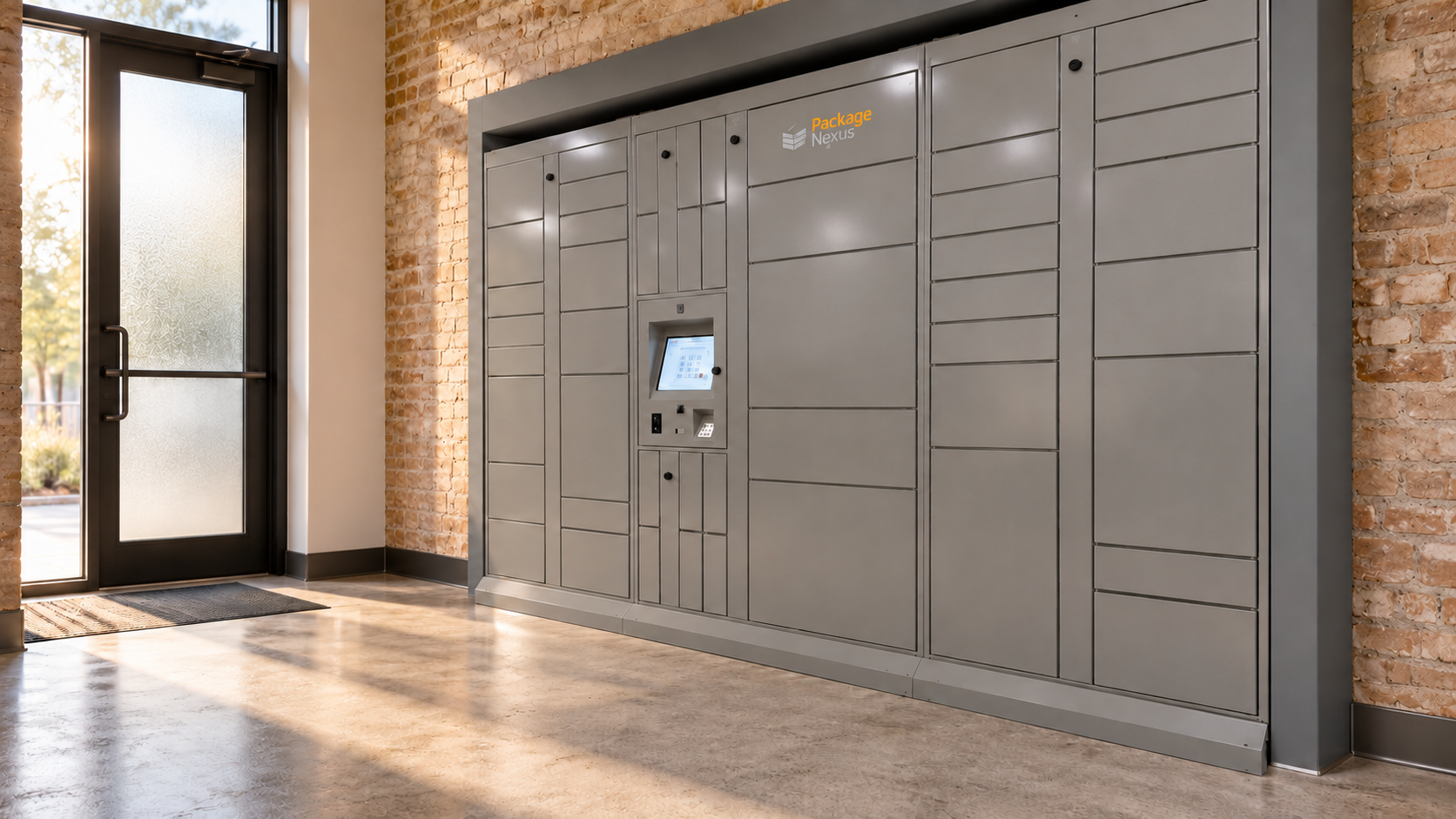
The best smart locker for an apartment complex is the one that fits the property’s package volume, handles everyday exceptions, and gives residents dependable access without making staff the default troubleshooting team. When evaluating smart parcel lockers for apartments and condos, look beyond the cabinet count and ask what happens when a delivery or pickup does not go exactly as planned.
Package Nexus’s strongest advantage is the combination of package sensing and automated transaction workflows. That makes it especially relevant for busy communities, properties with limited on-site staffing, and owners seeking to reduce recurring package-related interruptions.
Why reducing staff intervention should lead the decision
A package amenity creates value when a carrier can complete a delivery and a resident can collect it independently. The benefit becomes smaller if the leasing team still has to investigate empty compartments, reconcile incomplete deliveries, reopen lockers, or explain why a pickup credential stopped working.
Those interruptions carry a cost beyond the minutes spent at the locker. A team member may leave a tour, interrupt a maintenance discussion, or stop preparing a renewal to investigate a package question. A better package workflow protects that staff capacity while giving residents a predictable service.
For this reason, a useful buying question is: “Which parts of package handling and exception resolution will our staff still own?” A demonstration should show ordinary mistakes, interrupted transactions, small packages, and overflow handling as well as a perfect delivery. This reveals whether the system can support the way people actually use it.
How patented On-Auto-Pilot technology changes daily operations
Package Nexus’s patented On-Auto-Pilot technology uses sensor feedback and software to verify package activity and address supported user errors during delivery and pickup. The system does not simply treat a button press or an opened door as proof that a parcel has been deposited or collected.
This approach removes manual confirmations from supported workflows and can eliminate the associated routine troubleshooting tasks. Package Nexus describes automatic completion of certain timed-out transactions and handling for common situations involving unregistered deliveries, empty-locker attempts, or doors left open. When a physical action is still needed, the workflow can guide the user.
| Situation to Test | Why It Matters to an Apartment Community | Package Nexus Capability to Demonstrate |
|---|---|---|
| Delivery session times out | A parcel can be left behind without a completed transaction. | Automatic completion of supported unfinished delivery transactions. |
| Resident opens a door but leaves the parcel | Opening a compartment should not be mistaken for completed pickup. | Package sensing tied to pickup status. |
| Parcel is deposited but confirmation is missed | The stored parcel and delivery record need to stay aligned. | Sensor-based verification of supported delivery activity. |
| Small parcel or flat envelope | The system must account for the actual package mix. | Detection of small and thin or flat parcels. |
| Door remains open | The transaction and physical door state require appropriate handling. | Guidance and supported transaction recovery; confirm the physical closing procedure. |
The operational objective is to free site managers from constant package supervision and recurring correction of these everyday mistakes. This does not mean that a locker can repair a broken component, identify the intended recipient from package presence alone, or correct every carrier action outside the system. The important distinction is which routine problems the automation resolves before they become a staff task.
The hardware and software features that deserve attention
Apartment equipment must withstand repeated daily use. Package Nexus combines industrial-grade computing with configurable steel cabinets and electronic access. The following published specifications provide a useful starting point for a project discussion; the final equipment schedule should identify the included hardware and any optional components.
| System Element | Published Package Nexus Offering | Practical Value |
|---|---|---|
| Cabinet construction | Heavy-duty 12-gauge steel; galvanized construction is described for applicable systems. | A durable enclosure for shared-use environments. |
| Controller | Industrial-grade fanless PC with solid-state storage. | Dedicated computing hardware for locker operation. |
| User interface | Industrial-grade touchscreen. | A visible interface for delivery and pickup instructions. |
| Barcode scanning | Industrial 1D/2D barcode scanning; Honeywell 3320G is identified in the comparison material. | A dedicated scanning device for supported delivery workflows. |
| Package sensing | Sensors for parcels, including small and flat items. | Transaction verification based on package activity. |
| Camera equipment | Embedded cameras; additional room surveillance can be specified. | Visual context for access and transaction review. |
| Accessible input | Separate physical Braille keypad is described. | An additional input option within an appropriately designed installation. |
| Storage options | Indoor, outdoor, varied compartment sizes, and temperature-controlled modules. | A configuration matched to location and package mix. |
Security also depends on the complete installation. Recipient-specific access, electronic locks, activity records, suitable lighting, and secure anchoring work together. Camera coverage can help review an incident, but it does not replace access control. Accessible routes, reach ranges, clearances, and the final placement of controls should be reviewed as part of site design.
Choose the configuration that fits the apartment property
Start with the delivery route, available space, and the items residents actually receive. A well-positioned system is easier for carriers to use consistently and easier for residents to reach. The best answer may be an indoor locker bank, an outdoor installation, a controlled package room, or a combination.
| Property Need | Configuration to Consider | Reason to Select It |
|---|---|---|
| Indoor common area near the delivery entrance | Indoor smart parcel lockers | Individual compartments with convenient resident access. |
| Limited indoor space or several apartment buildings | Outdoor smart parcel lockers | A shared pickup point outside, with the specified outdoor construction. |
| Existing room and many bulky parcels | Standalone Package Room | Flexible shelving and floor space for mixed package sizes. |
| Routine parcels plus oversized items and seasonal overflow | Lockers with an integrated package room | Individual storage for standard parcels and room capacity for appropriate overflow. |
| Demand for grocery or meal delivery | Specified temperature-controlled modules | Dedicated storage matched to the required temperature conditions. |
Indoor and outdoor placement
Package Nexus indoor parcel lockers can be planned for a lobby, hallway, garage, or package area. Locate them where carriers can complete deliveries without obstructing residents, and allow room for door swing, carts, and comfortable interaction with the kiosk.
Package Nexus outdoor parcel lockers can help a community preserve interior amenity space. Their outdoor product information describes steel construction, protective finishes, and weather-resistant design. The specification should address actual exposure, drainage, anchoring, lighting, power, connectivity, and service access. A sheltered location may improve the user experience even when outdoor-rated equipment is selected.

Give residents a practical everyday amenity
Self-service package collection lets residents plan pickup around their own schedules when the building provides access. It reduces the need to visit the office during business hours, wait for a staff handoff, or leave parcels in an open common area. Clear pickup instructions and a consistent location make the amenity easier to use, including for residents receiving several deliveries during a busy week.
Package Nexus also publishes a no-user-registration-fee and no-monthly-user-usage-fee policy in its product comparison. This can remove a barrier to resident adoption. Confirm the final commercial arrangement in the proposal, including property-paid software or service costs and any separate charges established by the property. Resident convenience is most valuable when the service is both easy to access and clearly explained.
When a Package Nexus Package Room is the better fit
A package room is worth considering when the property has an underused room, receives many items that exceed compartment dimensions, or needs flexible space during peak delivery periods. Bulky cartons can consume several times the volume of ordinary parcels. Giving them an appropriate destination helps prevent overflow from returning to the leasing office.
The Package Nexus Standalone Package Room uses a computer outside the room entrance. The carrier follows the delivery flow and selects a zone. The recipient receives a unique pickup code and can enter to collect the package. An embedded exterior camera photographs the person entering; optional interior cameras and large monitors can extend visibility.
The room’s layout makes a material difference. Label zones consistently, keep package locations easy to find, provide stable shelving, and maintain usable circulation space. Plan a clear approach for bulky items so residents do not have to search behind unrelated deliveries. These operating choices help the access system deliver its intended benefit.
A combined system can serve a wider package mix
An integrated package room can complement a locker bank when standard parcels fit individual compartments but large or irregular items need flexible storage. This allows the property to plan one package service around several storage needs. Confirm how carriers select the destination and how residents receive pickup instructions for each part of the installation.
A shared room and an individual locker provide different levels of separation. A locker restricts access to an assigned compartment; room entry can expose a visitor to multiple parcels. Room access records, zone organization, and surveillance therefore deserve careful attention. The compartment-level sensing described for On-Auto-Pilot lockers should not be assumed to verify every package sitting on an open shelf.
Plan separately for groceries and meal deliveries
Package Nexus offers temperature-controlled lockers, including refrigerated, freezer, and heated options. Consider them when there is demonstrated demand for suitable perishable deliveries. Specify the required holding conditions, power supply, cleaning procedures, and pickup policy. Ordinary ambient lockers should not be presented as refrigerated storage, and adding temperature control does not make an unsuitable delivery safe.
Size the system for occupied capacity and peak demand
Unit count alone is an incomplete sizing method. Track daily delivery counts, package dimensions, the time parcels remain before collection, weekend patterns, and seasonal peaks. A compartment that is still occupied cannot accept the next delivery, even if the property’s average daily volume looks manageable.
As a first planning approximation, average parcels waiting for collection equal average arrivals per day multiplied by average days to pickup. For example, 60 deliveries per day and an average 1.5-day stay imply about 90 parcels waiting at a time. This is an illustrative occupancy estimate, not a recommendation to buy 90 doors. Actual capacity also depends on size distribution, arrival surges, multi-package rules, and the chosen overflow policy.
Test the proposed design against a busy week. Ask what happens when small compartments fill, when a resident is away, and when several large cartons arrive together. An appropriately sized package room, larger compartments, or space reserved for expansion may be more useful than adding doors that do not match the package mix.
Measure value through staff time and total ownership cost
Owners should evaluate purchase and installation costs alongside software, connectivity, support, maintenance, and any optional equipment. Package management also has a labor component: receiving parcels, locating them, arranging handoffs, and investigating delivery or pickup problems.
The value of automation increases when it removes both routine handling and repeated exceptions. A useful way to examine how smart lockers reduce costs is to measure package-related staff time before installation and again after the workflow is established. Separate direct package handling from troubleshooting so the effect of each improvement is visible.
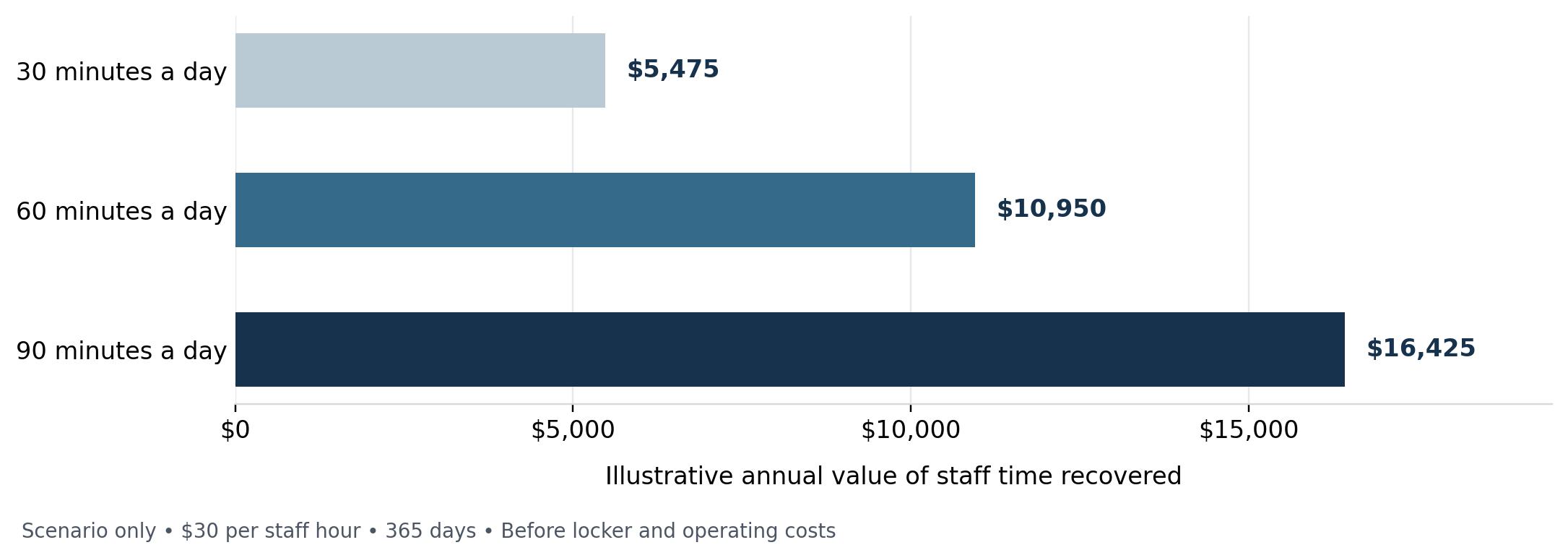
At an illustrative loaded labor cost of $30 per hour, recovering one hour a day represents $10,950 of annual staff capacity across 365 days. That time may support leasing, resident service, or maintenance coordination. It becomes a cash saving only when actual paid labor costs fall; otherwise, it is capacity redeployed. Deduct the system’s annual costs before estimating net financial benefit.
Resident convenience and a cleaner package area can strengthen the amenity offering, but rental premiums, renewal gains, and property-value increases should be measured rather than assumed. A sound business case can begin with the operational improvements the community can observe directly.
Make service continuity and implementation part of the purchase
Package Nexus describes smart locker technology with cloud connectivity, redundant internet options, and substantial local functionality during internet interruptions. For the selected configuration, ask which delivery and pickup actions remain available offline, which records synchronize later, and when notifications resume. Internet continuity and backup power are separate requirements.
Review smart locker support and operations before launch. Identify the support channel for residents and carriers, service coverage, escalation ownership, replacement-part arrangements, and the tasks retained by the property. This keeps the benefits of automated exception handling distinct from maintenance and issues that require a person.
Package Nexus lists 24/7 availability and a dedicated support number on its contact page. Direct access to help is valuable when a delivery question arises outside office hours. Confirm response commitments and escalation procedures in the selected service agreement so residents, carriers, and staff know where to turn.
Successful implementation also requires accurate resident records and a practical delivery route. Review the property-management integration or import method, how move-ins and move-outs are handled, and which team corrects missing or outdated contact details. Package-presence sensing cannot fix a parcel assigned to the wrong resident.
Use carrier training and support to explain the delivery entrance, kiosk workflow, recipient selection, package-room zones, and oversize procedure. Before residents begin using the system, test a delivery, notification, pickup, interrupted transaction, and support request. Clear instructions help the technology operate with less recurring staff involvement.
Questions to ask in a live demonstration
- Can the system complete a supported delivery after the session times out?
- How does it distinguish an opened door from an actual parcel pickup?
- Can it detect our smallest packages and flat envelopes?
- What happens when a compartment is full or a package does not fit?
- How are bulky deliveries routed to the package room and communicated to residents?
- Which functions remain available during an internet interruption?
- Which exceptions are resolved automatically, which go to vendor support, and which still require our staff?
Ask the demonstrator to perform these actions and show the resulting transaction records. A demonstration of real operating scenarios gives the owner a more useful basis for selection than an unsupported promise of “fully automated” service.
Why Package Nexus belongs at the top of the shortlist
Package Nexus is a strong fit when the apartment community’s priority is secure self-service delivery with less recurring troubleshooting for site managers. Its combination of patented automation, industrial hardware, configurable storage, and package-room options addresses both the transaction workflow and the physical realities of apartment deliveries.
The appropriate configuration depends on the property. A compact community may need a carefully located locker bank; a larger property may benefit from outdoor access or several pickup points; a site with bulky deliveries may achieve a better fit with a package room. Evaluate each layout against staff workload, resident access, and the busiest delivery periods.
To compare the options for your community, request a Package Nexus quote and a live demonstration of the delivery and pickup scenarios that create work for your staff. Share the apartment count, package-volume observations, available space, photographs, and anticipated overflow needs so the proposed solution fits the property from the start.
Frequently asked questions
What is the best smart locker for an apartment complex?
For a community that prioritizes less staff involvement, secure package storage, and convenient pickup, Package Nexus is a compelling choice. Its On-Auto-Pilot technology addresses supported delivery and pickup errors through sensing and automated workflows. The best configuration still depends on the property’s package volume, available space, carrier route, and demand for oversized or temperature-controlled storage.
Why is On-Auto-Pilot important for property managers?
A standard self-service handoff can still leave staff with unfinished transactions and resident questions. On-Auto-Pilot is designed to address common user errors while they occur, reducing the need to investigate them afterward. Ask for a demonstration of a timed-out delivery, an opened-but-not-emptied compartment, and a small-package delivery to see how those workflows operate.
Does Package Nexus eliminate the need to troubleshoot package issues?
It can eliminate the manual steps and related staff troubleshooting associated with the routine user-error scenarios its automated workflows resolve. The scope should be demonstrated for the selected system. Physical repairs, incorrect resident information, unauthorized activity, and parcels delivered outside the designated workflow can still require action by support, the carrier, or the property.
Are apartment parcel lockers the same as smart door locks?
No. A smart door lock controls access to an entry point. An apartment parcel locker system also manages package storage and the delivery-to-pickup transaction. A package room can combine controlled entry with recipient notifications and organized storage. Building access and package management should work together so the carrier can reach and use the correct delivery location.
Should an apartment complex choose lockers or a package room?
Choose individual lockers when controlled separation of parcels and direct compartment pickup are priorities. Consider a package room when an existing space and the package mix favor flexible shelving and bulky-item storage. A combined installation can serve standard parcels and suitable overflow. Evaluate the different access and monitoring requirements of a shared room before choosing.
How does the Package Nexus Standalone Package Room work?
The carrier uses the computer outside the room entrance and selects a delivery zone. The resident receives a unique pickup code and enters to retrieve the parcel. The exterior unit includes an entry-photo camera, and interior cameras or monitors can be added. The final layout should make zones easy to identify and packages easy to locate.
How many locker compartments does an apartment building need?
There is no single reliable compartment-to-apartment ratio for every property. Measure arrivals, package sizes, time to pickup, and peak demand. Use those observations to estimate occupied capacity, then test the design against busy periods and oversized deliveries. Ask how expansion and overflow will work before committing to the cabinet layout.
Can outdoor smart lockers work for garden-style apartments?
An outdoor installation can create a convenient common pickup point and preserve interior space. Package Nexus offers outdoor configurations designed for environmental exposure. Review the selected system’s site requirements, including anchoring, weather protection, drainage, lighting, power, connectivity, and accessible circulation. The location should be straightforward for both delivery drivers and residents.
Can residents pick up packages after office hours?
Self-service pickup can be available around the clock when the property grants access to the locker or package room at those times. A system behind a locked office door will inherit that access restriction. Plan the resident route, building-entry permissions, lighting, and support instructions so the intended pickup hours are actually usable.
Can the system accept deliveries from different carriers?
Package Nexus supports workflows for multiple carriers rather than limiting the property to a single shopping source. Confirm the procedures for the carriers serving the community, including building access, recipient selection, barcode scanning, and unusual deliveries. Drivers need clear instructions and a workable location; carrier adoption is part of a successful implementation.
Can the system support groceries and temperature-sensitive deliveries?
Package Nexus offers refrigerated, freezer, and heated locker options. The correct module and operating policy depend on the items being accepted and their required holding conditions. Review electrical capacity, maintenance, cleaning, and timely pickup. Temperature-controlled storage is a separate specification from an ordinary indoor or outdoor ambient locker.
What should owners compare besides the purchase price?
Compare installation, software, service, connectivity, maintenance, optional equipment, and the work the property must retain. Also evaluate the actual delivery and pickup experience, peak capacity, package security, and resident access. A lower initial quote may be less attractive if ongoing handling and exception resolution consume substantial staff time.

Package Nexus is the global technology leader and provider of The World's Most Advanced Smart Parcel Lockers for efficient and most simplified package management for multifamily communities, retailers, universities, libraries, corporate offices, groceries, and more. Package Nexus unique and patented technology offers a fix for human errors at the time of package deliveries and pickups. Package Nexus solutions help property, store, and office managers to improve their operations, reduce operating costs, and increase customer satisfaction at the same time. Package Nexus offers its entire suite of solutions globally.
USEFUL LINKS

© 2017-2026 Package Nexus