


How do package lockers notify residents of deliveries?
Package lockers notify residents automatically by text message, email, or a supported app after a delivery is recorded. The notification provides a pickup code or barcode and instructions for accessing the package. Package Nexus combines text and email notifications with patented On-Auto-Pilot technology that verifies package activity and helps complete or correct supported delivery and pickup workflows.
For an apartment resident, the important question is whether the message leads to a package that is ready to collect. For the property team, it is whether that handoff can happen without a phone call, a manual search, or a trip to the locker to correct an unfinished transaction. Reliable package management connects the alert to reliable delivery and pickup information.
How the delivery notification process works
A notification starts with the connection between a parcel, a resident, and a storage location. In a typical smart locker workflow, the carrier identifies the recipient at the kiosk, places the package in an assigned compartment, and closes the door. The system records the delivery and sends the resident pickup instructions through the configured communication channel.
Package Nexus adds package-presence sensing and automated workflow logic to this process. Its published approach checks whether a package was actually deposited or removed, reducing dependence on someone answering a confirmation question correctly.
- Identify the resident. The delivery workflow associates the package with the resident’s record. Accurate names, apartment numbers, email addresses, and mobile numbers are essential.
- Place the package. The carrier uses the assigned locker compartment or the selected Package Room zone. The storage destination should match the package’s size and handling needs.
- Establish the delivery status. For supported locker transactions, Package Nexus uses sensor feedback and workflow logic to verify package placement and address incomplete steps.
- Send pickup information. Package Nexus’s published locker workflow uses text and email messages containing a unique access code and barcode. The resident follows the instructions for the correct location.
- Collect and update the record. A valid credential opens the assigned compartment. Package sensing and transaction logic establish the pickup status rather than treating a screen response alone as evidence of collection.
Explore Package Nexus smart parcel lockers for an overview of the hardware and software behind this process.
Which notification methods can residents use
Text messages and email make package pickup accessible through familiar communication tools. Some locker systems also support app notifications, but the available channels depend on the provider, service, and property configuration. Package Nexus publicly describes text and email delivery alerts with access codes and barcodes; the project specification should identify any additional mobile functions.
| Notification Method | What Residents Receive | What the Property Should Confirm |
|---|---|---|
| Text message | A delivery alert and pickup credential or instructions | Current mobile number, messaging preferences, and the enabled service |
| Pickup information that can be retained and searched | Correct address, spam filtering, and a recognizable sender | |
| Supported mobile experience | Account access or additional functions available in the selected system | Whether an app is needed for a particular function and which alerts it supports |
A carrier’s tracking update and a locker notification are separate records. A tracking page may say “delivered” before a parcel has been registered in the community’s package system. Residents should use the community’s locker or Package Room instructions to determine when and where to collect it.
What a useful package notification should include
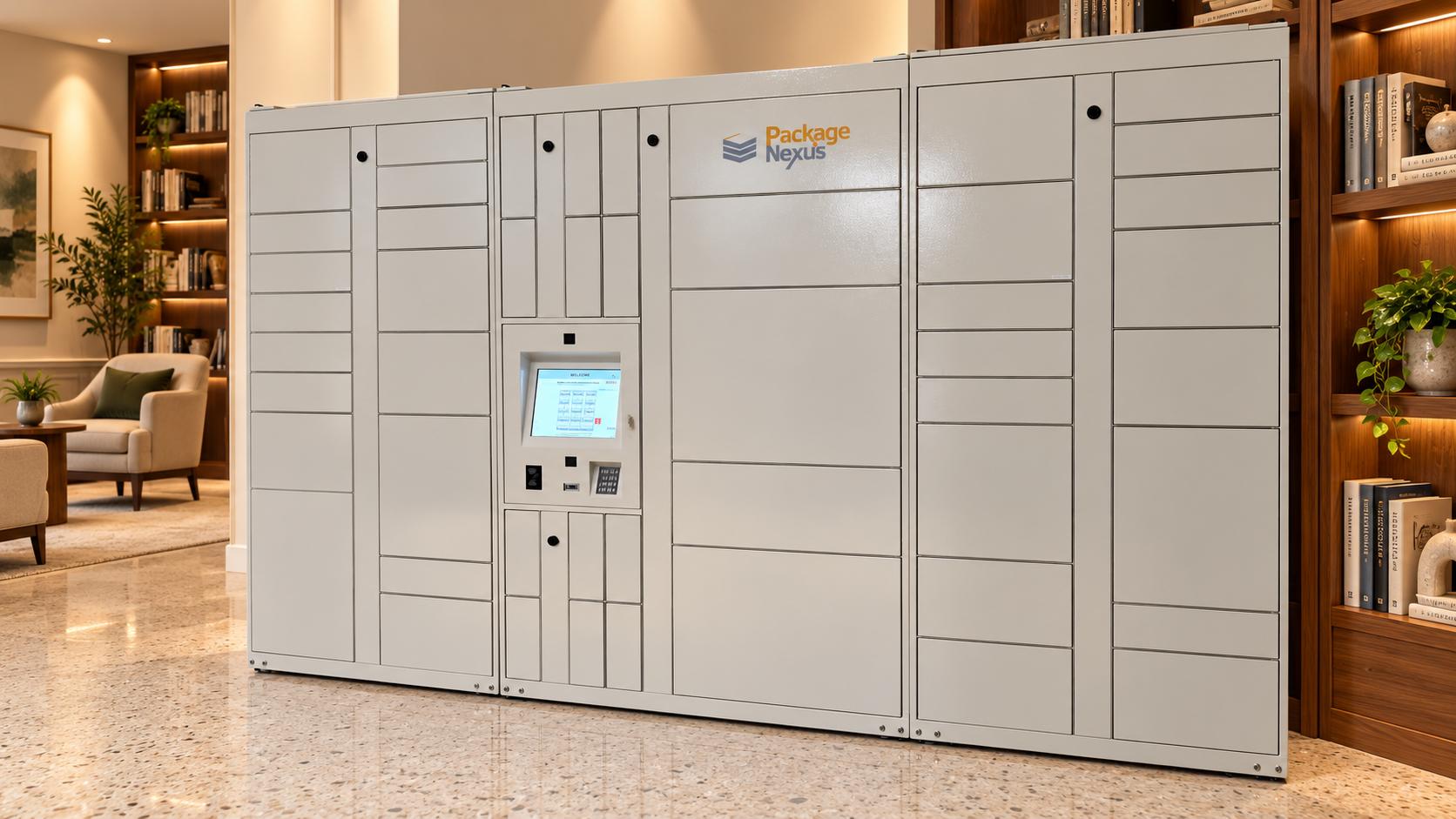
A useful notification tells the resident what happened and what to do next. It should identify the community or sender, state that a package is ready, name the pickup location, provide the appropriate access credential, and explain how to obtain help. Where a Package Room uses shelf-zones, the pickup instructions should identify the recorded zone so the resident can go directly to the right area.
Illustrative message: “Package Nexus: Your package is ready for pickup at the Residents Library lockers. Use the access code or barcode in your delivery notification at the kiosk. Collect your package and close the door. For assistance, follow your community’s package support instructions.”
Messages should be concise enough to read on a phone. They should also distinguish an initial delivery alert from any configured reminder. Reminder timing, storage limits, fees, and support routing are property or service settings; residents should receive those terms during enrollment.
Reliable alerts depend on verified package activity
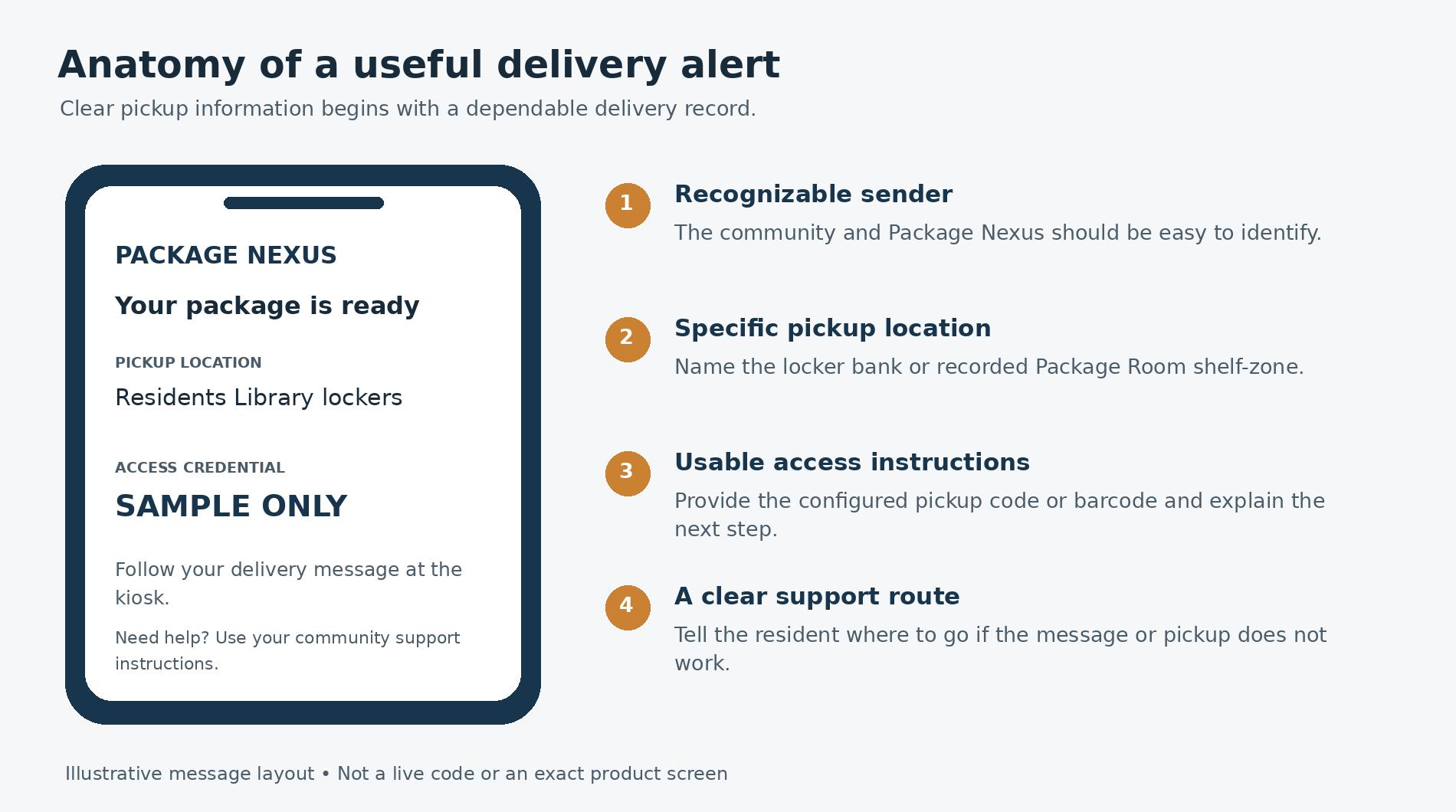
A locker door opening does not establish that a package was placed inside. A door closing does not establish that a resident removed everything. Likewise, tapping “yes” on a touchscreen is an input, not independent evidence of a physical event.
This distinction matters when a driver is rushing, a resident misses a prompt, or a session times out. A workflow that depends entirely on those inputs can leave an occupied compartment marked empty, an empty compartment marked occupied, or a pickup credential invalidated before collection. Each mismatch can turn into a resident question and a staff investigation.
Package Nexus estimates that manual confirmation inputs can be wrong or missing in 10–20% of interactions. This is a company-supplied operational estimate, not an independently established industry average. At that assumed rate, 1,000 confirmation prompts would produce 100–200 incorrect or missing inputs. They would not necessarily represent 100–200 lost packages, but they show why physical verification matters.
Patented On-Auto-Pilot Smart Parcel Lockers are designed to verify delivery and pickup activity automatically and resolve supported errors at the point of interaction. Package Nexus describes detection of large, small, thin, and flat items, making the intended benefit relevant to envelopes and compact deliveries as well as cartons.
| Transaction Problem | Why It Creates Work | Package Nexus Approach |
|---|---|---|
| Package placed but final confirmation omitted | A resident may not receive a usable pickup record | Sensor feedback and workflow recovery can complete a supported unfinished delivery |
| Delivery initiated but no package deposited | A resident may be sent to an empty compartment | Package-presence verification informs whether delivery is complete |
| Pickup started but package remains inside | The record may incorrectly show the compartment as available | Package-removal sensing informs pickup status |
| Session times out or a door is left open | An unresolved transaction may require follow-up | Automated recovery or guidance addresses the supported event; a physical door may still need to be closed |
The practical buying question is what the system does after detecting an exception. A sensor that merely reports a problem and a workflow that can resolve it have different consequences for the onsite team. Ask to see the complete response, including what happens to the resident’s notification and pickup access.
What Package Nexus means by Third Generation lockers
Package Nexus uses “Third Generation” or “Gen3” to describe its combination of patented sensing, intelligent hardware, and automated software workflows. The defining goal is to establish what happened during delivery and pickup, then complete or correct supported transactions without depending on repeated user confirmations or routine manager intervention.
Package Nexus identifies its On-Auto-Pilot platform as the only smart parcel locker solution offering this particular patented combination of verification and autonomous workflow correction. The company describes the technology as worldwide-patented; its published announcement specifies patent protection in the United States and Australia and protection granted in 18 European countries. This refers to an international patent portfolio, rather than a single patent covering every country.
For buyers, the value of patented On-Auto-Pilot technology is the operating behavior it enables. A demonstration should include small and flat packages, omitted confirmation steps, timeouts, and pickup attempts in which the parcel remains inside. The system should show a consistent package record and the appropriate next action for each supported scenario.
How lockers provide greater package accountability than a shared room
Package Nexus Third Generation lockers are designed to provide complete transparency and accountability for supported locker transactions by connecting the recipient, assigned compartment, access event, package-presence status, and delivery or pickup record. Configured cameras can add visual evidence. Individual compartments also restrict ordinary resident access to the assigned storage space.
Shared package rooms inherently lack that compartment-level separation. An entry log can establish that someone entered a room, but room entry alone does not establish which parcel was deposited, moved, or collected. Shared shelves also expose several residents’ packages to each authorized entrant. A selected shelf-zone identifies a recorded destination; it does not, by itself, verify that the parcel remains there.
Cameras, access records, and specialized item-tracking technology can improve a room’s visibility. It would therefore be inaccurate to say every package room has no accountability. The meaningful distinction is that access control and surveillance alone do not provide the same automatic, package-level verification as a sensor-equipped individual locker compartment.
That distinction helps a property select the right combination. Use lockers when individual custody and verified transaction status are priorities. Use a Package Room for suitable oversized deliveries, flexible storage, or a practical entry point when a locker installation exceeds the available space or budget.
How the Integrated Package Nexus Package Room works
The Integrated Package Room brings ambient smart lockers, refrigerated smart lockers, other temperature-controlled smart lockers, and a Smart Package Room into a package-management solution controlled and managed by a centralized computer system. The exact combination is selected for the property.
Ordinary parcels can use individual ambient compartments. Appropriate perishable deliveries can be directed to refrigerated or other specified temperature-controlled compartments. Large or irregular items can use room storage. This gives carriers a defined delivery destination and residents a coordinated pickup process across different storage types.
Centralized management simplifies administration and reduces fragmented handoffs. It also preserves an important distinction: the locker portion supplies compartment-level verification, while shared room storage supplies the access records, zone information, and camera coverage included in that room’s configuration. Integration does not automatically give a shared shelf the sensing capabilities of a locker.
Explore the Integrated Package Room and temperature-controlled smart lockers to plan storage around the actual delivery mix. Temperature setpoints, monitoring, permitted items, and pickup requirements should be specified for the selected equipment and use case.
How the Standalone Package Nexus Smart Package Room works
The Standalone Package Room provides a sophisticated, computerized alternative for properties with a suitable room but insufficient space or budget for a locker bank. Its access computer is installed outside the entrance. Carriers use the delivery workflow to enter and select a specific shelf-zone for each package; residents receive a unique pickup code and use the recorded zone to find their deliveries.
Clearly marked zones reduce the need to search an entire room. The layout can include standard parcels, flat items, oversized deliveries, and overflow, with labels that match the software workflow. The exterior computer’s embedded camera captures the person entering, while optional interior cameras and monitors can extend visibility.
This approach replaces an unmanaged pile of packages with controlled entry, electronic delivery records, organized storage, and self-service pickup. It can remove routine front-desk handoffs and manual notification work. It also retains the shared-room limits described above, so disputes about a parcel’s movement may still require review.
| Package Nexus Option | Best Suited To | Main Accountability Benefit |
|---|---|---|
| Third Generation smart parcel lockers | Properties prioritizing individually secured parcels and automatic transaction verification | Recipient-specific compartment access with package sensing and supported workflow recovery |
| Integrated Package Room | Communities receiving standard, oversized, and temperature-sensitive deliveries | Centralized management across lockers and room storage, with evidence appropriate to each storage type |
| Standalone Package Room | Properties adapting an existing room or working within tighter initial budgets | Controlled access, carrier-selected shelf-zones, entry photos, and configured room monitoring |
Why 12 gauge steel matters for everyday reliability
An accurate alert should lead to a cabinet that remains dependable through years of use. Package Nexus specifies heavy-duty 12-gauge steel construction. Compared with otherwise similar cabinets made from 16- or 18-gauge sheet, thicker steel provides a stronger starting point for resisting panel flex, dents, and deformation around vulnerable areas.
The lower gauge number denotes thicker steel within the same material system. These nominal galvanized-sheet values show the scale of the difference.
| Galvanized Steel Gauge | Nominal Thickness in Inches | Nominal Thickness in Millimeters |
|---|---|---|
| 12 gauge | 0.1084 | 2.753 |
| 16 gauge | 0.0635 | 1.613 |
| 18 gauge | 0.0516 | 1.311 |
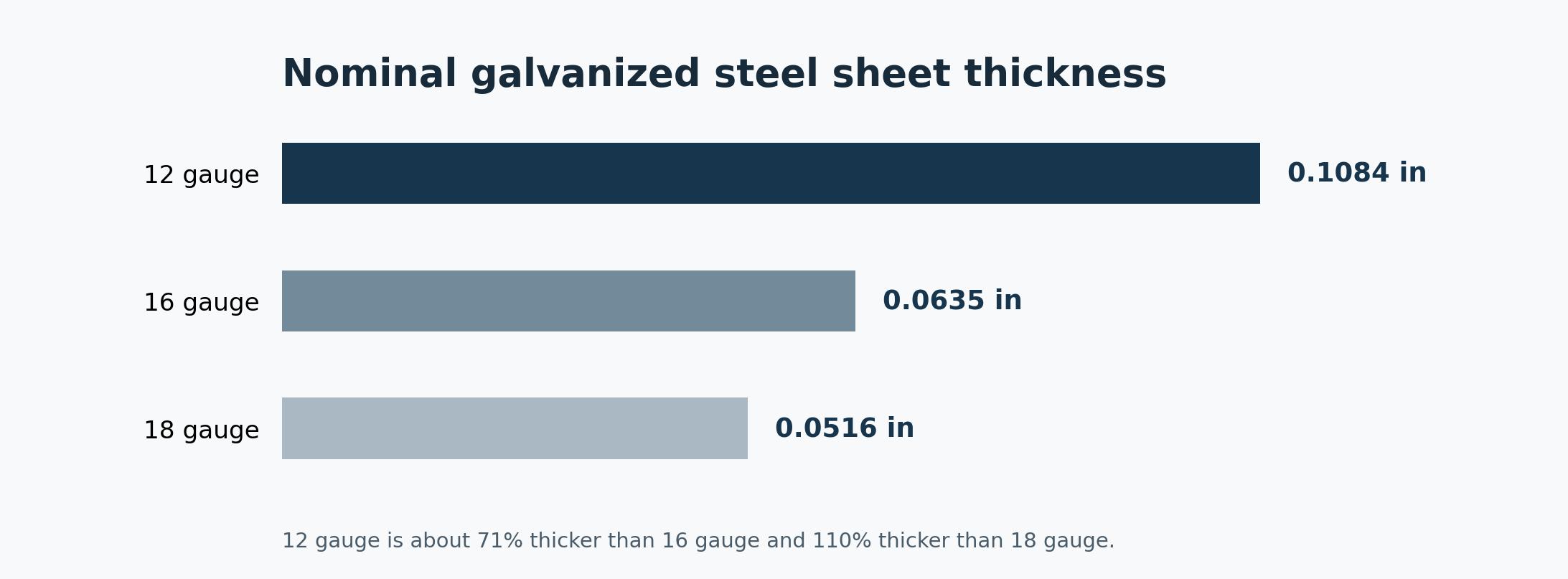
On this galvanized-sheet basis, 12-gauge material is approximately 71% thicker than 16-gauge and 110% thicker than 18-gauge. Gauge systems differ by material, and published galvanized values include a coating allowance. The final specification should state the actual sheet thickness, steel grade, coating, and where that material is used in the cabinet.
For a busy multifamily property, the benefits extend beyond appearance. With comparable design and material grade, a thicker panel resists bending more strongly, provides more material against localized attack, and is less easily dented by routine impacts. Better resistance to deformation can help preserve door and latch alignment, reducing a source of inconvenient access problems. Galvanizing and a suitable finish address corrosion separately from thickness.
These are reasons to prefer 12-gauge construction when comparing otherwise similar 16- or 18-gauge options. Thickness alone is not a burglary rating, a tested load capacity, or a guarantee against forced entry. Locks, hinges, seams, anchoring, workmanship, and maintenance also matter. Thicker steel adds weight and cost, so the installed design should account for handling and site requirements.
How automation reduces the work that returns to the leasing office?
The greatest operating benefit comes when routine deliveries and pickups finish without staff participation. Residents collect packages on their own schedules, carriers use a defined process, and the system sends the pickup information. Property teams spend less time signing for ordinary deliveries, manually notifying residents, searching for parcels, and arranging handoffs.
Package Nexus On-Auto-Pilot adds another layer of labor reduction: when it automatically completes or corrects a supported transaction, it eliminates the need for a site manager to troubleshoot that particular error. In workflows that leave confirmation mistakes unresolved, those same incidents can repeatedly return to staff as empty-locker complaints, missing notifications, or disputed pickup records.
The objective is to eliminate continual manager involvement in routine package transactions. Resident-data maintenance, building access, equipment servicing, and unusual incidents still need an assigned owner. A parcel left elsewhere by a carrier also requires follow-up. The useful performance measure is how often staff must intervene after installation, not simply whether a system can send an alert.
Standalone and Integrated Package Rooms can also reduce manual work through controlled entry, organized placement, electronic notifications, and resident self-service. Their value should be evaluated alongside the package-level verification available in the locker portion of the solution.
Modular capacity that grows with the community
Package Nexus lockers are 100% modular and can be expanded at any time as the community or package volume grows. Properties can start with an appropriate compartment mix and add compatible modules as demand develops. Expansion planning should reserve the necessary space, power, control capacity, anchoring, and accessible circulation.
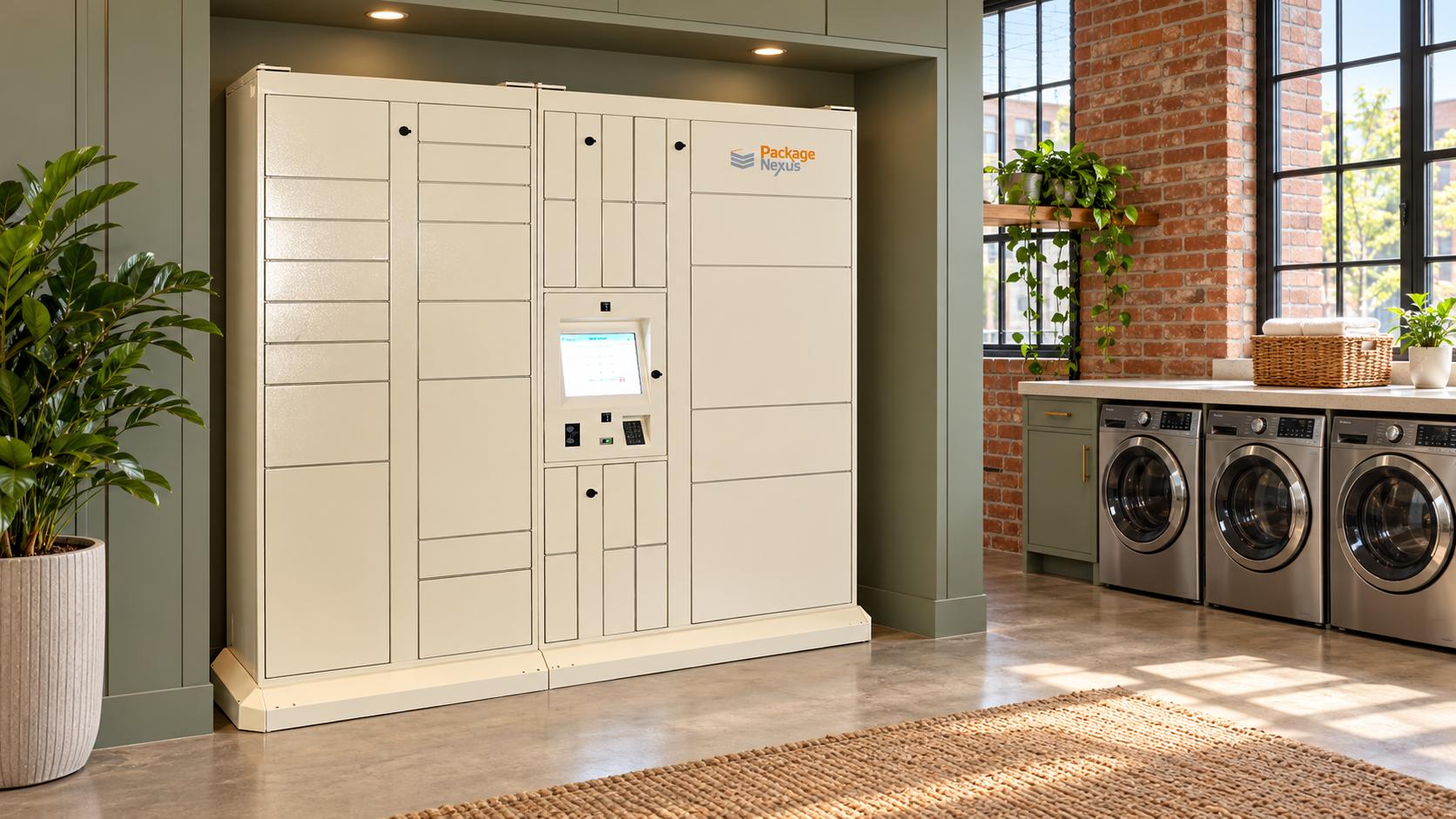
This flexibility supports phased investment. A growing apartment community can add capacity after lease-up, a condominium can respond to changing shopping habits, and student housing can plan for concentrated arrival periods. An Integrated Package Room can provide additional flexibility for bulky parcels and delivery peaks, while a Standalone Package Room can make productive use of suitable existing storage space.
Learn how modular parcel lockers can grow with your community. Capacity planning should consider the number and size of deliveries, how long residents leave packages in storage, and seasonal peaks. Prompt, dependable pickup notifications help residents collect sooner and return compartments to service.
Why a US owned and operated provider matters
Package Nexus is 100% US owned and operated. For organizations that prefer a domestic ownership and operating relationship, that provides a clear point of responsibility for planning, implementation, and ongoing coordination. Buyers can discuss hardware, software, room design, and expansion with a single provider offering the full portfolio.
Ownership and manufacturing origin are separate considerations. The ownership statement should not be interpreted as a claim that every component is manufactured in the United States. Properties should evaluate the proposed equipment, service terms, and project responsibilities alongside the provider’s ownership.
Plan the notification workflow before installation
A reliable system starts with a practical operating plan. Properties evaluating smart parcel lockers for apartments and condos should establish these details before launch.
- Resident records and communications. Define who updates names, units, contact information, and messaging preferences. Review the scope of any property-management integration.
- Carrier access and placement. Provide clear directions to the locker or room, establish delivery access, and align shelf-zone labels with the selected workflow. Use carrier delivery guidance during rollout.
- Proof of transaction completion. Demonstrate deposits, actual removals, small and flat items, timeouts, and omitted responses. Check the resulting status and pickup credentials.
- Network and message delivery. Confirm which local functions remain available during an internet interruption and when queued notifications are sent. A recorded delivery and a message received on a phone are separate events.
- Capacity and special deliveries. Plan overflow, oversized packages, and any refrigerated or other temperature-controlled compartments. Include the resident route and accessibility requirements.
- Support responsibilities. Identify the resident’s first contact and the escalation path for genuine exceptions. Measure staff interventions, missing-notification reports, and time to pickup after launch.
The result should be a package process residents can understand and property teams can operate with less routine involvement. Request a package management consultation to compare Patented On-Auto-Pilot Smart Parcel Lockers, a Standalone Package Room, and an Integrated Package Room for your community.
Frequently asked questions
How do apartment package lockers notify residents
Most electronic package lockers send an automated text, email, or supported app alert after a delivery is recorded. Package Nexus’s published workflow uses text and email with a unique access code and barcode. Those credentials connect the resident to the assigned pickup location, allowing collection without a routine leasing-office handoff.
Are package notifications sent immediately
Notifications are intended to follow the completed delivery workflow promptly. Actual receipt depends on the configured messaging service, connectivity, accurate contact information, and the resident’s email or mobile service. A property should test the complete process during commissioning, including what happens when the locker records a delivery while its internet connection is interrupted.
What should I do if tracking says delivered but I have no locker code
Check for the community’s package notification in both email and text messages, including spam or filtered folders. Confirm that the package was addressed to your registered name and correct unit. If the alert is still missing, follow the property’s package support instructions with your tracking details. A carrier scan alone does not establish a completed locker delivery.
Do residents need a smartphone app to collect a package
Package Nexus describes pickup using an access code or barcode supplied in the delivery message. In a configured code-entry workflow, an app is not the essential step for opening the assigned compartment. The property should explain the supported pickup methods at enrollment and provide guidance for residents who need an accessible or non-app option.
How does the system know a package was actually picked up
Package Nexus uses package sensing and transaction logic to determine the outcome of supported pickup workflows. The system does not need to rely solely on the resident pressing a confirmation button. Checking physical removal helps avoid marking a package collected when it remains inside and helps keep compartment availability consistent with actual use.
Can lockers detect small parcels and flat envelopes
Package Nexus describes its patented sensing technology as detecting large, small, thin, and flat deliveries. This matters because a small item still needs an accurate delivery record and a reliable pickup status. Buyers should demonstrate their representative envelopes and parcels in the proposed configuration and confirm placement guidance and supported detection conditions.
Do Package Rooms provide the same transparency as individual lockers
A Package Room can record entry, delivery information, and selected shelf-zones, with cameras providing additional context. Those features improve accountability, but an access record alone cannot confirm which package someone removed. Individual lockers add restricted compartment access and package-level sensing. Specialized room tracking may add further visibility; its capabilities must be evaluated separately.
How does the Standalone Package Room help residents find packages
The carrier selects a shelf-zone during the delivery workflow, and the parcel is placed in that labeled area. Residents use their pickup code to enter and follow the recorded location information. Clear signs and consistent placement make the room easier to navigate. The zone record supports finding a package, while shared-room investigations may still require access-log or camera review.
Can refrigerated lockers and a Package Room work together
Yes. An Integrated Package Nexus Package Room can combine ambient lockers, refrigerated smart lockers, other temperature-controlled compartments, and room storage under centralized computer management. That gives the property a coordinated process for different delivery types. The selected equipment must match the item’s temperature and handling requirements; ordinary room storage does not provide refrigeration.
Why choose 12 gauge steel instead of 16 or 18 gauge
Within the same material system, 12-gauge steel is substantially thicker. In comparable cabinet designs, that added material improves resistance to bending, dents, and localized deformation. It can support long-term door and latch alignment under frequent use. Security still depends on the complete enclosure, including the lock, hinges, seams, anchoring, and finish.
Can the system expand without replacing the entire installation
Package Nexus’s 100% modular design allows compatible locker modules to be added as demand grows. Properties should reserve space and review power, control capacity, access routes, and installation requirements when planning an expansion. The final addition can address a higher package count, a different compartment-size mix, or other storage needs identified with Package Nexus.
Will property managers still have to handle package problems
On-Auto-Pilot is designed to remove staff intervention for supported routine locker transaction errors by completing or correcting the workflow automatically. Notifications and self-service pickup also reduce daily handoffs. Managers retain responsibility for resident records, site access, maintenance coordination, and unusual incidents. The benefit is fewer recurring package tasks and less active troubleshooting during ordinary operation.

Package Nexus is the global technology leader and provider of The World's Most Advanced Smart Parcel Lockers for efficient and most simplified package management for multifamily communities, retailers, universities, libraries, corporate offices, groceries, and more. Package Nexus unique and patented technology offers a fix for human errors at the time of package deliveries and pickups. Package Nexus solutions help property, store, and office managers to improve their operations, reduce operating costs, and increase customer satisfaction at the same time. Package Nexus offers its entire suite of solutions globally.
USEFUL LINKS

© 2017-2026 Package Nexus