


Package room locker system for condo buildings
A package room locker system for condo buildings combines secure storage, controlled access, resident notifications, and self-service pickup. Package Nexus offers three approaches: individually secured smart parcel lockers, a Standalone Package Room with carrier-selected shelf zones, and an Integrated Package Room that brings lockers and room storage together. The right configuration depends on package sizes, delivery volume, pickup habits, available space, and the association’s operating priorities.
Package delivery should serve the community
Condominium buildings need a dependable way to receive deliveries when residents are away and staff are occupied. A concierge desk covered in cartons, an unlocked storage room, or an improvised delivery table creates uncertainty about where packages belong and who is responsible for each handoff. Owners expect a convenient amenity; boards need an investment that remains useful as demand changes.
Package Nexus smart parcel lockers for apartments and condos move routine delivery and pickup into an organized, computerized process. Residents can collect packages on their own schedules, subject to building access hours. Staff can spend more time on resident service, maintenance coordination, and property operations. Patented On-Auto-Pilot technology addresses common locker delivery and pickup errors automatically, while 100% modular hardware gives the community a practical path to expansion.
Choose the right mix of lockers and room storage
The phrase package room locker system can describe a locker bank, a controlled package room, or both. These configurations solve different storage problems. Start with the building’s actual delivery mix and decide which parcels need individual compartment protection, which need flexible shelf space, and which need a dedicated temperature-controlled environment.
Smart parcel lockers
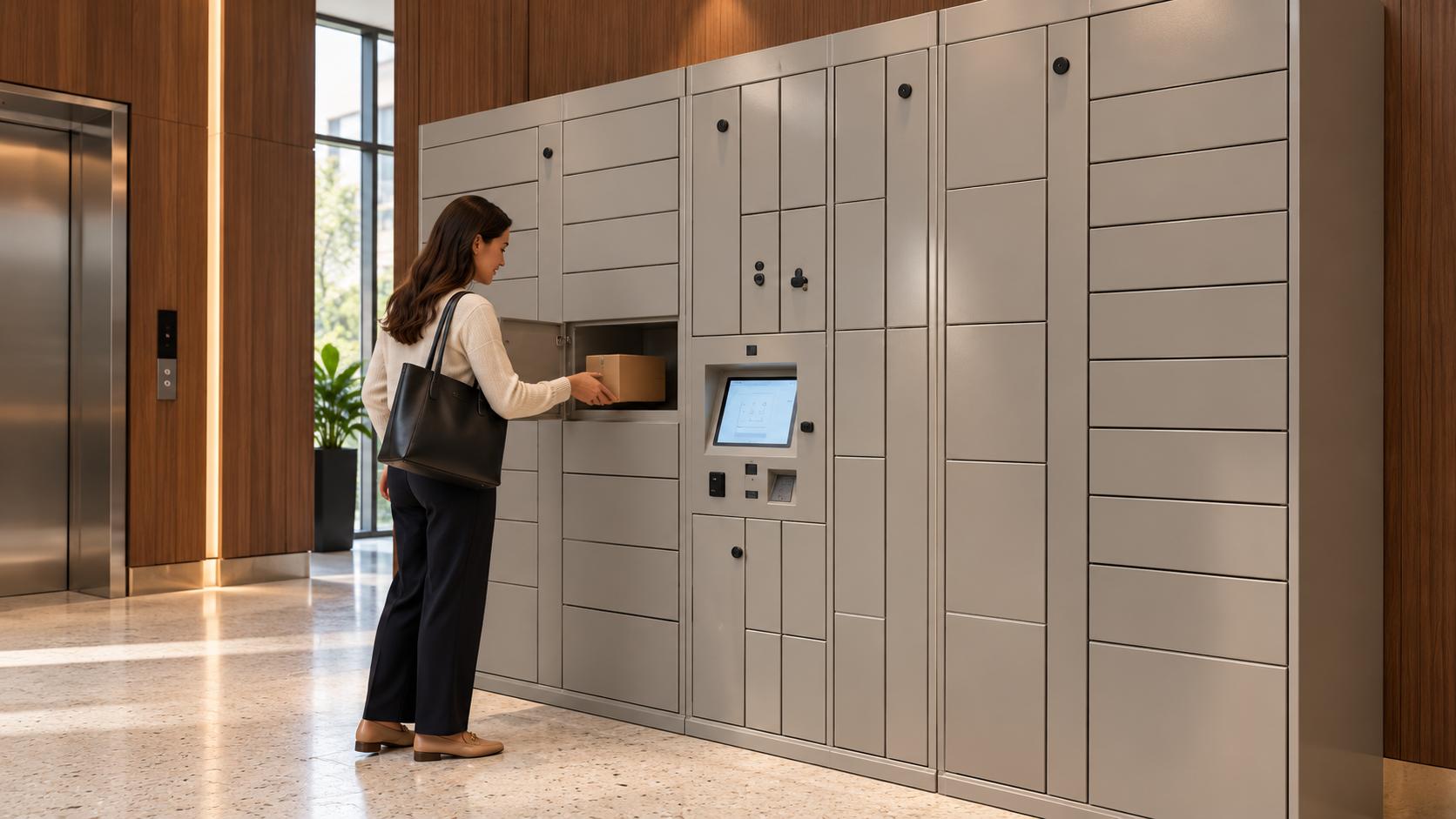
Package Nexus indoor parcel lockers place deliveries in separate electronically locked compartments. A resident uses an authorized pickup credential to open the assigned compartment. This arrangement is useful when the association wants separation between residents’ packages and a clear, repeatable pickup process. Different compartment sizes accommodate a mix of cartons, small items, and flat parcels; the final layout should reflect measured demand.
Standalone Package Room
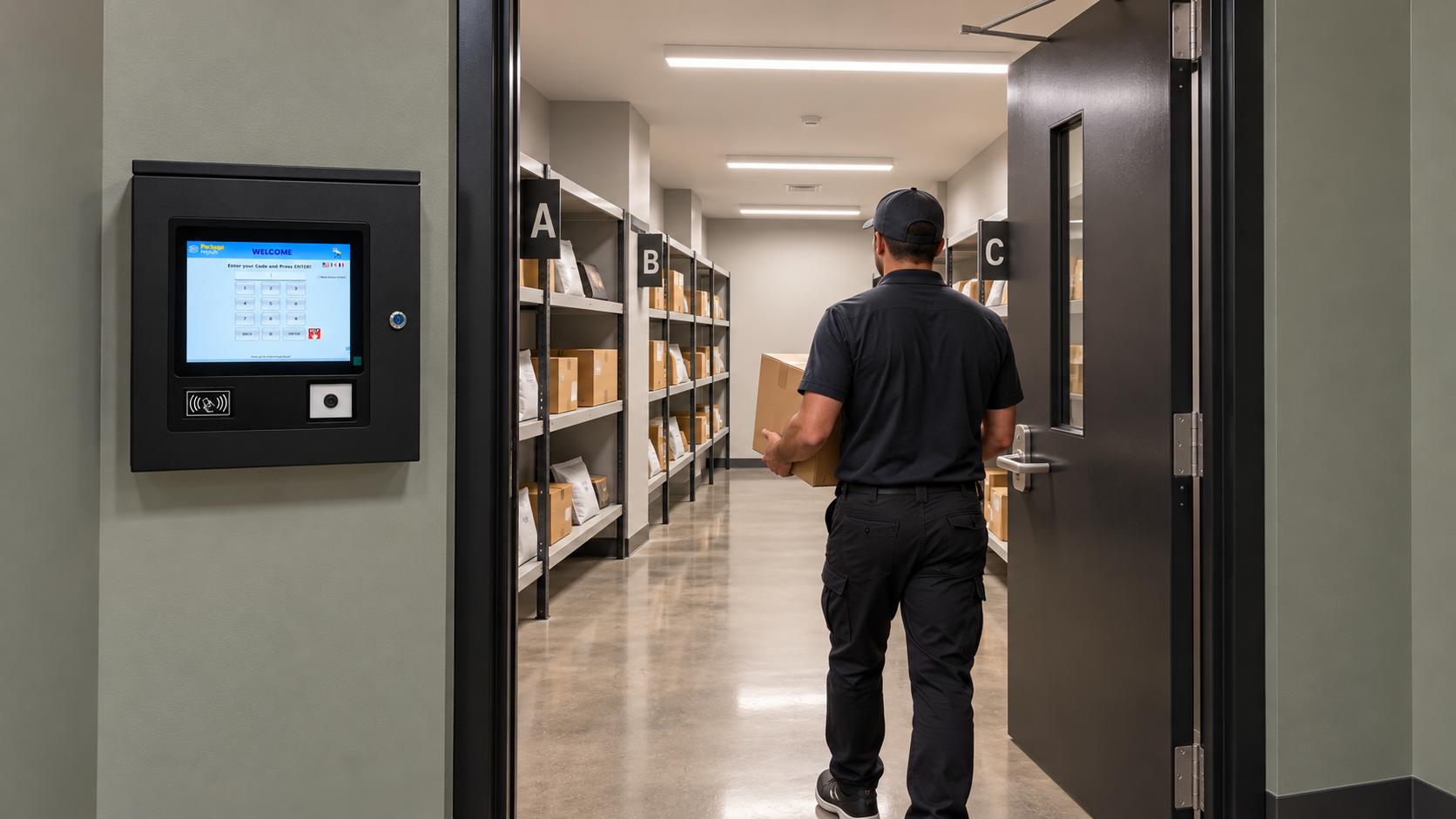
The Package Nexus Standalone Package Room converts a suitable room into a computerized delivery destination. A computer outside the entrance controls access for carriers and residents. During delivery, the carrier chooses a shelf zone and places the package there. The resident receives a unique pickup code and can find the delivery in its designated area.
This is a practical option when a building has usable room space but limited space or budget for a full locker installation. Shelving can accommodate varied package dimensions, while an appropriate floor area can handle approved bulky items. The exterior terminal’s embedded camera captures a photo of the person entering; optional interior cameras and large monitors extend room visibility.
Integrated Package Room
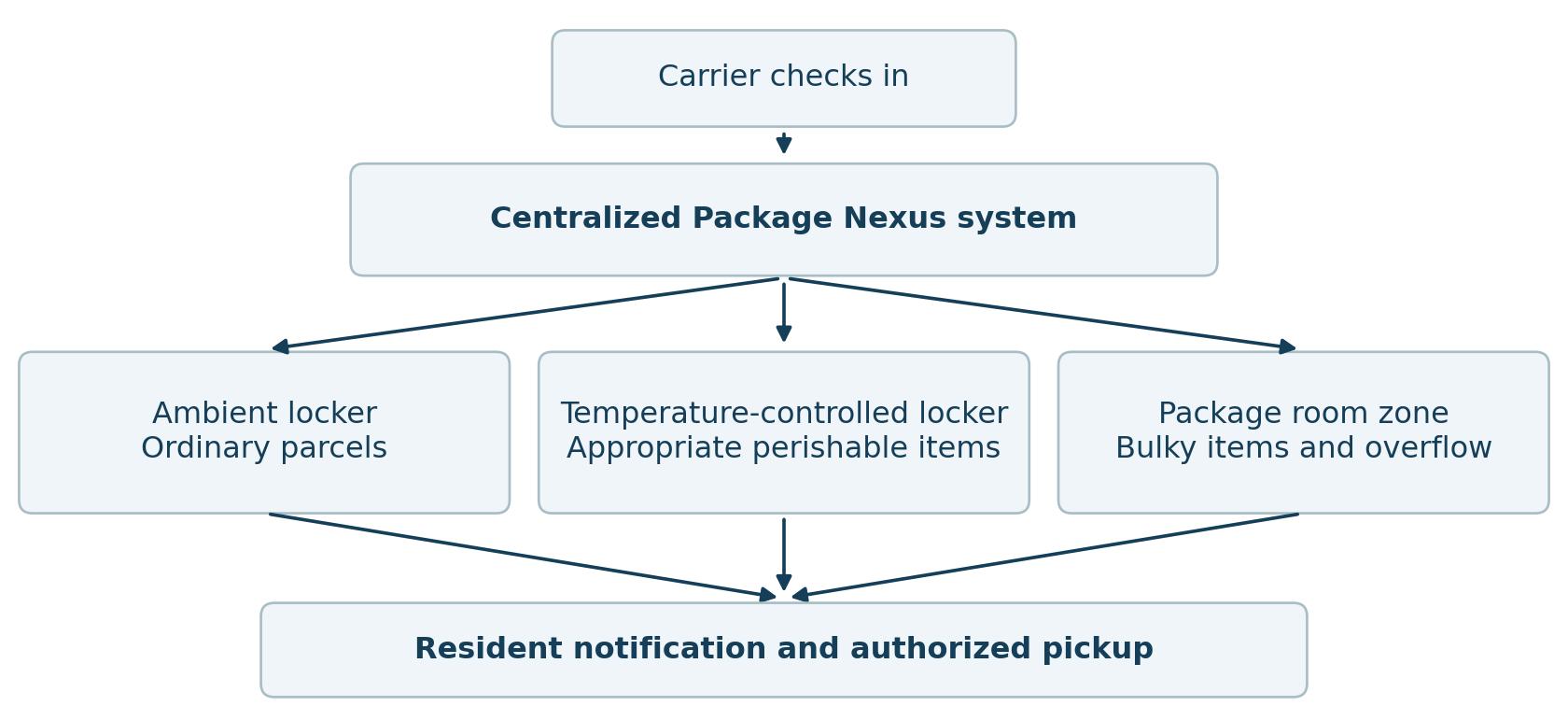
A Package Nexus Integrated Package Room combines ambient smart lockers, refrigerated or other temperature-controlled lockers, and room storage under a centralized computer system. Ordinary parcels can use individual compartments, appropriate perishable deliveries can use dedicated temperature-controlled storage, and oversized or overflow deliveries can use the room.
This combination is particularly useful when the association wants one coordinated package management solution for several delivery types. The room complements the locker bank, giving the building an organized alternative when a carton does not fit a compartment or seasonal demand consumes the available locker capacity.
| Decision Factor | Smart Lockers | Standalone Room | Integrated System |
|---|---|---|---|
| Storage protection | Individual locked compartments | Controlled entry to shared storage | Individual compartments plus room access |
| Package placement | Assigned compartment | Carrier-selected shelf zone | Appropriate locker or room zone |
| Strongest fit | Routine parcels and separated storage | Mixed sizes and suitable existing room | Mixed deliveries and planned overflow |
| Expansion path | Add compatible modules | Add usable storage within room limits | Expand lockers and room capacity |
| Perishable deliveries | Specify dedicated modules | Ordinary shelves are ambient | Specify refrigerated, freezer, or heated modules |
How condo delivery and pickup work
A useful system connects the person receiving a package with a specific storage destination. The building’s delivery instructions should tell carriers where to enter, how to find the terminal, and what to do with an item that cannot be accepted.
- The carrier reaches the designated delivery point. Place clear directions at the approved carrier entrance. Building access and package access should work together so a driver can reach the system without searching for staff.
- The delivery is assigned to the recipient and storage location. At a locker, the workflow directs the package to an appropriate compartment. In the Standalone Package Room, the carrier uses the exterior computer and selects the delivery zone. Accurate resident names and unit numbers are essential.
- The package is placed and the delivery is recorded. Locker sensors provide feedback about package presence and retrieval. Room delivery follows its configured access and zone workflow. The notification should correspond to the recorded delivery and its actual destination.
- The resident receives pickup instructions. The enabled notification channel supplies the pickup credential and relevant location information. Configure and test text or email delivery, resident contact information, and the instructions for households receiving multiple packages.
- The resident collects the delivery independently. The authorized credential opens the assigned locker or permits entry to the room. Locker sensing supports pickup verification; room access records and any configured cameras support activity review. An entry photo alone does not prove which shelf item was collected.
Why patented On Auto Pilot matters to condo staff
A locker can automate notifications yet still generate work if its records depend on users correctly answering every confirmation prompt. A driver may leave before finishing a transaction, or a resident may open a door without removing the parcel. If the system records the wrong outcome, someone has to investigate the mismatch.
Package Nexus patented On-Auto-Pilot technology combines sensor feedback with automated workflows to identify and correct supported delivery and pickup errors as they occur. Published examples include completing a delivery after a workflow timeout and recognizing when a package remains in a compartment after the resident opens it. These capabilities remove the routine troubleshooting associated with those supported situations from the site manager’s workload.
For a condo association, the benefit is fewer interruptions to the concierge desk and less time reconstructing what happened at the kiosk. It also supports a clearer experience for a resident who needs the system to reflect the actual package status.
Evaluate this advantage in a live demonstration. Ask to see a small flat parcel, a timed-out delivery, and a compartment opened without package removal. Observe what the system records, what the resident receives, and whether staff action is required. Routine automation should be demonstrated separately from physical repairs, network service, and exceptions outside the configured workflow.
Expand as the community and package volume grow
Package Nexus lockers are 100% modular and can be expanded at any time as the community or its package volume grows. A board can establish the initial configuration around current demand and plan additional compatible modules for future phases. This makes expansion part of the original investment strategy.
Growth does not require more homes. The same building may receive more deliveries because residents order more frequently, groceries arrive in separate shipments, or pickup takes longer during travel periods. Plan for both higher volume and a changing package-size mix.
Reserve a realistic expansion area, identify electrical and network needs, and confirm how future modules will connect to the existing system. Physical expansion still depends on usable space, access, installation requirements, and the final equipment plan. A package room can provide a complementary route for oversized items and peaks while the association evaluates additional lockers.
Size the system around packages waiting for pickup
The number of condo units is a starting point, but storage demand depends on how many packages arrive and how long they remain. Review several representative weeks of deliveries, including busy periods. Separate small parcels, standard cartons, bulky items, and temperature-sensitive deliveries so one category does not hide a shortage in another.
A useful first approximation is daily parcel arrivals multiplied by average time to pickup, measured in days. The examples below show why pickup behavior changes the amount of occupied storage. They are planning illustrations, not a recommended compartment count or an industry benchmark.
| Illustrative Condition | Parcels per Day | Average Time to Pickup | Estimated Parcels in Storage |
|---|---|---|---|
| Ordinary demand | 60 | 1.5 days | 90 |
| Faster collection | 60 | 0.75 day | 45 |
| Busy period with slower pickup | 90 | 2 days | 180 |
Convert these estimates into a configuration only after reviewing compartment sizes, eligible package types, any supported consolidation rules, accessible compartments, and a realistic buffer. A parcel position is not necessarily one locker compartment. Daily averages also hide concentrated arrival waves, so stress-test the proposed layout against the building’s busiest delivery window.
Clear pickup reminders and a workable policy for long-held packages can release capacity. Modular expansion addresses a lasting increase in demand; a planned room overflow route addresses parcels that cannot use the available compartments.
Build security around the complete delivery path
Security begins at the building entrance and continues through storage and pickup. Electronic compartment locks and recipient-specific credentials provide a controlled handoff. Keeping parcels behind a secured boundary reduces exposure compared with unattended packages in a public lobby.
A shared package room has a different security model from individual lockers. Once an authorized person enters the room, other residents’ packages may be physically reachable. Clear shelf zones, controlled credentials, appropriate camera coverage, and visible operating instructions support accountability, but room entry control does not create an individual lock around every parcel.
Use the locker and room combination to match protection to the package mix. Position cameras to support the chosen workflow, limit access to records to designated personnel, and define how long records are retained. An entry photo identifies a moment of access; interior coverage can provide additional context when the property chooses that option.
Make door closure, lighting, and orderly storage part of the operating plan. Keep delivery routes clear and prevent parcels from obstructing circulation. No system makes theft or misuse impossible, so the building should provide a clear support route for missing items and damaged equipment.
Hardware and software details that support daily use
Published Package Nexus features provide a useful starting point for the condo’s equipment schedule. Confirm the included components, options, dimensions, and installation requirements for the quoted configuration. Select indoor equipment for suitable interior conditions and outdoor parcel lockers when the delivery point is exposed to the weather.
| Published Feature | Practical Benefit for a Condo |
|---|---|
| 12-gauge steel and galvanized construction | A durable enclosure for repeated delivery and pickup use. |
| Industrial-grade fanless computer | Dedicated local computing for the locker workflow. |
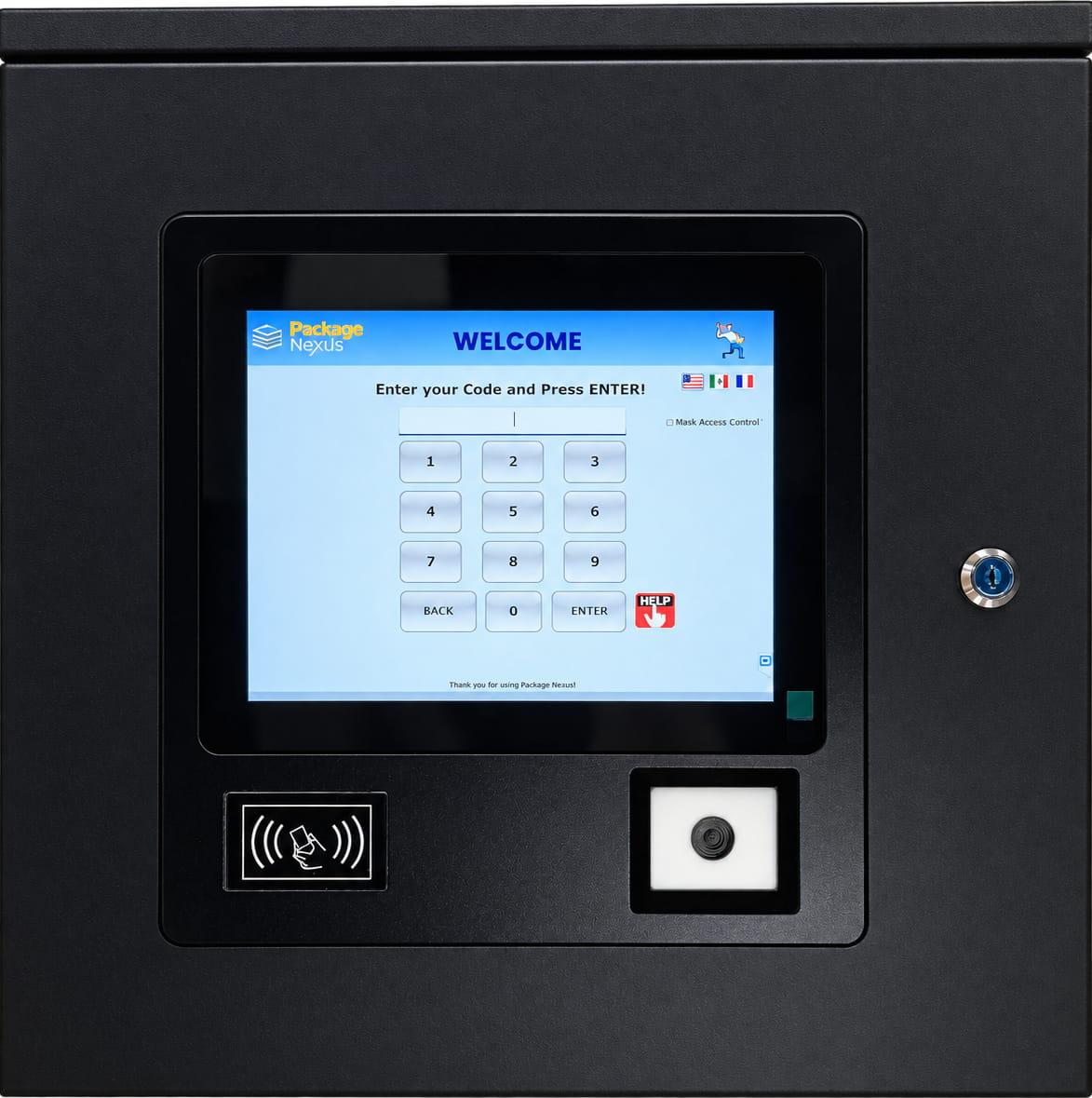
| 15-inch touchscreen | A visible shared interface for carriers and residents. |
| Honeywell 3320G barcode scanner | Dedicated scanning hardware for supported codes. |
| Package sensing including small and flat items | Feedback for delivery and retrieval verification. |
| Computer-controlled electronic locks | Authorized access to assigned compartments. |
| Braille keypad and audio prompts | Additional interaction methods in the specified setup. |
| Compartment LED lighting and camera options | Visibility for package handling and activity review. |
| Local database and cloud-connected management | Local operation capability during an internet interruption; confirm available functions. |
| Property-management integration capabilities | A coordinated recipient-data workflow when the integration is configured. |
Provide the right destination for groceries and special deliveries
Package Nexus temperature-controlled smart lockers include refrigerated, freezer, and heated options. A condo can specify the appropriate modules alongside ambient lockers and room storage, giving carriers a defined destination for eligible temperature-sensitive deliveries.
Ordinary package-room shelving and ambient lockers do not refrigerate deliveries. Define accepted items, storage settings, monitoring responsibilities, cleaning, and pickup expectations for any temperature-controlled installation. Select the equipment around the actual delivery service and product requirements; specialized storage does not correct mishandling that occurred before arrival.
Give condo boards a clear operating and financial case
A board should evaluate the system’s total cost over its intended service life. Include equipment, delivery and installation, site preparation, electrical and network work, recurring software or support charges, camera options, maintenance, and future expansion. Compare proposals using the same package volumes and service assumptions.
Labor value is easiest to understand through a measured baseline. Record how much time staff spend receiving, recording, locating, and handing out packages, then identify which tasks the proposed workflow removes. Include exception handling in the demonstration; a system that accepts a delivery smoothly can still create work later if pickup records are inaccurate.
For illustration, 60 daily packages requiring three minutes of total manual attention each represent three staff hours per day. If a proposed workflow removes 80% of that work, it releases 2.4 hours daily. At an assumed loaded labor cost of $30 per hour over 365 days, that is $26,280 of annual staff-time value. These inputs are hypothetical. Recovered time becomes payroll savings only when staffing costs actually change; otherwise, its value lies in capacity for other work.
Owners may also value dependable pickup, a more orderly lobby, and fewer trips to the front desk. Present these as service improvements. Do not assume a specific increase in resale prices or a guaranteed reduction in association dues. For a broader purchasing discussion, review how smart lockers reduce property management costs.
Match the configuration to the condo building
A smaller building with an existing storage room
A Standalone Package Room may be a practical starting point when a suitable room already exists. Place the access terminal outside, label shelf zones clearly, and reserve an area for approved bulky deliveries. Compare the complete room fit-out cost with a compact locker configuration before deciding.
A tower with a busy concierge desk
A modular locker bank can take routine handoffs away from the front desk. An integrated room can absorb oversized items and approved overflow. Locate the delivery point along the carrier route while keeping resident pickup convenient and circulation clear.
A community growing in phases
Plan the first installation with future compatible modules and delivery routes in mind. Review whether one central location remains convenient as additional buildings open. Capacity growth should preserve an understandable pickup experience, not simply add storage wherever a wall becomes available.
Plan an orderly launch and simple ongoing management
Start with a site review covering room or locker dimensions, delivery access, the route from unloading to storage, power, connectivity, door operation, lighting, and accessible use. Evaluate the complete resident journey, including reach, turning space, screen interaction, and package retrieval. Accessible hardware is one part of a usable installation.
Before launch, establish who maintains resident and unit records, who can view activity information, and how residents contact support. A condominium may contain owner-occupied units, rented units, seasonal residents, and multi-person households; its recipient directory needs to reflect who actually receives deliveries.
Test real carrier labels, a small envelope, a large carton, a notification, and an authorized pickup. Where an integration is planned, confirm the actual data fields, update frequency, move-out handling, and service responsibilities. For connectivity interruptions, demonstrate which local delivery and pickup functions remain available and how delayed messages and records are handled after reconnection.
After launch, review storage occupancy, long-held packages, oversized deliveries, and support requests. Use these observations to adjust the compartment mix, room layout, resident communications, or expansion timing. A clear process helps the automation deliver its intended benefit.
Why choose a US owned and operated technology provider
Package Nexus is 100% U.S.-owned and operated. For condo associations seeking a domestic technology partner, that offers a clear relationship with the company responsible for the solution and its ongoing development. Package Nexus combines that ownership model with patented automation, configurable storage, and support for both locker and package-room workflows.
The purchasing advantage comes from the complete fit: a system that serves residents, reduces routine staff intervention, and can expand as demand changes. Ask for the support arrangements, included services, warranty, and future expansion scope in the proposal so the board can evaluate the long-term relationship alongside the equipment.
Plan a Package Nexus solution for your condo
Bring Package Nexus the building’s unit count, typical and peak package activity, common package sizes, pickup patterns, available dimensions, and any grocery or oversized-delivery needs. A useful consultation should compare the locker, Standalone Package Room, and integrated approaches against those requirements.
Request a condo package management proposal and a live demonstration of On-Auto-Pilot handling. See how the system responds to incomplete deliveries and pickup mistakes, how residents receive access instructions, and how compatible modules can be added later. Package Nexus can help the association create a more convenient delivery amenity with a practical plan for growth. Explore additional Package Nexus resources as the board develops its requirements.
Frequently asked questions
What is a package room locker system for condo buildings
It is a coordinated way to receive, store, and release residents’ deliveries using computerized access and pickup instructions. A building can use individual smart lockers, a controlled package room, or an integrated arrangement. The best configuration depends on the package mix, available space, security priorities, and the amount of staff involvement the association wants to remove.
Are package lockers or a package room better for condos
Individual lockers are a strong fit when the board prioritizes separately secured compartments and a defined pickup location for each delivery. A room offers flexible storage for mixed sizes and bulky items. An integrated system combines these benefits. Assess the building’s actual needs before choosing; neither approach is universally best for every condominium.
Can Package Nexus lockers be expanded later
Yes. Package Nexus lockers are 100% modular and can be expanded as the community or delivery volume grows. Plan for future compatible modules when choosing the initial location, and preserve the necessary space, access, power, and connectivity. Expansion can then follow measured demand rather than requiring the association to guess its eventual maximum needs at the outset.
How does the Standalone Package Room help residents find deliveries
The carrier uses the computer outside the room and selects a delivery zone. The parcel is placed in that area, and the recipient receives a unique pickup code. Clearly labeled shelves make the selected zone easy to find. The physical labels and configured zone names should match so the location remains useful to residents.
What does the Integrated Package Room include
The Package Nexus Integrated Package Room can coordinate ambient smart lockers, refrigerated or other temperature-controlled lockers, and a Smart Package Room through a centralized computer system. The quoted configuration determines which modules and room features are included. This lets a condo serve ordinary parcels, appropriate perishable deliveries, and bulky or overflow items within one coordinated solution.
Does On Auto Pilot remove the need for routine troubleshooting
On-Auto-Pilot is designed to prevent and automatically resolve supported user errors in locker delivery and pickup, removing the routine staff troubleshooting those errors would otherwise create. Ask to see the relevant scenarios in a live demo. Hardware damage, power or network problems, and issues outside the configured workflow still need an appropriate service response; an open physical door still needs to close.
Can residents collect packages outside office hours
Yes, self-service pickup can be available around the clock when the building permits access to the locker or room location. Confirm the complete route, including exterior doors, elevators, and any restricted areas. A 24-hour locker does not provide after-hours access if the building locks the only route to it.
Will the system work for all delivery carriers
Package Nexus supports a carrier-neutral package workflow for authorized deliveries. The community should coordinate carrier entry, signage, recipient names, and any item restrictions before launch. Demonstrate the labels and delivery routines used at the property. A parcel system does not replace the building’s ordinary mail arrangements or override a carrier’s own delivery requirements.
How many compartments does a condo need
Use daily arrivals, peak demand, time to pickup, and package dimensions to estimate storage requirements. Unit count alone is insufficient. A building receiving the same number of parcels can need very different capacity if residents collect within hours instead of days. Include appropriate room storage, accessible compartments, and an expansion plan in the final design.
Is a controlled package room as secure as an individual locker
The protections differ. A locker limits physical access to an assigned compartment. A room limits entry to a shared storage area, where other packages may remain within reach. Access records, entry photos, optional interior cameras, and clear procedures improve accountability. Choose the mix that matches the association’s package-security expectations.
Can a condo use the system for grocery deliveries
Yes, when the project includes suitable refrigerated, freezer, or heated modules for the accepted delivery types. Ambient lockers and ordinary room shelves do not provide those functions. Plan the operating settings, cleaning, monitoring, and pickup expectations with Package Nexus and the delivery service, and confirm which deliveries the building will accept.
What happens during an internet interruption
Package Nexus publishes a local database capability for standalone locker operation during internet outages. Available actions depend on configuration, stored information, credentials, and power. Confirm the delivery and pickup behavior in a demonstration, including any notification delays and synchronization after connectivity returns. Do not assume every cloud-connected feature remains available offline.
Can an existing condo building install a system
Yes, a retrofit may use an appropriate lobby, mailroom, garage location, or existing room. The site review should confirm physical dimensions, installation access, power, connectivity, circulation, door operation, and accessible use. A Standalone Package Room is especially worth evaluating when an existing room can be adapted to the intended workflow.
What should the association request in a quote
Ask for the compartment and room layout, included hardware and software, integration scope, installation responsibilities, recurring charges, support arrangements, warranty, and expansion options. Request demonstrations of ordinary deliveries and exception handling. Compare the full installed and operating scope so the board can judge the long-term value of each proposed configuration.

Package Nexus is the global technology leader and provider of The World's Most Advanced Smart Parcel Lockers for efficient and most simplified package management for multifamily communities, retailers, universities, libraries, corporate offices, groceries, and more. Package Nexus unique and patented technology offers a fix for human errors at the time of package deliveries and pickups. Package Nexus solutions help property, store, and office managers to improve their operations, reduce operating costs, and increase customer satisfaction at the same time. Package Nexus offers its entire suite of solutions globally.
USEFUL LINKS

© 2017-2026 Package Nexus