


Why are apartment communities installing smart parcel lockers
Apartment communities are installing smart parcel lockers to protect deliveries, give residents convenient pickup access, and free property teams from receiving, sorting, and distributing packages. Package Nexus adds a further operational advantage: patented On-Auto-Pilot technology detects and resolves common delivery and pickup errors automatically. Communities can choose individual lockers, a controlled-access Package Room, or a combination that accommodates their space, package sizes, and delivery volume.
For owners and managers, the opportunity extends beyond adding another amenity. A well-planned package system can reduce daily interruptions, improve the resident experience, keep common areas organized, and make package operations easier to scale. The most valuable solution handles both everyday deliveries and the mistakes that would otherwise send residents and couriers to the leasing office.
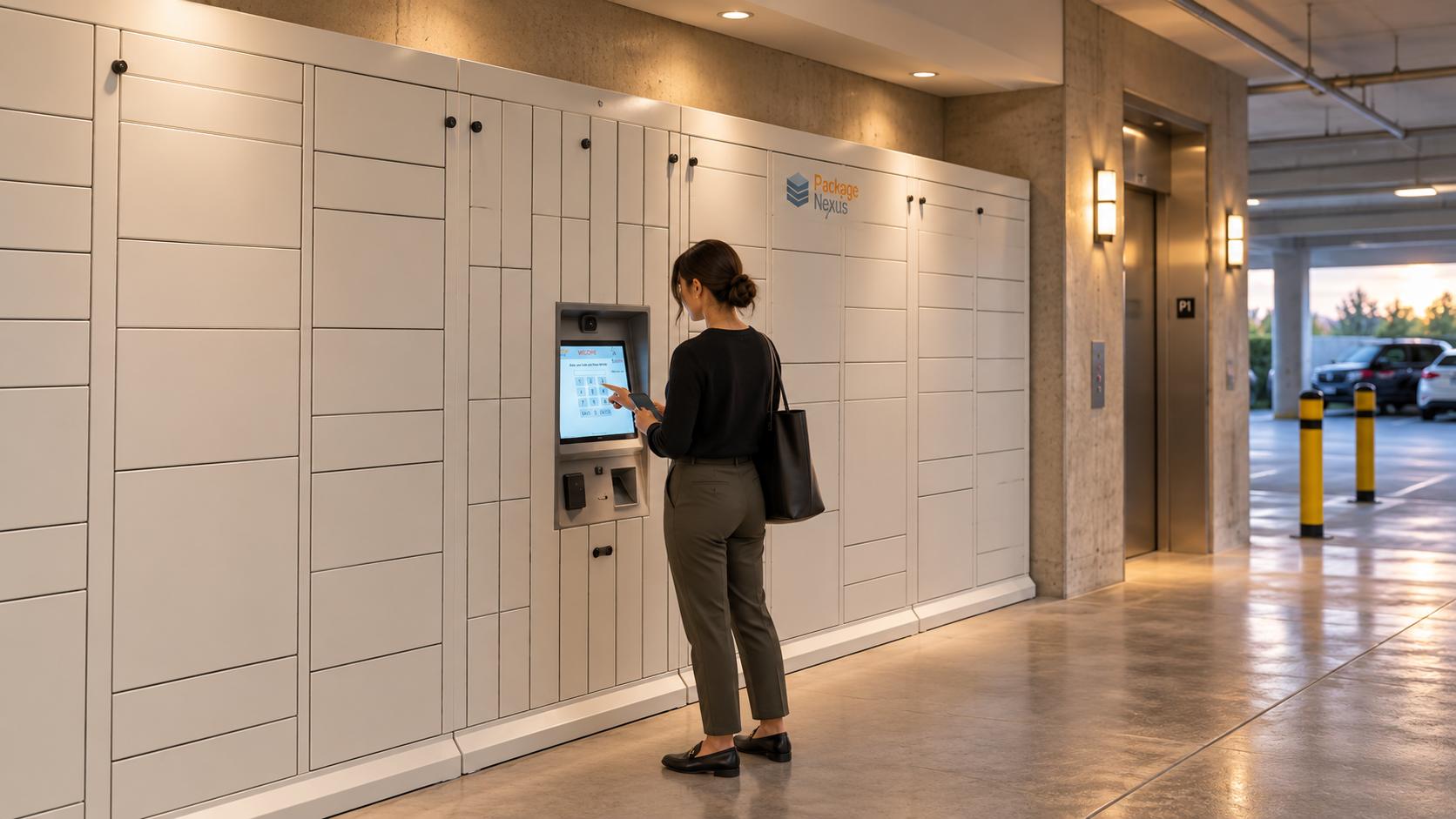
What smart parcel lockers do for an apartment community
A smart parcel locker is an electronically controlled storage system that connects a delivery to an authorized recipient. A carrier follows the delivery workflow, deposits a package in a suitable compartment, and closes the door. The system records the delivery and sends pickup information. The resident then uses the authorized code or barcode to retrieve the package independently.
Package Nexus smart parcel lockers for apartments and condos combine this self-service process with patented sensors and software that verify package activity. Staff do not need to stand between the carrier and resident for every handoff. Where the property permits access around the clock, residents can collect deliveries outside leasing-office hours.
The reasons apartment communities are making the investment
More time for leasing and resident service
Manual package handling creates repeated small tasks: receiving boxes, finding shelf space, maintaining logs, notifying residents, checking identification, and searching for individual parcels. Those tasks interrupt tours, prospect calls, maintenance coordination, and resident conversations. Automation removes the need for staff to perform the routine handoff and notification work for each package.
The value includes the ability to finish work without repeatedly stopping to answer the door or locate a delivery. A community can redirect that capacity toward faster responses, better tours, and more attentive resident service. Track the recovered time rather than assuming that every saved minute becomes a payroll reduction.
Pickup that fits residents’ schedules
Residents working evening shifts, commuting, traveling, or caring for family members may be unable to visit the leasing office during business hours. Self-service pickup gives them a dependable way to collect packages when they return home. A delivery notification also removes uncertainty about whether a parcel is ready for collection.
This convenience is useful every week. It can strengthen the community’s amenity offering because residents experience the benefit directly, without making an appointment or arranging a staffed handoff. Actual pickup hours depend on access to the building and the locker location.
Less exposure to package theft and tampering
Deliveries left on doorsteps or open shelving are accessible to anyone who reaches them. Individual locker compartments put a locked physical barrier around each stored delivery. Authorized pickup credentials, transaction records, cameras, and package sensing provide additional layers of accountability.
Package Nexus secure electronic parcel lockers help communities establish a controlled delivery destination. Security also depends on site access, installation, resident practices, and the selected equipment. The useful promise is better protection and visibility, rather than a guarantee that no incident can ever occur.
Fewer package questions and stronger accountability
When a delivery record and the physical package do not match, staff may spend time opening compartments, contacting the carrier, or trying to reconstruct events. Reliable sensing and transaction records reduce ambiguity about whether a package was deposited or removed. Photo capture can provide additional context when an authorized review is necessary.
Preventing these mismatches protects the resident experience as well as staff time. Residents should be able to use their pickup information with confidence, and property teams should have a defined process for the exceptional questions that remain.
Cleaner common areas and more useful space
A designated package destination keeps deliveries from spreading into reception areas, desks, and circulation routes. Modular locker banks can organize storage vertically, while a Package Room can make practical use of an existing room for a varied package mix. The right layout helps preserve a professional arrival experience for residents and prospective renters.
Space planning should include open doors, carts, people waiting, and residents carrying bulky items. A successful installation provides storage capacity while maintaining comfortable access and clear circulation.
A visible amenity that supports leasing and retention
Package convenience is easy to demonstrate during a tour. A leasing team can show where deliveries arrive, explain how residents are notified, and demonstrate independent pickup. That is more persuasive than an amenity list that does not explain everyday value.
Reliable package service may support resident satisfaction, favorable reviews, and lease renewal decisions. It can also strengthen a property’s competitive position. The financial effect will vary by market and execution; higher rents, occupancy, and property values should be evaluated with the community’s own results rather than assumed.
Capacity for holiday peaks and changing delivery habits
Communities need room for both normal daily volume and concentrated arrivals during holidays, move-ins, and major shopping events. Locker capacity can be planned through a mix of compartment sizes, compatible modular expansion, and a separate route for oversized items. A Package Room can complement lockers when the package mix or available space calls for flexible storage.
Faster pickup can also release capacity sooner. Notifications and convenient access help residents collect promptly, while usage information reveals whether the limiting factor is total storage, the number of large compartments, or packages remaining uncollected.
Easier delivery routes for carriers
A clearly identified delivery point reduces the need to search for a staff member or navigate multiple residential floors. Simple instructions, working building access, and an intuitive kiosk make it easier for carriers to use the designated workflow consistently. Package Nexus supports deliveries from major carriers; the property should communicate its delivery location and access procedures during rollout.
Consolidated delivery may also reduce unsuccessful handoffs and unnecessary repeat visits. The environmental effect depends on actual delivery routes and equipment use, so communities should measure outcomes before making quantified sustainability claims.
How patented On Auto Pilot technology removes routine troubleshooting
Package Nexus’s patented On-Auto-Pilot technology addresses a critical source of work that can remain after lockers are installed: user errors during delivery and pickup. A workflow that depends on a carrier or resident answering a confirmation question correctly can create inaccurate records when someone makes a mistake, walks away, or allows a session to time out.
Package Nexus combines patented package sensors with intelligent software to verify physical activity. The system does not simply assume that a pickup occurred because someone entered a code, and it does not rely on a resident’s yes-or-no answer to establish that the package was removed. Its published capabilities include sensing small and flat items and completing supported transactions after a timeout.
For the common user-error scenarios that it detects and resolves automatically, On-Auto-Pilot eliminates the need for site managers to troubleshoot the transaction. Staff do not have to remain actively involved in routine recovery, repeatedly visit the lockers, or reconstruct the same preventable mistakes. This is a central reason to evaluate Package Nexus when a community wants package operations to run independently.
| Delivery or Pickup Scenario | Package Nexus Response | Operational Benefit |
|---|---|---|
| A carrier deposits a package but the session times out | Sensor feedback and software can complete the supported unfinished delivery | Avoids a routine staff visit to reconcile that transaction |
| A resident enters a code without removing the parcel | Package removal is verified rather than inferred from code entry | Helps preserve an accurate pickup status |
| A user would otherwise give an incorrect completion answer | The workflow relies on sensed activity instead of a yes-or-no confirmation | Removes that source of recordkeeping error |
| A small parcel or flat envelope is placed in a compartment | Published sensor capabilities include small and flat items | Extends verification beyond large boxes |
| A transaction is interrupted or a door remains open | The system detects the incomplete condition and applies the supported recovery workflow or guidance | Reduces ambiguity and avoidable intervention; it does not physically close the door |
This distinction is especially useful when comparing systems. Ask to see live demonstrations of interrupted deliveries, small-item detection, and pickups that are not completed as expected. Evaluate the workflow’s response and the staff steps it requires. A support telephone number is useful, but preventing a support incident also protects time and convenience.
On-Auto-Pilot addresses transaction errors; a property still maintains its facilities, resident information, power, connectivity, and physical equipment. A package left outside the designated system or a damaged door requires an appropriate response. Package Nexus’s approach to reducing delivery errors focuses on preventing recurring operational problems before they become staff tasks.
Choosing lockers a Package Room or a combined solution
The best configuration follows the community’s delivery pattern. Individual lockers provide compartment-level separation. Package Rooms provide controlled entry to flexible shared storage. A combined installation can give everyday parcels individual protection while providing another destination for bulky deliveries and peaks.
| Solution | Particularly Useful When | Planning Priority |
|---|---|---|
| Indoor smart parcel lockers | A community has a suitable interior delivery area | Resident access hours, compartment mix, circulation and installation route |
| Outdoor smart parcel lockers | Interior space is limited or a convenient exterior delivery point is available | Site-rated equipment, drainage, exposure, lighting and power |
| Standalone Package Room | An existing room can support controlled delivery and pickup | Door access, zones, shelving, camera coverage and clear pathways |
| Lockers with an integrated Package Room | Everyday parcels need separate compartments while other items need flexible space | A clear carrier workflow for lockers, oversized items and overflow |
Indoor and outdoor lockers
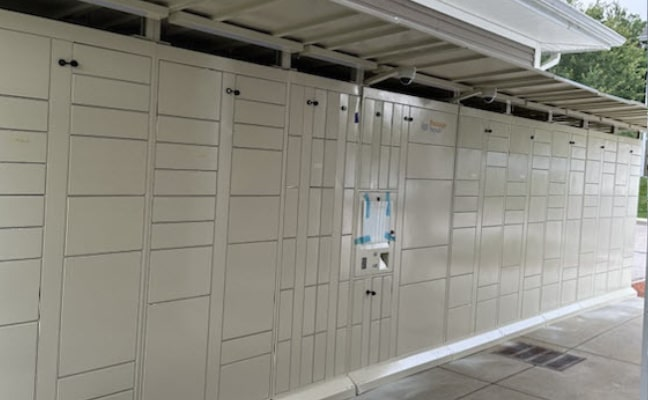
Package Nexus indoor parcel lockers can serve communities with an appropriate interior delivery area. Outdoor parcel lockers can preserve interior floor space and place pickup closer to residents’ usual routes. Final placement should consider weather exposure, resident walking distance, carrier access, and equipment serviceability.
An outdoor installation is a particularly practical option for a garden-style property with several buildings. A high-rise may benefit from a centralized interior installation near a natural arrival point. These are planning examples, not claims about results at a specific property.
The Package Nexus Standalone Package Room
The Package Nexus Standalone Package Room places the access computer outside the room by the entrance. Carriers use the exterior computer to enter the delivery workflow and select a delivery zone. Residents receive a unique pickup code and enter to collect their packages from the designated area.
The exterior computer’s embedded camera takes a photo of the person entering. Optional interior security cameras and large monitors can extend visibility inside the room. Clearly labeled zones, appropriate shelving, and a planned area for bulky cartons help carriers place deliveries consistently and make collection easier.
A room can reduce the need for staff to admit carriers, coordinate resident pickup, or serve as the routine package handoff point. Its access records and entry photos support accountability. Shared shelves do not provide the same individual physical separation as locked compartments, and the room should not be described as automatically detecting every item on an open shelf.
A combined approach for oversized deliveries and overflow
An integrated Package Room solution can complement lockers when deliveries regularly exceed the available compartment sizes. Large cartons and irregular items can have a designated destination instead of returning to the leasing office. Capacity still depends on the room’s dimensions, shelving, circulation, and operating rules.
Where grocery deliveries are a priority, Package Nexus offers temperature-controlled lockers, including refrigerated, freezer, and heated configurations. These are distinct equipment options. An ambient locker or ordinary Package Room does not provide refrigeration, and the selected temperature settings and handling procedures must suit the intended items.
Package Nexus features that support apartment operations
Hardware quality and workflow design determine how well a package system supports repeated daily use. The following features are described in Package Nexus’s published product and comparison materials. The project quotation should confirm the selected hardware, options, integration scope, and installation requirements.
| Feature or Specification | What It Contributes to the Community |
|---|---|
| Patented package sensing | Verifies deposit and removal, including small and flat parcels |
| Heavy-duty 12-gauge steel | Provides a substantial enclosure for daily use and physical protection |
| Galvanized steel and industrial powder coating | Support corrosion resistance and finish durability |
| Industrial-grade fanless PC with solid-state storage | Provides dedicated computing for kiosk operations |
| Industrial touchscreen in the published standard comparison | Gives residents and carriers a larger interface; confirm the selected monitor |
| Dedicated Honeywell 3320G barcode scanner | Supports barcode-based interactions using a separate scanning device |
| Two embedded fisheye cameras in the published locker specification | Provide visual records around kiosk interactions; confirm coverage and recording settings |
| Separate Braille keypad and audio prompts | Support accessible interaction alongside appropriate physical placement |
| LED lighting inside compartments | Helps residents see and retrieve stored items |
| Unique pickup credentials and notifications | Connect an authorized recipient with the recorded delivery |
| Cloud-connected software and transaction records | Support visibility into delivery activity and package status |
| API integration capabilities | Support an agreed resident-data workflow with property software |
| Multiple compartment sizes and modular layouts | Match storage to parcel dimensions, site space and expansion plans |
| Indoor, outdoor and temperature-controlled options | Allow the equipment to suit the chosen location and delivery types |
| US-based support | Provides an escalation path when assistance is needed |
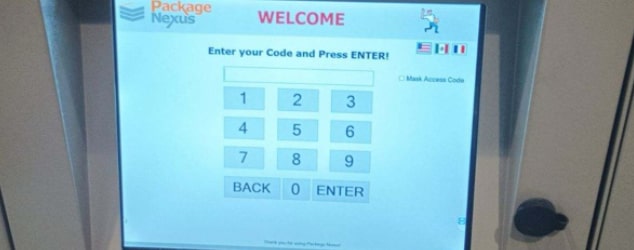
Accessibility involves the whole installation, including the approach, clear floor area, controls, and reachable compartments. Similarly, camera coverage, outdoor suitability, and network resilience depend on the selected configuration. Review these details during design so the delivered system supports the community’s actual needs.
How to plan capacity for the community
Unit count alone is not enough to size a package installation. Review normal and peak deliveries, parcel dimensions, time until pickup, and the proportion of oversized or temperature-sensitive items. A system with spare small compartments can still have a shortage of suitable space for larger cartons.
A useful starting estimate is average daily deliveries multiplied by average days until pickup. For example, 60 packages per day remaining for an average of 1.5 days represents about 90 packages in storage. Under a one-package-per-compartment assumption, that is 90 occupied compartments on average, before adding peak and operational reserves. It is an illustration, not a recommended locker count.
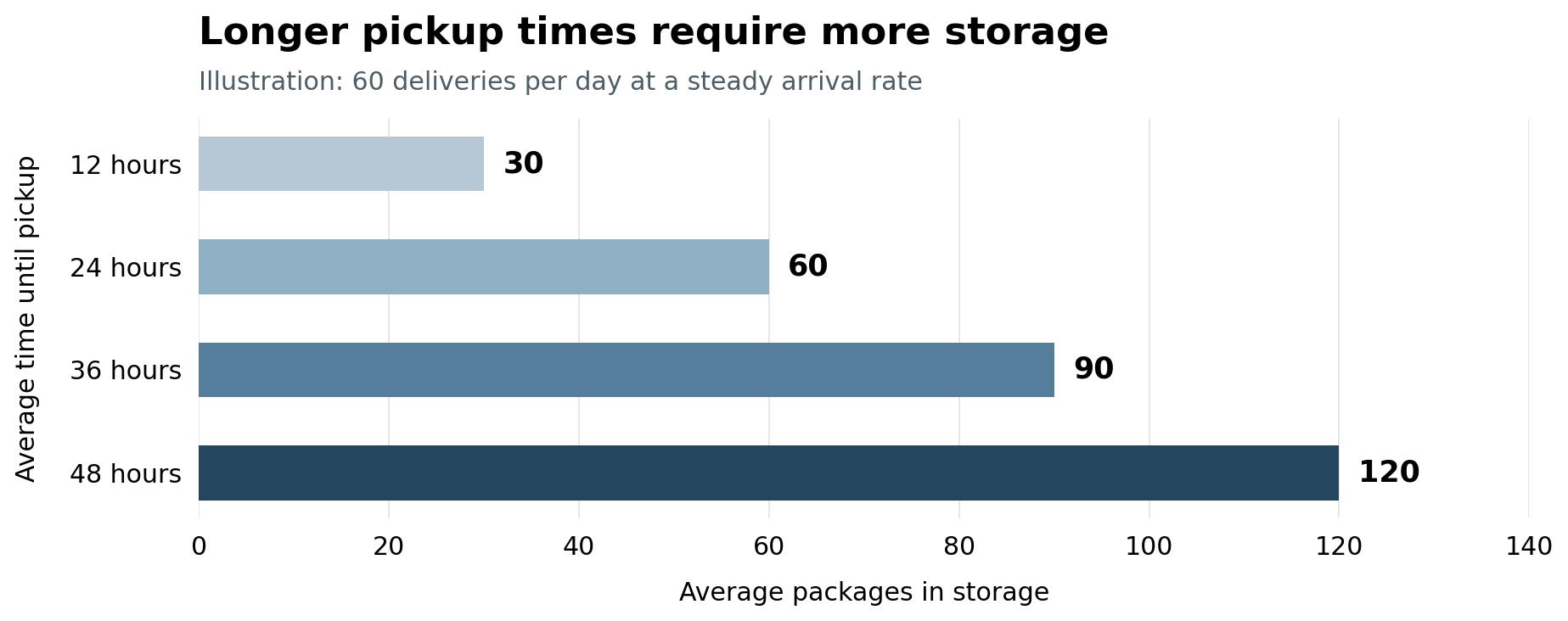
The final design should account for holiday peaks, the compartment-size distribution, uneven arrivals, resident absences, and the chosen overflow process. Averages alone do not protect against a surge. Package Nexus can help size lockers for oversized packages and identify when a Package Room is a better destination for items that do not fit the planned door mix.
How to evaluate the financial benefit
The strongest business case starts with the property’s current workload. Record time spent receiving, logging, notifying, retrieving, investigating, and resolving package questions. Repeat the measurement after installation. Include residual administrative and service time so the comparison reflects the complete workflow.
Consider this illustrative calculation: a community reduces package-related staff work from 90 minutes to 30 minutes on each of 300 measured delivery days. The difference is 300 staff hours annually. At an assumed fully loaded labor rate of $30 per hour, the gross value of recovered capacity is $9,000 per year. These are hypothetical inputs, not Package Nexus customer results or a savings guarantee.
| Business-Case Item | How to Evaluate It |
|---|---|
| Staff capacity recovered | Measured reduction in package-related minutes, multiplied by operating days |
| Gross labor capacity value | Hours recovered multiplied by the property’s fully loaded hourly rate |
| Ongoing cost | Software, service, connectivity, electricity and expected maintenance |
| Initial investment | Equipment, freight, installation, site preparation and any room improvements |
| Additional operational benefit | Documented changes in incidents, complaints, overtime or outsourced handling |
Recovered time creates financial value when it improves service capacity, avoids additional labor, or reduces actual spending. Calculate cash savings separately from staff time that is reassigned. Any payback estimate should use net annual cash benefits after ongoing costs, with financing and other project-specific factors treated consistently.
Read more about how smart lockers reduce costs when developing a site-specific case. For Package Nexus, avoiding recurring user-error troubleshooting is an additional source of operational value to measure alongside the routine handoff work removed.
Where the opportunity is greatest
Communities with frequent leasing-office interruptions should prioritize automation and exception handling. Properties with open package piles should prioritize controlled storage and accountability. Sites with substantial oversized deliveries should evaluate a room or hybrid installation early, while communities with limited interior space should review outdoor placement.
New developments can reserve delivery access, electrical service, connectivity, and expansion space before construction limits their options. Existing communities can begin with a short operational review and a measured floor plan. Properties replacing an existing locker system should document the incidents that consume staff time and require a demonstration of how the proposed workflow handles those exact situations.
Putting the system into service
Successful rollout begins with clear responsibilities and a practical layout. Confirm the equipment route into the building, power and network availability, anchoring, access hours, and space for residents and delivery carts. For a Package Room, review the entry door, lock arrangement, zone labels, shelving, and camera placement.
Keep resident records current, provide concise pickup instructions, and tell carriers where and how to deliver. Agree on procedures for parcels that cannot enter the intended workflow and for physical equipment issues. After launch, review occupancy, dwell time, staff intervention minutes, and resident feedback to determine whether capacity or operating settings should be adjusted.
Plan a package solution around your apartment community
Package Nexus brings together patented On-Auto-Pilot Smart Parcel Lockers, indoor and outdoor configurations, and flexible Package Room solutions. The objective is a reliable delivery and pickup experience that gives residents independence and allows site teams to concentrate on running the community.
To request a Package Nexus quote, share your unit count, typical and peak package volumes, available installation space, and the package issues that currently require staff attention. Package Nexus can help evaluate the right combination of lockers, room capacity, and workflow. Explore additional Package Nexus resources for related planning guidance.
Frequently asked questions
Why are apartment communities installing smart parcel lockers
Communities use smart parcel lockers for convenient pickup, protected storage, and less manual package handling. A well-planned installation also organizes common areas and improves delivery visibility. Package Nexus adds patented automation that resolves supported user errors before they become routine staff troubleshooting tasks.
How do smart parcel lockers save property managers time
Carriers deposit packages directly, the system generates notifications, and residents retrieve deliveries independently. This removes receiving, logging, and handoff tasks from the leasing office. Package Nexus’s sensor-driven workflows also address recurring user errors, reducing the exception-handling work that can remain after routine handoffs are automated.
What makes Package Nexus On Auto Pilot technology different
Package Nexus combines patented sensing with software that verifies actual package activity, rather than relying solely on code entry or user confirmation. Published functions include sensing small and flat items and completing supported unfinished transactions after a timeout. This helps prevent discrepancies between the package and its transaction record.
Does On Auto Pilot remove the need for staff troubleshooting
For the common transaction errors that On-Auto-Pilot automatically detects and corrects, staff do not need to intervene. This removes the recurring recovery work associated with those events. Facilities management, physical damage, resident-data accuracy, and deliveries outside the system remain separate responsibilities, supported by the property’s procedures and the applicable service arrangement.
Are smart parcel lockers more secure than an open package area
Individual locked compartments restrict access to stored parcels, while pickup credentials and activity records improve accountability. Package Nexus also describes cameras and package sensing as part of its locker technology. These features provide stronger controls than an unattended open area, although overall protection also depends on site access, installation, and how the equipment is used.
Can residents collect packages at any time
Residents can collect packages independently when the installation is accessible. A community that provides around-the-clock access to the locker or Package Room location can offer pickup outside leasing-office hours. If the equipment is behind a door that closes overnight, the building’s access rules determine the actual pickup window.
How does the Package Nexus Standalone Package Room work
Carriers use a computer outside the room entrance, follow the delivery workflow, and select a zone for the package. Residents receive a unique pickup code to enter and collect their delivery. The exterior computer captures an entry photo, and optional interior cameras and monitors can provide additional visibility inside the room.
Is a Package Room the same as an individual locker system
No. A Package Room controls access to shared storage, while lockers place parcels inside separate locked compartments. Rooms can accommodate a flexible mix of sizes and support overflow, but entry control does not isolate every package on an open shelf. The right choice depends on the property’s space, security priorities, and package mix.
Can a community combine lockers with a Package Room
Yes. A combined arrangement can use lockers for routine parcels and a Package Room for oversized items or planned overflow. Carriers need a clear process for choosing the appropriate destination. The room layout, access controls, package zones, and any optional surveillance should be specified as part of the complete installation.
How many lockers does an apartment building need
The answer depends on package arrivals, pickup time, parcel sizes, and seasonal peaks. Multiplying daily volume by average days until pickup provides an initial estimate of packages in storage, but the design also needs capacity for variation and the correct compartment mix. Unit count should be one input rather than the entire sizing method.
Can Package Nexus lockers be installed outdoors
Package Nexus offers outdoor locker configurations. The selected model and site design should suit local weather exposure, drainage, lighting, power, and resident access. Outdoor placement can free interior space and make pickup convenient across a larger property. Confirm the final equipment and installation requirements during project planning.
Can the system accommodate groceries and other sensitive deliveries
Package Nexus offers refrigerated, freezer, and heated locker configurations for appropriate applications. These require suitable equipment and handling procedures; they are not features of every ambient locker or Package Room. Discuss the intended items, required conditions, expected storage duration, and operating responsibilities when selecting a temperature-controlled solution.
Can Package Nexus connect with property management software
Package Nexus publishes API integration capabilities for property-management workflows. The property should confirm its platform, the required data fields, the update process, and the integration scope. Keeping resident information current helps carriers identify recipients and supports reliable notifications as residents move in and out.
Are residents required to pay a separate usage fee
Package Nexus’s published comparison describes an offering without resident registration or recurring usage fees. The property should confirm the quoted service terms and communicate its own resident policies clearly. Equipment and service charges paid by the community are separate from any charge the property itself may establish.
Will installing lockers increase property value or guarantee savings
Lockers can strengthen the amenity offering and reduce workload, but do not guarantee increased rent, occupancy, value, or savings. Build the investment case from measured staff requirements, total ownership cost, delivery needs, and the resident experience the project is intended to improve.
What should a community provide when requesting a proposal
Provide unit count, average and peak delivery volume, common parcel sizes, pickup patterns, and a measured plan or photographs of the proposed location. Include oversized-item needs, access hours, power and connectivity information, and any current package problems. These details help Package Nexus recommend a practical configuration and a defined installation scope.

Package Nexus is the global technology leader and provider of The World's Most Advanced Smart Parcel Lockers for efficient and most simplified package management for multifamily communities, retailers, universities, libraries, corporate offices, groceries, and more. Package Nexus unique and patented technology offers a fix for human errors at the time of package deliveries and pickups. Package Nexus solutions help property, store, and office managers to improve their operations, reduce operating costs, and increase customer satisfaction at the same time. Package Nexus offers its entire suite of solutions globally.
USEFUL LINKS

© 2017-2026 Package Nexus