


How Smart Parcel Lockers Are Changing Last Mile Delivery Logistics
Faster handoffs, 100% verifiable package activity and convenient collection for modern properties
Smart parcel lockers are changing last mile delivery logistics by giving carriers a secure, shared destination where packages can be deposited without waiting for recipients or onsite staff. Residents and customers collect their deliveries on their own schedules. Indoor and outdoor installations, ambient storage and temperature-controlled options extend this model to more locations and more delivery types.
Package Nexus brings another important improvement to the last mile: patented On-Auto-Pilot technology that uses package sensing to guide delivery and pickup workflows. The goal is to combine speed with trustworthy transaction records, so a fast delivery does not become a slow investigation for the property team.
Package Nexus states that delivering a package to its Smart Locker takes only five seconds. This is a company-reported locker transaction claim, not the total time required to park, unload, enter a building or complete a route. Actual performance depends on the workflow and site conditions.
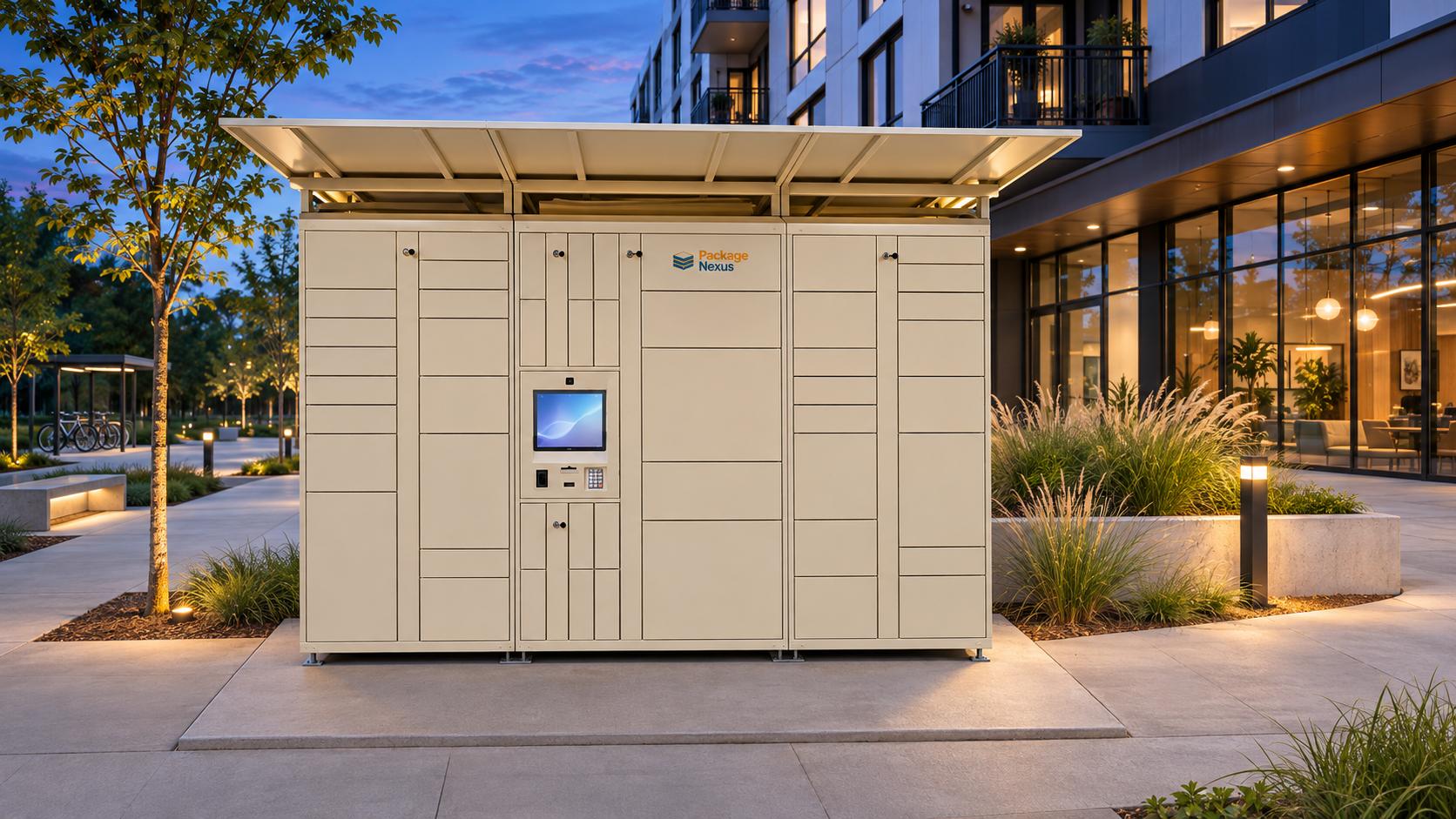
Indoor and outdoor lockers extend delivery access
Indoor parcel lockers can fit into mailrooms, entrance vestibules, dedicated parcel galleries and corporate receiving areas. They place collection on the recipient’s normal route and help keep packages away from public corridors. Building entry must still be available to authorized carriers and recipients during the hours promised.
Outdoor parcel lockers can create an accessible delivery point outside leasing-office hours and help properties with limited indoor space. With suitable access arrangements, Package Nexus supports 24/7 deliveries and pickups. The installation must also provide a safe approach, appropriate lighting, reliable utilities, clear door movement and a location matched to the selected equipment’s environmental limits.
Hardware that supports an unattended outdoor location
| Package Nexus feature | Why it matters in the last mile |
|---|---|
| 12-gauge galvanized steel | Rigid cabinets help resist everyday impacts; the zinc coating helps protect steel against corrosion. |
| Outdoor design and outdoor-rated monitors | Match the enclosure and interface to sun, moisture and temperature exposure at the installation. |
| LED lights inside every compartment | Help users see parcels and check the compartment during nighttime collection. |
| Canopy with LED lighting | Adds shelter and illumination around the interaction area; site lighting remains part of the design. |
| Motion sensors and security cameras | Support activity monitoring and visibility around the equipment; confirm coverage and configuration. |
| Industrial powder-coated finish | Adds a protective finish and supports a coordinated architectural appearance. |
These are Package Nexus published specifications and features supplied for this article. Final equipment selection should confirm dimensions, power, network connections, environmental ratings, installation clearances and included options. No universal IP rating, temperature range or electrical load is asserted here.
Ambient and temperature controlled storage serve different needs
Ambient lockers hold ordinary parcels without actively maintaining a chosen storage temperature. An outdoor-rated ambient locker protects against relevant weather exposure but should not be treated as refrigeration. Temperature-controlled smart lockers add a specified thermal environment for deliveries that need one.
Package Nexus offers hot, cool and frozen storage options, alongside ambient compartments. Groceries, prepared meals and other temperature-sensitive deliveries may benefit from an appropriate tower. Specify the required range, monitoring, holding period and exception process for the goods involved; outdoor weather resistance alone does not establish suitability for every temperature-sensitive product.
On Auto Pilot changes how delivery events are verified
Package Nexus describes its platform as the only Third Generation Smart Parcel Locker system backed by its U.S. and international patented technology. In the company’s generation framework, the distinguishing feature is that sensing guides the delivery and pickup workflow rather than depending on a user’s answer to a completion question. Package Nexus states that the relevant patents expire in 2040. These are company positioning and patent-term claims; “Third Generation” is not presented here as an independently standardized industry classification.
Why a confirmation prompt is not the same as verification
A workflow that asks “Did you deliver? Yes/No” or “Did you pick up? Yes/No” depends on the user accurately reporting the event. A rushed courier can miss a prompt, and a recipient can confirm a pickup without removing the item. Whenever software treats a response as the entire proof of completion, physical activity and the electronic record can diverge.
Package Nexus estimates that user inputs can be wrong or missing in 5–15% of interactions. This range is supplied by the company, not established here as an industry-wide measured error rate. The underlying design issue remains important: the more a workflow relies on manual confirmation, the more consequential an incorrect or missing response can become.
Technology guides the workflow
Package Nexus states that its patented technology automatically determines whether a package has been deposited or removed, instead of asking users to confirm those events. Its comparison page describes package sensing, automated completion and recovery for supported mistakes, including incomplete transactions and timeout scenarios. This is the practical meaning of Patented On-Auto-Pilot Smart Parcel Lockers: reducing routine dependence on human confirmations while maintaining a clearer delivery and pickup history.
The company describes this approach as providing 100% transparency and accountability. That phrase expresses its product proposition; it is not a guarantee that every delivery will be error-free, that every parcel will be correctly addressed, or that theft, outages and physical damage are impossible. Sensing a package also does not independently verify the contents of that package.
Less troubleshooting for property teams
Automating routine verification can remove many of the situations that otherwise require a manager to inspect a compartment, reconcile a confusing record or contact support. Properties benefit when the software can resolve a supported error before it becomes a resident complaint. Staff can focus on leasing, service and genuine exceptions instead of supervising each handoff.
The operating goal is to eliminate the need for continuous manager involvement in routine package workflows. Some responsibilities remain: maintaining recipient records, handling oversized or unclaimed goods, resolving wrong-recipient deliveries, arranging maintenance and responding to exceptional access or connectivity problems. Ask for a demonstration of the actual recovery behavior before selecting a system.
A better arrival experience for luxury communities
For high-end and luxury multifamily communities, package handling is part of the resident experience. A cluttered leasing office or a package that cannot be located can undermine an otherwise polished arrival. A well-integrated locker system offers secure storage, convenient pickup and a clean visual presence without turning routine collection into another concierge transaction.
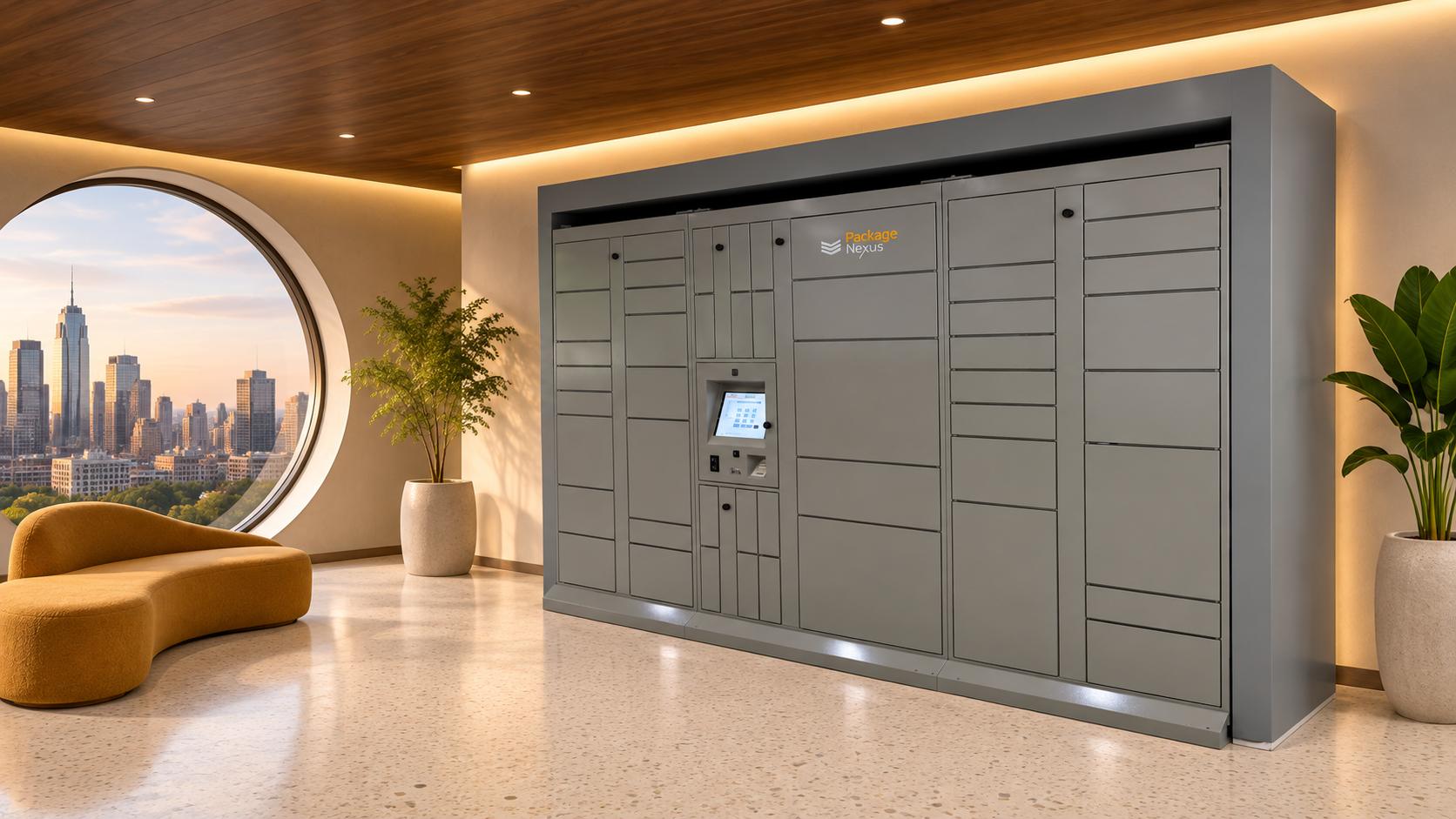
Package Nexus offers a clean, customizable appearance, touchless pickup options, and indoor, outdoor and temperature-controlled configurations. These options help designers coordinate the system with a community’s architecture while property teams remove package clutter from the leasing office. Confirm the supported touchless method and required credentials for the chosen installation.
Industrial components for repeated commercial use
Package Nexus specifies an industrial-grade computer, touchscreen, Braille keypad, cameras, barcode reader and speakers. Its comparison page describes a fanless PC, dedicated indoor and outdoor monitors, two cameras and a Honeywell 3320G scanner. These are published component descriptions rather than a guarantee of the same bill of materials on every future order.
Separate commercial components can support serviceability and an interface suited to repeated daily use. Buyers should compare environmental ratings, expected support life, replacement procedures and warranty terms with any tablet-based proposal. A consumer tablet’s purchase price alone does not establish its lifetime cost, and industrial-grade terminology alone does not establish a fixed number of service years.
Where the highest impact opportunities are
The strongest opportunities combine concentrated parcel volume with frequent interruptions or inconvenient pickup hours. A locker installation produces more value when it solves an identified workflow problem and sits on a route recipients already use. DC Locker and Snaile also describe centralized, self-service handoffs as ways to reduce manual coordination and improve delivery security.
| Market | High impact application | Planning priority |
|---|---|---|
| Multifamily and student housing | Consolidated carrier deliveries and pickup beyond office hours | Peak occupancy, dwell time and accurate resident records |
| Retail and groceries | Self-service collection of prepared orders | Order integration, collection windows and thermal requirements |
| Libraries | Convenient collection of reserved materials | Patron authentication, circulation workflow and accessible reach |
| Corporate mailrooms | Employee package collection without a staffed handoff | Employee directory, access permissions and audit history |
| Hotels | Organized guest and staff package collection | Guest turnover, identity checks and time-limited permissions |
| Warehouses and service operations | Controlled pickup of parts, supplies or internal transfers | Item tracking, authorized users and operational integration |
These are potential use cases, not promises that every application or software integration is included in a standard parcel-locker purchase. Define the required workflow with Package Nexus before finalizing the configuration.
Modularity protects the expansion path
Package Nexus states that its lockers are 100% modular and can be expanded as the community or package volume grows. Plan the original location with room for compatible additional towers, adequate electrical and network capacity, and a clear accessible route. Modular parcel locker expansion is most useful when future installation space is preserved from the beginning.
Package Nexus is 100% U.S.-owned and operated, according to the company. Ownership is distinct from the origin of every component. For customers planning a long-term deployment, evaluate the support relationship, parts availability and responsibilities alongside the physical configuration.
Capacity depends on pickup behavior as well as unit count
A useful starting estimate is daily parcels multiplied by average days held. For example, 80 parcels per day held for 1.5 days imply approximately 120 occupied parcel positions before a buffer for peaks and compartment-size mismatches. This is an illustrative planning estimate, not a specification; parcel positions and compartments are not always interchangeable. Measure actual dwell time and package sizes before determining the tower mix.
Integrated Package Room solutions can accommodate oversized items or overflow alongside lockers. Shared room access and cameras should not be assumed to provide the same individual package isolation or sensing as an equipped locker compartment. Define how packages are recorded and collected in each storage area.
Build a measurable business case
Start with the existing operation. Measure driver time at the property, staff minutes spent on packages, delivery exceptions, pickup delays and peak occupied capacity. Repeat the measurements after deployment using comparable periods. This makes the discussion about observable operational improvement rather than an assumed return on investment.
| Measure | What to record | Decision it supports |
|---|---|---|
| Carrier dwell time | Arrival-to-departure time and parcels delivered | Whether location and transaction speed improve the stop |
| Staff workload | Routine handling and exception minutes per week | Whether automation releases useful staff capacity |
| Exception frequency | Issues per 1,000 deliveries, separated by cause | Whether verification and directory practices need adjustment |
| Pickup dwell time | Median and high-percentile time to collection | Whether reminders or additional compartments are needed |
| Capacity pressure | Full-locker events and overflow by package size | Which compatible tower or storage option to add |
Illustrative labor calculation: if a property saves two staff hours per day at an assumed loaded labor cost of $30 per hour over 300 operating days, the gross value is $18,000 per year. This is capacity released for other work, not necessarily a payroll reduction. Subtract software, support, electricity, maintenance and other relevant costs before calculating net savings or payback.
Evaluate the workflow rather than the brand label
When comparing Package Nexus with Luxer One, Parcel Pending, Amazon Hub, Package Concierge or another provider, request a demonstration of the current model and software version. Test a normal deposit, a flat parcel, a pickup without removal, an abandoned screen and a timeout. Ask which events are sensed, which are inferred, which require confirmation and which need staff action.
Package Nexus’s comparison framework emphasizes its sensor-driven approach over earlier-generation workflows. However, the reviewed material does not independently establish that every current competing product requires the same prompts, lacks comparable features or uses consumer-grade tablets. A model-specific demonstration provides a more useful purchasing basis than a blanket brand claim.
A more efficient last mile can also reduce unnecessary travel
Consolidated deliveries and fewer repeat attempts can reduce avoidable driving. The outcome depends on the location and collection behavior: placing lockers along a resident’s normal walking route is more favorable than creating a separate car journey for every pickup. Include energy consumption, including temperature control, when evaluating the full operating picture. No universal emissions reduction is claimed here.
Plan the next step
Review Package Nexus smart lockers for apartments and condos, then request a Package Nexus site assessment. Share the expected parcel volume, floor plan, access hours, package-size mix and temperature-control requirements. A demonstration should show how the system handles ordinary deliveries and the exceptions that currently occupy the property team.
Frequently asked questions
How do smart parcel lockers improve last mile delivery logistics?
They create a secure shared destination where carriers can leave multiple deliveries without coordinating a face-to-face handoff with every recipient. Automated pickup instructions let recipients collect later. The largest practical benefits come from combining a convenient location, adequate capacity and dependable package records.
How fast can a carrier deliver a package to a Package Nexus locker?
Package Nexus states that a package can be delivered to its Smart Locker in only five seconds. Treat this as a company-reported locker transaction claim rather than a complete building-stop measurement. Ask to see the defined start and end points in a demonstration and measure parking, unloading and walking separately.
Can Package Nexus lockers accept deliveries and pickups 24 hours a day?
Yes, a suitably configured and accessible installation can support 24/7 deliveries and pickups. A locker inside a building that is locked overnight is only as accessible as the building-entry arrangement. Plan carrier credentials, resident access, lighting and support procedures together.
Can smart parcel lockers be installed outdoors?
Package Nexus offers outdoor configurations using heavy-duty construction and equipment intended for outdoor service. Its stated features include 12-gauge galvanized steel, outdoor monitors, compartment LEDs, canopy lighting, motion sensors and cameras. Confirm the exact options, environmental limits and installation requirements for the proposed location.
What is the difference between ambient and temperature controlled lockers?
Ambient lockers do not actively maintain a chosen storage temperature. Temperature-controlled lockers provide a specified heating or cooling environment for suitable items. Package Nexus offers hot, cool and frozen options; the selected system and operating process must match the goods, required temperature and collection time.
What makes Package Nexus On Auto Pilot different?
Package Nexus describes a patented workflow that senses package deposits and removals rather than relying on yes-or-no completion prompts. Supported recovery functions can address common user mistakes automatically. The intended benefit is fewer discrepancies between the physical parcel and the recorded transaction, with less routine troubleshooting.
Do smart lockers eliminate all property manager involvement?
They can eliminate many routine handoffs and reduce common workflow interventions, but they do not remove every operational responsibility. Staff still need a process for recipient-list changes, incorrect addressing, unclaimed parcels, physical damage and service interruptions. The goal is a predictable exception process instead of continuous package supervision.
Why are Package Nexus lockers a strong option for luxury multifamily communities?
They combine self-service collection, controlled storage, customizable appearance and sensor-guided workflows. Together, these features can keep parcels out of the leasing office and make collection feel integrated with the building. The best configuration also accounts for accessibility, privacy, peak demand and resident convenience.
Can the locker system grow with package volume?
Package Nexus states that its platform is 100% modular and can be expanded with compatible towers. Preserve enough physical space and utility capacity for expansion. Track full-locker events and package-size patterns so the next module addresses the actual constraint rather than simply increasing the overall door count.
Why compare industrial computers with consumer tablets?
The computer and interface must support repeated daily interactions and the surrounding environment. Package Nexus specifies industrial-grade computing and dedicated peripherals. Compare serviceability, environmental limits, software support and replacement cost; do not assume that every competing model uses the same hardware or has the same durability.
Do parcel lockers reduce delivery costs and emissions?
They can improve route efficiency by consolidating handoffs and reducing unsuccessful delivery attempts. The financial result depends on actual carrier and staff time saved, operating costs and utilization. Environmental benefits depend on avoided vehicle travel, pickup-trip behavior and electricity use, so site-level measurement is preferable to a general percentage claim.
How should buyers verify a supplier’s automation claims?
Ask the supplier to demonstrate small and flat parcels, incomplete interactions, timeouts and pickups where the parcel is left behind. Review the resulting notification, compartment status and activity record. Request written specifications for the selected product and support process, including what still requires staff intervention.

Package Nexus is the global technology leader and provider of The World's Most Advanced Smart Parcel Lockers for efficient and most simplified package management for multifamily communities, retailers, universities, libraries, corporate offices, groceries, and more. Package Nexus unique and patented technology offers a fix for human errors at the time of package deliveries and pickups. Package Nexus solutions help property, store, and office managers to improve their operations, reduce operating costs, and increase customer satisfaction at the same time. Package Nexus offers its entire suite of solutions globally.
USEFUL LINKS

© 2017-2026 Package Nexus