


Why smart parcel lockers are a must-have for apartment communities
At 7 p.m., a resident returning from work and a driver finishing a route may face the same locked leasing office. A property that accepts deliveries all day but releases them only during office hours has solved half the problem. Smart parcel lockers give both people a secure place to complete the handoff on their own schedules.
An indoor parcel bank can serve a controlled-access vestibule. An outdoor installation can give carriers a direct route from the curb. Both can support 24/7 deliveries and pickups where building access permits. Ambient compartments handle ordinary parcels, while temperature-controlled towers can hold chilled groceries, frozen orders or hot meals in the appropriate compartment.
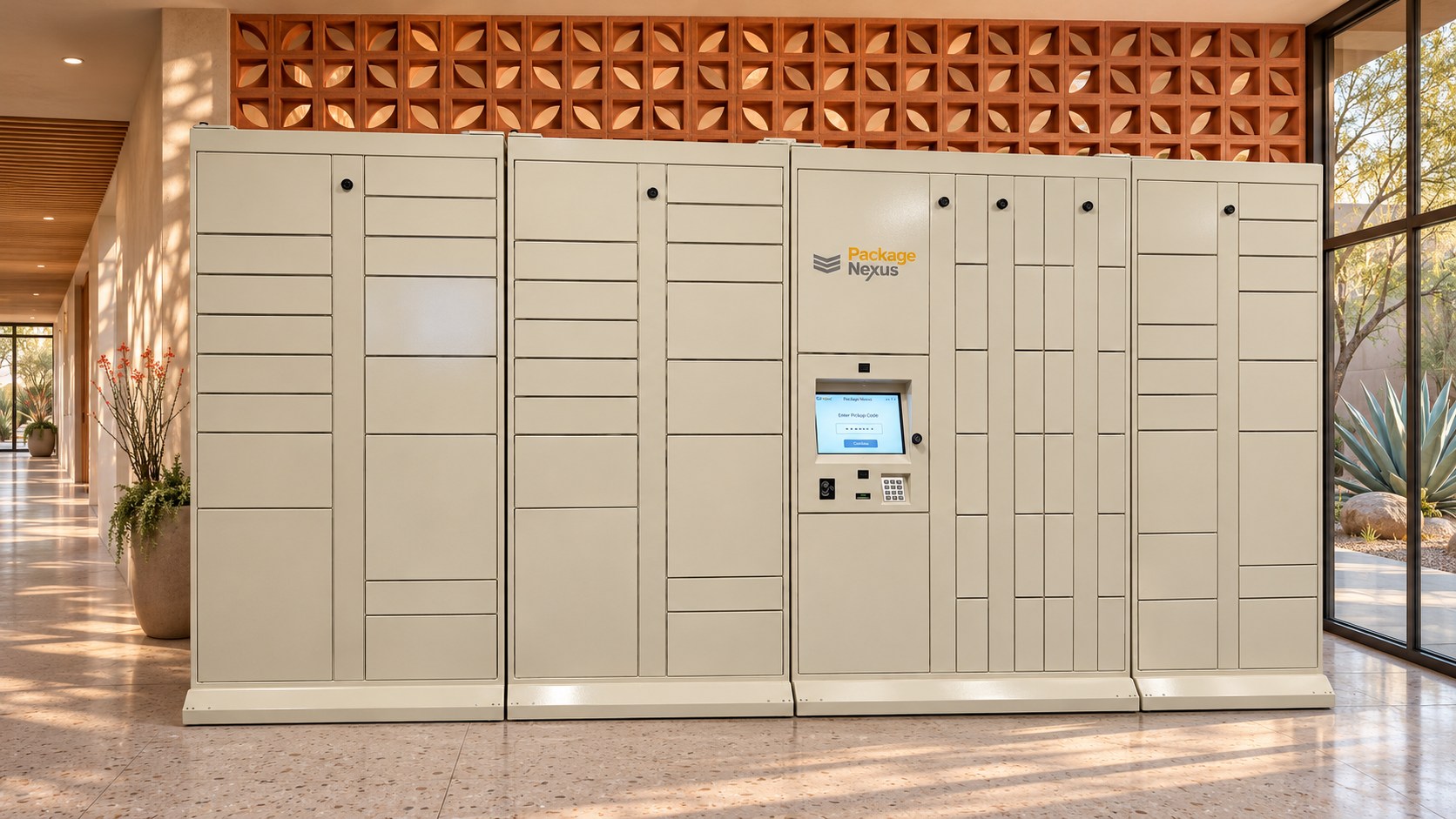
Package Nexus reports that a carrier can deliver one package to its Smart Locker in as little as five seconds at the locker. For the resident, the bigger saving may be an entire return trip. A notification arrives when the parcel is ready, and the resident can collect it on the way home.
For properties weighing smart parcel lockers for apartments and condos, the strongest case arises when deliveries regularly outlast office hours, crowd the reception desk or interrupt resident service.
What makes a package handoff accountable
Consider a driver who opens a door and realizes the box will not fit. The door has opened, but the parcel is still on the cart. A delivery record that misses that distinction can send a resident downstairs for an empty compartment. A reliable system needs to know what happened inside.
From the carrier’s scan to the resident’s pickup
The driver identifies the resident and receives a compartment assignment. Once the parcel is placed inside, Package Nexus combines compartment sensing with the transaction record to verify deposit and trigger pickup instructions. The resident scans a credential for touchless kiosk access or enters a code. The system detects removal and updates availability. See how indoor smart parcel lockers work for the full sequence.
01 / Assign
Match the resident
Choose a fitting door
02 / Deposit
Detect the parcel
Record the delivery
03 / Notify
Send pickup details
Authorize access
04 / Collect
Detect removal
Release capacity
Deposit and removal each have a corresponding physical event.
Why the last question on the screen matters
A driver can skip “Did you deliver?” and a resident can answer “Did you pick up?” while the parcel is still inside. Package Nexus estimates that 5–15% of manual responses can be wrong or missing. That estimate concerns user inputs. It should not be read as a percentage of packages lost.
Package Nexus identifies itself as the only provider of its third-generation, worldwide-patented On-Auto-Pilot technology. It reports U.S. and international patents with relevant terms expected to expire in 2040. The company describes the goal as 100% transparency and accountability for locker handoffs. Deposit and pickup verification rely entirely on its technology, freeing users from a final yes-or-no confirmation.
What a property manager can resolve remotely
If a driver leaves before completing a session, On-Auto-Pilot can use detected activity to reconcile a supported timeout. A manager investigating a complaint can review the assigned compartment, delivery and pickup history, and available camera records. This removes routine confirmation work from the site team and gives it evidence when a genuine exception needs attention.
Choose the location and climate together
Walk the route with a delivery cart and then walk it as a resident arriving after dark. A beautiful locker wall behind a locked office door cannot deliver the same service as a modest bank in an accessible vestibule. At a luxury property, a clear route, discreet cameras and a finish that belongs with the surrounding materials all contribute to the arrival experience.
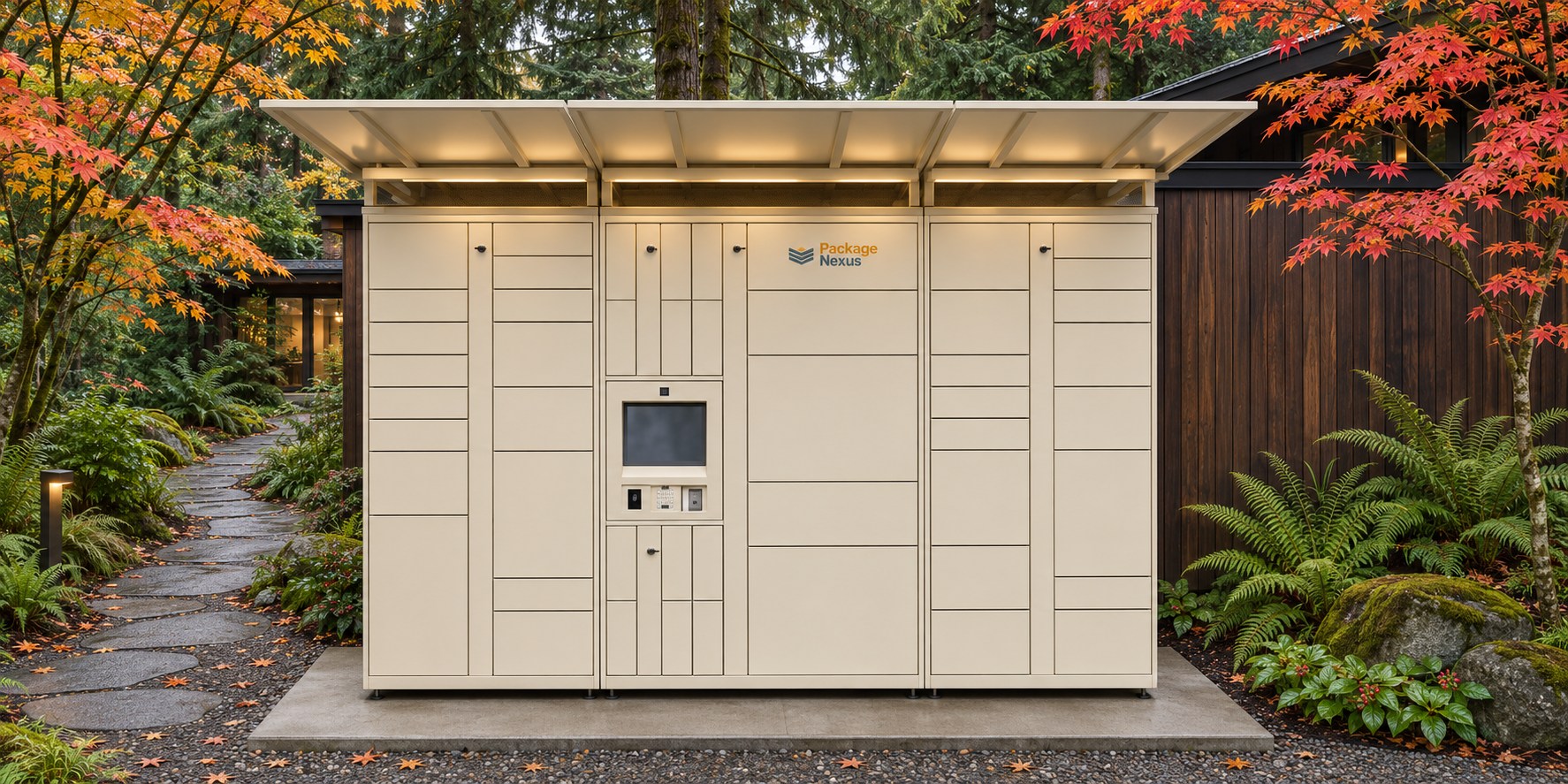
Outdoor hardware for the hours residents actually use it
Package Nexus offers outdoor parcel lockers with heavy-duty 12-gauge galvanized steel, an outdoor-rated monitor and a weather-oriented enclosure design. LEDs inside every compartment help residents spot small envelopes after dark. Canopy LEDs illuminate the approach and controls, while motion sensors and security cameras support monitoring. Specify the equipment for the site’s sun exposure, precipitation and expected temperatures.
A sheltered box and a refrigerated box solve different problems
An outdoor enclosure protects ordinary parcels from exposure. Groceries that need refrigeration require active cooling even when the locker sits indoors. Package Nexus offers temperature-controlled smart lockers in refrigerated, freezer and heated configurations. Base the mix on what residents receive and how long those items typically wait for collection.
Where a community gains the most
| Operating pressure | Design decision | What to measure |
|---|---|---|
| Reception staff sort and release parcels | Place routine deliveries on the carrier’s normal route to the lockers. | Weekly staff minutes spent receiving parcels and handling exceptions. |
| Residents arrive after the office closes | Offer credentialed evening access and a clear path from the entrance. | After-hours collections and requests for staff assistance. |
| Large boxes occupy the remaining doors | Add larger compartments or connect an overflow room. | Full-bank events and overflow by parcel size. |
| Grocery orders gather at reception | Assign appropriate refrigerated capacity and communicate pickup windows. | Peak occupied chilled compartments and collection times. |
Keep a luxury arrival experience intact
Residents notice the difference when a concierge can greet them without searching behind a desk for a box. Custom colors and wraps let a locker bank fit the architecture. A scan at the kiosk can open the assigned door without touching the screen. For the leasing team, moving stacks out of sight also frees the space used to welcome visitors and conduct tours.
Specify commercial electronics and room to grow
Package Nexus uses a fanless industrial-grade computer, a dedicated 15-inch touchscreen, a Braille keypad, speakers for audio prompts, cameras and an industrial Honeywell 3320g barcode reader. These components are designed for years of frequent commercial use. A buyer can evaluate the display, scanner and computer separately for serviceability, environmental ratings and replacement support.
Package Nexus is 100% U.S.-owned and operated. Its lockers are 100% modular. Communities can add towers as occupancy or delivery volume grows, subject to space, power and site conditions. Reserve the expansion footprint at installation. An integrated package room can accommodate bulky items that would otherwise consume valuable locker space.
Build the investment case from your own numbers
For illustration, 40 daily handoffs at two staff minutes each consume 80 minutes a day. If 30 move to self-service, the team can regain about one hour before allowing for exceptions. Measure the actual time at your property and compare it with equipment, installation, service and operating costs. Count resident convenience separately so the financial estimate stays credible.
How to compare locker systems in a demonstration
Package Nexus’s smart locker comparison guide groups Luxer One and Package Concierge in its first generation, Parcel Pending and Amazon Hub in its second, and Package Nexus in its third. These are the manufacturer’s categories. Model, installation date and software configuration matter when evaluating a specific proposal.
For example, a 2019 Luxer One package-room manual identifies an iPad as the controller for that system. Parcel Pending documents infrared detection in some locker products. Ask what the exact model senses, how it uses that signal and which exceptions still require a person. A demonstration can answer those questions more precisely than a list of components.
| Ask the supplier to demonstrate | Look for this result |
|---|---|
| Open and close an assigned door without depositing a package. | The history distinguishes the empty compartment from a completed deposit. |
| Deposit a parcel and walk away before the last screen. | The vendor shows the recorded state, notification decision and any staff task. |
| Open the correct door but leave the parcel inside. | The system accounts for the parcel before assigning the compartment again. |
| Scan a pickup credential at night. | The resident can find the controls, see the contents and collect the parcel with minimal effort. |
Apply the same principle beyond apartments
A university can release a library hold after the circulation desk closes. A retailer can stage a paid order for evening collection. In a hybrid workplace, an IT team can leave a replacement laptop for an employee on another shift. The value in each case is the ability to authorize the right person, document the exchange and keep the item available across different schedules.
Plan a demonstration around your busiest day
Bring a week of delivery counts, your largest recurring parcel and a floor plan. Ask the vendor to show where a carrier enters, where a resident collects after hours and what appears in the manager’s history when someone walks away mid-transaction. To compare an indoor, outdoor or mixed-temperature layout for your property, request a locker proposal.
Frequently asked questions
When do smart parcel lockers become a must-have?
When package handling regularly competes with resident service or the office cannot cover the hours people need. Count after-hours requests, staff interruptions and parcels awaiting collection over a typical week. Those observations show whether the property needs longer access hours, more capacity or better delivery records.
Can a carrier complete a delivery in five seconds?
Package Nexus reports an at-locker delivery time as short as five seconds. Walking from the truck, entering the building and resolving a missing resident record add time to the stop. Test the transaction with a familiar carrier and the same labels, parcel sizes and entrance the property normally uses.
Can residents use the lockers at night without staff?
Yes, when the location and access policy support 24/7 pickup. A resident can use the issued credential to open the assigned compartment. Place the lockers on an illuminated route residents can reach after hours and give approved carriers a separate way to enter for late deliveries.
What makes On-Auto-Pilot useful at an unstaffed property?
Compartment sensing lets the system verify deposit and removal without asking a user to confirm the final step. It can also address supported mistakes during the session. Remote staff can consult the activity history when a resident reports a discrepancy, reducing visits made simply to check whether a door is empty.
How many compartments should a community order?
Count parcels waiting at the same time, including those held overnight or across weekends. Separate small, large and refrigerated items. If refrigerated doors fill while ambient doors remain empty, the property needs a different mix. A modular layout lets the team address the specific shortage as demand changes.
Which features matter most for a luxury multifamily community?
Start with a convenient route, discreet placement, finishes that match the building, touchless kiosk pickup and a credible record for disputed handoffs. Add outdoor-rated equipment or temperature-controlled compartments where the delivery mix calls for them. Evaluate these choices on an evening walkthrough as well as during a daytime tour.

Package Nexus is the global technology leader and provider of The World's Most Advanced Smart Parcel Lockers for efficient and most simplified package management for multifamily communities, retailers, universities, libraries, corporate offices, groceries, and more. Package Nexus unique and patented technology offers a fix for human errors at the time of package deliveries and pickups. Package Nexus solutions help property, store, and office managers to improve their operations, reduce operating costs, and increase customer satisfaction at the same time. Package Nexus offers its entire suite of solutions globally.
USEFUL LINKS

© 2017-2026 Package Nexus