


The Future of Smart Package Lockers in the Last Mile Delivery Industry
Automated handoffs • Verified package events • Infrastructure that grows
Smart package lockers are becoming a practical foundation for the future of last-mile delivery. They bring multiple deliveries to a convenient collection point, let recipients collect packages on their own schedules, and connect physical handoffs with digital records. The greatest opportunity is to make every handoff faster, easier to verify, and less dependent on property staff.
Package Nexus brings this approach to indoor and outdoor installations, ambient and temperature-controlled storage, and 24/7 delivery and pickup where site access permits. Its patented On-Auto-Pilot technology is designed to determine whether a parcel has actually been deposited or collected, reducing the routine errors that turn a convenient amenity into an administrative burden.
Why the last mile needs a better handoff
A delivery route can be optimized digitally and still lose time at its final stop. Drivers must locate entrances, gain access, identify recipients, travel through buildings, and find somewhere appropriate to leave a parcel. Property teams then inherit the work of sorting deliveries, finding missing items, and arranging collection. A smart locker changes that handoff by providing an organized destination shared by many recipients.
DHL describes parcel lockers as a way to separate delivery time from collection time and make centralized locations useful beyond conventional working hours. For communities, that means residents can collect a parcel after a late shift or before an early flight. For couriers, the opportunity is to deliver to an available compartment without waiting for the resident.
Five second delivery can make repeated transactions simpler
Package Nexus states that it takes only 5 seconds to deliver a package to a Package Nexus Smart Locker. This company-reported figure highlights the value of a streamlined transaction. It should be evaluated in a live demonstration with clearly defined start and finish points; it is not a promise that parking, unloading, building access, recipient lookup, and all other stop activities together take five seconds.
For an illustrative batch of 60 packages, five seconds per package equals five minutes of transaction time. If the same measured transaction took 20 seconds per package, it would total 20 minutes—a 15-minute difference for that batch. This is arithmetic using an assumed comparison, not a measured competitor benchmark. The practical test is total stop time alongside accurate delivery records, not screen speed alone.
Indoor and outdoor lockers extend service availability
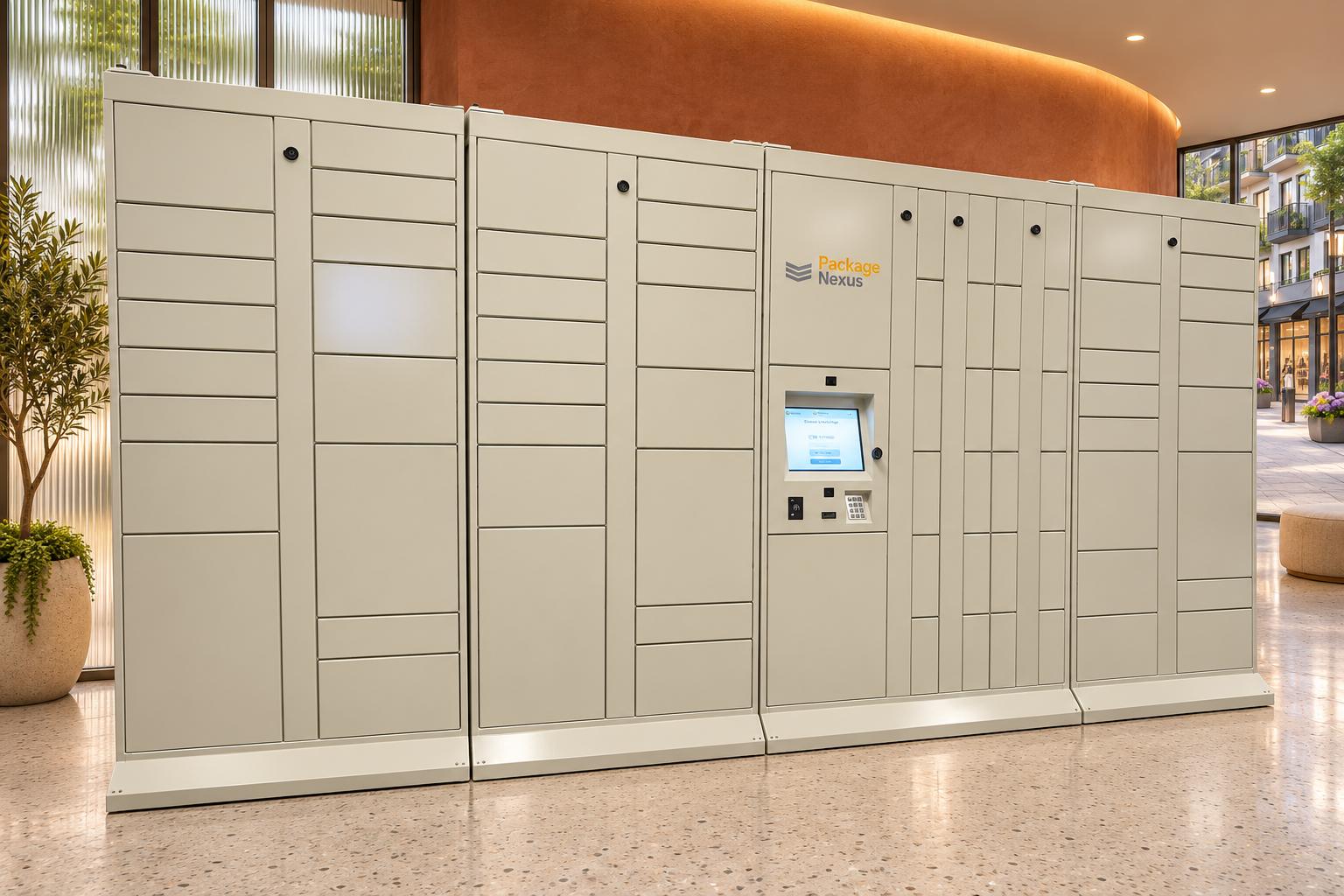
Indoor parcel lockers fit naturally into lobbies, mailrooms, vestibules, and dedicated collection areas. The best location makes the carrier route short and the resident route obvious. A beautifully finished locker bank behind a locked office door cannot provide true 24/7 access, so building access must be planned with the equipment. The guide to how indoor smart parcel lockers work explains the relationship between credentials, compartment assignment, notifications, and retrieval.
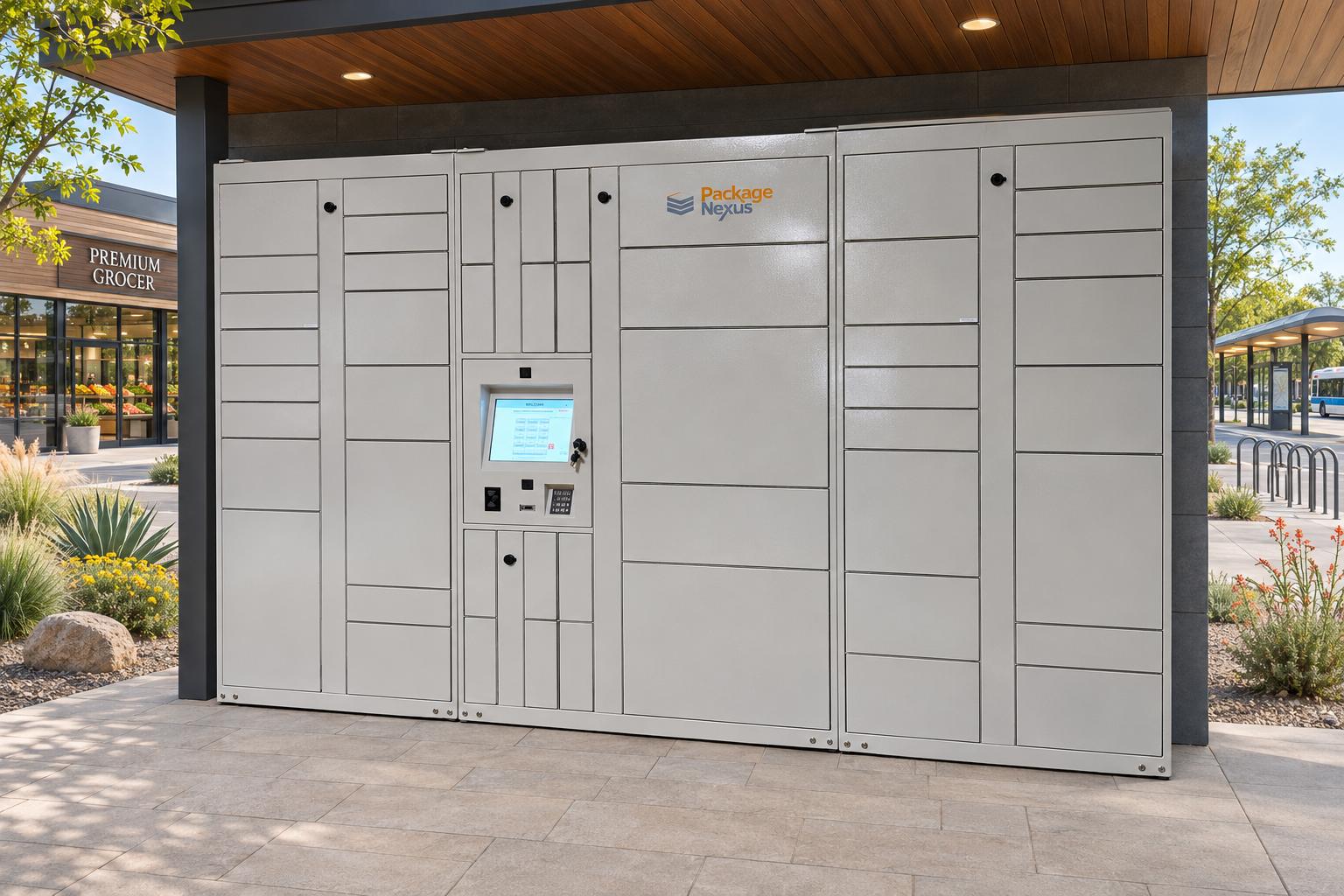
Outdoor parcel lockers can move the handoff closer to a vehicle route or pedestrian entrance while freeing valuable indoor space. Package Nexus specifies 12-gauge galvanized steel, an outdoor-suitable design, outdoor monitors, LEDs inside every compartment, a canopy with LED lighting, motion sensors, and security cameras for its outdoor offering. Compartment lighting is particularly useful when identifying and collecting items at night. Confirm the selected configuration, weather exposure, drainage, anchoring, power, network connection, and safe pedestrian approach during site planning.
The next step is verification that does not depend on a Yes or No answer
Opening a door is not proof that a parcel was deposited. Closing a delivery session is not proof that the correct package was collected. The future of unattended delivery depends on understanding the physical event rather than treating a screen response as the event itself.
Package Nexus describes its platform as the only third-generation smart parcel locker solution with its worldwide-patented On-Auto-Pilot technology, backed by US and international patents that the company states expire in 2040. “Third generation” is Package Nexus’s classification for this sensing-led approach, rather than a universal industry standard. Patent coverage is jurisdiction-specific; the stated exclusivity and expiry date are company claims.
In Package Nexus’s described workflow, patented technology guides delivery and pickup and determines whether an item has been deposited or removed. Users do not have to validate those physical events through repetitive prompts such as “Did you deliver? Yes/No” or “Did you pick up? Yes/No.” Identification, authentication, and other necessary selections still form part of the user experience.
Package Nexus estimates that manual inputs can be wrong or missing in 5–15% of interactions. This is a company-supplied estimate, not an independently established industry-wide error rate. Its significance is the underlying design problem: when a response becomes the only evidence of a handoff, an unanswered question or mistaken selection can create an inaccurate record. Removing that dependency is a meaningful operational improvement.
Identify
Recipient and parcel
Deposit
Physical item detected
Notify
Pickup details issued
Collect
Removal detected
If an event is incomplete, apply the configured recovery workflow
Resolve supported exceptions automatically or escalate for assistance.
Conceptual workflow • Exact behavior depends on configuration
What complete transparency and accountability should mean
Package Nexus describes its value proposition as 100% transparency and accountability. For a buyer, that should mean a clear relationship between the recipient, assigned compartment, observed package event, and recorded transaction. It should not be interpreted as a guarantee against every theft, outage, incorrectly addressed parcel, or unauthorized credential use. A useful demonstration shows what evidence is available when a resident asks where a package went.
On-Auto-Pilot is intended to remove the need for site managers to stay continuously involved in routine package troubleshooting. A timed-out session, an unregistered deposit, or a package left behind can be handled through supported recovery workflows instead of immediately becoming a staff investigation. Property teams still manage resident information, physical access, maintenance, and unusual incidents. Automating common exceptions lets those teams spend more time on residents and less time reconstructing transactions.
Commercial hardware is essential to a dependable service
A locker serving a busy community is commercial infrastructure. Its computer, display, scanner, access controls, and enclosure must work together through repeated daily use. Package Nexus uses an industrial-grade computer and dedicated components including a touchscreen, Braille keypad, cameras, barcode reader, and speakers. This architecture supports serviceability and allows the interface and processing hardware to be selected for their individual tasks.
| Feature | Package Nexus configuration or offering | Operational value |
|---|---|---|
| Enclosure | 12-gauge galvanized steel | Rigid construction with corrosion protection; finish and maintenance still matter. |
| Computing and interface | Industrial-grade PC and touchscreen; Braille keypad; speakers | Dedicated commercial components and multiple interaction methods. |
| Parcel handling | Patented sensing, barcode reader and guided workflows | Connect physical deposits and removals with transaction records. |
| Outdoor visibility | Outdoor monitor, compartment LEDs and canopy LEDs | Improve screen visibility and nighttime collection. |
| Site security | Cameras and motion sensors | Support monitoring; placement and retention policies determine usefulness. |
| Storage choice | Ambient and temperature-controlled towers | Match storage conditions to the delivery mix. |
| Expansion | 100% modular locker architecture | Add compatible modules as demand grows and site capacity allows. |
Specifications above reflect the company brief and published product information. Confirm model-specific dimensions, compartment sizes, electrical loads, environmental ratings, temperature ranges, and selected options in the project quotation; the reviewed pages do not establish one universal specification for all installations.
Why heavier galvanized steel matters
For a comparable steel grade and panel design, 12-gauge sheet is thicker than 16- or 18-gauge sheet and generally provides greater resistance to flexing and denting. Galvanizing adds a zinc coating that helps protect the underlying steel against corrosion. These choices support the long-term appearance and structural integrity of a frequently used locker bank. Overall security also depends on locks, hinges, seams, anchoring, access controls, and maintenance; gauge alone does not establish a burglary rating.
How to compare Package Nexus with other suppliers
Buyers considering Luxer One, Parcel Pending, Amazon Hub, Package Concierge, and similar providers should compare the actual model and workflow being proposed. Package Nexus groups traditional systems into first and second generations in its own comparison framework. That label should not replace a model-specific evaluation or imply that every competing system lacks tracking, attractive finishes, or automated access.
Luxer One’s own support material documents iPad-based configurations. This supports a specific hardware comparison, but it does not prove that every current Luxer One product uses the same hardware or that all tablets have short service lives. Industrial-grade electronics are designed for demanding applications; useful life still depends on component ratings, thermal management, workload, maintenance, and support.
Ask each supplier to demonstrate a deposit without a final confirmation, pickup with an item left behind, a small flat envelope, and a session timeout. Then inspect the notification and management record. Ask what happens automatically and what requires staff. This makes the comparison concrete without assuming that every competitor requires the same questions after every transaction.
Ambient and temperature controlled lockers broaden the delivery mix
Ambient lockers serve ordinary parcels that do not require regulated storage temperatures. Temperature-controlled parcel lockers extend the opportunity to groceries, prepared meals, and other deliveries with defined holding requirements. Package Nexus offers refrigerated, frozen, and heated configurations, alongside room-temperature storage.
Outdoor suitability and parcel temperature control are separate requirements. A weather-resistant enclosure does not refrigerate groceries, and cooling a kiosk computer does not cool the parcel compartments. Each project should define storage temperature, allowable holding time, monitoring, alerts, cleaning, and the response to power loss. For sensitive products, match the installation to the supplier’s handling requirements before promising suitability.
A mixed installation can allocate most compartments to everyday parcels and add a specialized tower for the smaller share of deliveries that need temperature management. This avoids treating every package as if it has the same requirements and creates an expansion path as grocery or meal delivery grows. The goal is appropriate capacity in each category, not simply the largest possible locker bank.
High impact opportunities across the last mile
The strongest opportunities combine frequent deliveries, convenient recipient access, and a recurring handoff problem. The following priorities are an editorial assessment, not a market-share forecast. Each deployment should be measured against its own baseline.
| Market | High impact opportunity | Measure of success |
|---|---|---|
| Luxury multifamily | 24/7 collection, discreet design and fewer leasing-office interruptions | Staff minutes per parcel; pickup time; resident support requests. |
| Retail and groceries | After-hours order collection and appropriately controlled storage | Queue time; collection completion; holding-time exceptions. |
| Corporate mailrooms | Self-service distribution across hybrid work schedules | Internal handoffs; overdue packages; time spent locating items. |
| Libraries and campuses | Convenient collection of holds, materials and approved equipment | After-hours use; fulfillment time; patron or student accessibility. |
| Hotels | Organized guest and staff deliveries with clear recipient records | Front-desk interruptions; misrouted parcels; uncollected items. |
| Warehouses and service teams | Controlled parts or equipment handoffs across shifts | Waiting time; uncollected reservations; item traceability. |
| Shared community hubs | Consolidated deliveries close to existing shopping or travel routes | Parcels per stop; utilization; additional recipient travel. |
Luxury communities can make convenience part of the arrival experience
For high-end multifamily communities, the best locker experience combines reliable automated service with an installation that belongs in the architecture. Package Nexus’s clean, customizable appearance, touchless pickup options, and indoor, outdoor, and climate-controlled choices support that objective. Coordinated finishes, lighting, circulation, and signage can turn package collection into a natural part of arriving home.
Secure individual compartments help remove parcel clutter from leasing offices and reduce visible piles near reception. Patented event verification strengthens accountability behind the polished appearance. A resident should be able to authenticate, find the assigned compartment, and collect a package without answering unnecessary completion questions or seeking help from the concierge.
The business value is strongest when the improvement is both visible and operational: a calmer lobby, predictable access, and fewer interruptions. Smart parcel lockers for apartments and condos should therefore be evaluated as part of the resident service model, with management workload and pickup success considered alongside the design.
What the next phase of smart locker adoption could look like
Connected capacity and better placement
A useful future network would connect available compartments, expected arrivals, and recipient pickup patterns. That could help operators identify capacity pressure before a bank fills and guide expansion toward the locations that need it. Integrations must be confirmed for each deployment; a conceptual network capability should not be mistaken for a currently included Package Nexus feature.
The 2026 review by Mohammad and colleagues examines 93 studies of parcel-locker-enabled delivery. Its abstract identifies gaps in real-world validation, consumer behavior, and environmental and social outcomes. This supports a practical conclusion: site selection and user behavior deserve as much attention as optimization models. A locker is most useful when people can reach it conveniently and carriers can serve it efficiently.
Predictive tools built on dependable records
AI could help forecast package peaks, identify unusual dwell times, and recommend maintenance or capacity adjustments. Reliable physical-event data makes those tools more useful. An algorithm trained on mistaken “delivered” or “collected” records may optimize around the wrong picture of reality. Sensor-led verification is therefore a valuable foundation for future analytics, even when the analytics are a development opportunity rather than a deployed feature.
Locus describes a broader industry shift toward delivery promises informed by live operational capacity. For lockers, the corresponding opportunity is to align the delivery promise with available space and workable access. Retail integrations, returns, and robotic handoffs are potential extensions, but each needs its own integration, ownership rules, and proof of operational value.
Sustainability that is measured at the system level
Combining deliveries can reduce repeated stops and failed attempts. The net environmental benefit also depends on recipient travel, locker electricity use, refrigeration loads, and installation materials. A station that fits into an existing walk or shopping trip has a different impact from one that generates a separate car journey. Measure the whole service rather than assuming that every locker location produces the same emissions reduction.
Build a business case around work avoided and service improved
A useful financial comparison starts with current package volume, staff handling time, exception frequency, and operating costs. Separate the property’s benefits from the carrier’s benefits: faster delivery may help the carrier, while reduced sorting and troubleshooting help the property. Do not count the same minute twice or treat time released for other work as an automatic payroll reduction.
| Illustrative property scenario | Calculation | Result |
|---|---|---|
| Annual volume | 100 parcels per day × 365 days | 36,500 parcels |
| Manual work avoided | 36,500 × 1.5 minutes ÷ 60 | 912.5 hours per year |
| Labor capacity value | 912.5 hours × $30 per hour | $27,375 per year |
| Annual operating costs | Assumed software, support, power and maintenance | $4,000 per year |
| Net annual value | Illustrative labor capacity value less operating costs | $23,375 per year |
| Simple payback | Assumed $45,000 installed cost ÷ $23,375 | About 1.9 years |
All figures in this scenario are assumptions for planning, not Package Nexus pricing, measured results, or a savings guarantee. If only half the assumed labor value is realized, net annual value falls to $9,687.50 and simple payback rises to about 4.6 years. Financing, taxes, residual value, rent effects, and carrier savings are excluded.
Compare total installed and ongoing costs, including site work, delivery, power, connectivity, support, maintenance, and future expansion. Track support incidents per 1,000 packages as well as occupancy and pickup dwell time. A low purchase price loses its appeal if staff must repeatedly resolve preventable exceptions.
Design for modular growth and a clear support relationship
Package Nexus smart parcel lockers are 100% modular and can be expanded as the community or package volume grows. Plan that expansion from the beginning by reserving space, access clearances, and the required infrastructure. Compatible modules can then be added without treating each demand increase as a complete replacement project.
As an initial planning relationship, required occupied capacity depends on daily deliveries multiplied by average storage time, with additional allowance for peak arrivals and package-size mismatch. Shortening collection delays can free capacity, but the design still needs realistic headroom. Track each compartment size and temperature category separately.
Package Nexus is 100% US owned and operated, with US-based support described in its published materials. That provides a clear point of accountability for planning and service. Ownership should be distinguished from manufacturing origin: US ownership alone does not establish where every component is made.
To plan an installation, review the Package Nexus smart locker technology, discuss current and future parcel demand, and request a smart locker quote. A live demonstration of normal transactions and common exceptions is the best next step toward selecting a configuration that fits the property.
Frequently asked questions
What is the future of smart package lockers in last mile delivery?
Smart lockers are likely to become more closely integrated with property operations, retail fulfillment, and delivery networks. Their value will come from convenient access, dependable package records, and flexible capacity. Package Nexus’s sensing-led approach addresses a central requirement of that future: knowing whether a physical handoff actually occurred. Predictions about AI, routing integration, or autonomous delivery should be separated from features available in a specific installation today.
How do smart parcel lockers improve the last mile?
They create a shared delivery point where couriers can leave parcels for multiple recipients, and recipients can collect them later. This can reduce individual handoffs, missed connections, and repeated trips through a building. Actual time and cost savings depend on location, carrier access, package volume, available compartments, and how quickly recipients collect their items.
Does a Package Nexus delivery really take five seconds?
Package Nexus reports a five-second package delivery transaction. Treat this as a company performance statement and ask for a demonstration that defines the timing boundaries and workflow. A complete carrier stop also includes parking, unloading, access, and any preparation or recipient lookup outside the measured transaction. Those activities should be included when evaluating route productivity.
Can deliveries and pickups happen 24 hours a day?
Yes, a suitably configured locker installation can support 24/7 delivery and collection. The surrounding site must also permit access: a locker behind a reception desk or a locked building entrance may be unavailable after hours. Align carrier access, resident credentials, lighting, signage, and site rules with the intended service hours.
Can Package Nexus lockers be installed outdoors?
Yes. Package Nexus offers outdoor configurations with heavy-duty galvanized steel, suitable monitors, compartment lighting, canopy lighting, motion sensors, and cameras as specified for the project. The installation still needs an environmental and site assessment. Confirm operating conditions, weather protection, electrical provisions, drainage, and maintenance requirements instead of assuming every configuration is suitable for every climate.
What is the difference between ambient and temperature controlled lockers?
Ambient compartments do not actively maintain a specialized product-storage temperature. Temperature-controlled lockers use an appropriate heating or cooling configuration for the intended goods. Package Nexus offers refrigerated, frozen, and heated options. Match the temperature range and holding-time requirements to the product and establish monitoring and an exception response before using the lockers for sensitive deliveries.
Why is automated sensing better than a delivery confirmation question?
A confirmation records what a user says happened. Sensing can help establish what happened inside the compartment. Package Nexus’s patented workflows are designed to use physical-event verification rather than a final Yes or No answer to determine deposit or removal. This reduces a source of incorrect records while retaining necessary recipient identification and access controls.
Does On Auto Pilot eliminate every need for a property manager?
It is designed to eliminate continuous staff involvement in supported routine package exceptions, not every responsibility connected with the service. Accurate recipient records, site access, maintenance coordination, and unusual incidents still need an owner. The most useful evaluation measures how many incidents resolve automatically and how much staff time remains after installation.
Why are these lockers suitable for luxury multifamily communities?
Luxury communities need dependable service as well as an attractive appearance. Package Nexus combines customizable finishes and configurations with touchless pickup options, secure compartments, and sensing-led accountability. Placed thoughtfully, the lockers reduce office clutter and make collection part of a smooth arrival experience. A successful design also considers accessibility, circulation, lighting, and future demand.
Can the locker system grow with package volume?
Yes. Package Nexus describes its locker system as 100% modular, allowing compatible modules to be added as needs grow. Reserve expansion space and confirm infrastructure capacity at the first installation. Review peak occupancy, parcel sizes, and pickup delays before deciding whether the next investment should be more ambient compartments, specialized storage, or a different size mix.
How should buyers compare Package Nexus with Luxer One or Parcel Pending?
Compare the exact models, software configurations, service terms, and recovery workflows. Include Amazon Hub and Package Concierge where relevant to the procurement. Ask each supplier to demonstrate incomplete deposits, partial collection, timeouts, and small-package detection, then examine the resulting records. Do not assume that a brand name or a generation label describes every current product.
Is Package Nexus a US owned company?
Package Nexus states that it is 100% US owned and operated and provides US-based support. Buyers can discuss service ownership, escalation routes, and support expectations directly during procurement. Ask separately about manufacturing and component sourcing if those details are part of the project requirements.
Ready to make package delivery easier for residents, customers, and staff? Explore Package Nexus indoor, outdoor, and temperature-controlled options and request a demonstration of patented On-Auto-Pilot workflows.

Package Nexus is the global technology leader and provider of The World's Most Advanced Smart Parcel Lockers for efficient and most simplified package management for multifamily communities, retailers, universities, libraries, corporate offices, groceries, and more. Package Nexus unique and patented technology offers a fix for human errors at the time of package deliveries and pickups. Package Nexus solutions help property, store, and office managers to improve their operations, reduce operating costs, and increase customer satisfaction at the same time. Package Nexus offers its entire suite of solutions globally.
USEFUL LINKS

© 2017-2026 Package Nexus