

Where can smart parcel lockers be installed
Smart parcel lockers can be installed indoors or outdoors at apartment communities, condominiums, retail stores, universities, libraries, offices, hotels, warehouses, and other shared facilities. Suitable locations include entrance vestibules, lobbies, mailrooms, dedicated package areas, protected garage zones, and purpose-designed outdoor stations. The best location combines convenient carrier access, safe recipient access, suitable utilities, sufficient operating space, and equipment matched to the environment.
A successful installation does more than fill an unused wall. It creates a dependable handoff point that people can find, reach, and use without repeatedly interrupting staff. Package Nexus brings this planning together with modular lockers, industrial hardware, patented automation, and package room options for different buildings and budgets.
Start with the route. Identify where delivery vehicles stop, how a carrier reaches the kiosk, and how recipients collect a parcel after normal office hours. Then choose the storage configuration and capacity that make that route work.
Installation locations at a glance
The right location depends on who delivers, who collects, and when the building is accessible. These are planning options, not a statement that every model is suitable for every space.
| Property or use | Useful installation locations | Primary planning priority |
|---|---|---|
| Apartments and condos | Lobby, entrance vestibule, mailroom, amenity building, or outdoor station | Convenient pickup without allowing unrestricted access to residential areas. |
| Student housing and campuses | Residence hall entry, campus mail center, student services building | Move-in peaks, evening access, and walking distances between buildings. |
| Retail and grocery | Store entrance, pickup vestibule, customer service area, or exterior pickup plaza | Separate pickup traffic from checkout lines; specify cold storage where needed. |
| Libraries | Entrance vestibule, lobby, or exterior pickup location | Access outside staffed hours and an agreed holds-distribution workflow. |
| Corporate offices | Mailroom perimeter, employee entrance, reception-adjacent area | Keep delivery routes separate from secure office and staff-only areas. |
| Hotels and hospitality | Lobby-adjacent parcel area or a designated guest services zone | Guest identity, checkout timing, and clear responsibility for uncollected items. |
| Warehouses and service centers | Dispatch office, parts counter, or a protected employee pickup area | Keep pedestrians away from forklifts, truck docks, and material movement. |
| Mixed-use developments | Shared delivery hub, building-specific station, or common access pavilion | Define user groups, building addresses, operating hours, and capacity ownership. |
| Community and public facilities | Visitor services entry, municipal facility, or an approved collection hub | Permission, public opening hours, site security, and carrier participation. |
| Healthcare and pharmacies | Administrative mailroom or a specifically approved pickup location | Match the workflow and storage conditions to the item and applicable requirements. |
For residential projects, smart parcel lockers for apartments and condos work best when the location is part of residents’ normal daily route. A central station can simplify carrier delivery; several smaller stations may improve access across a large property. Choose that balance using real delivery and pickup patterns.
Choosing between indoor and outdoor locations
Lobbies and entrance vestibules
An entrance vestibule can place parcel pickup between the public approach and the secured interior of a building. That arrangement helps couriers reach the lockers without entering residential floors or workspaces. Confirm that the outer door is available during delivery hours and that recipients can enter during the pickup hours being advertised.
A lobby installation is easy to see and can present the lockers as a useful building amenity. Position the kiosk where people can stop, read instructions, open a compartment, and carry a box away without blocking reception or the main entrance. Strong sightlines and good lighting improve both usability and oversight.
Mailrooms and dedicated package areas
A mailroom often has an established delivery route, making it a practical retrofit candidate. Use indoor smart parcel lockers where the environmental conditions match the selected equipment. Reserve space for open doors, carts, turning movements, and service access; the cabinet footprint alone is not the installation footprint. Locate oversized storage so it cannot gradually consume the pickup aisle.
Garages and covered parking areas
A garage can work when it includes a protected pedestrian area with appropriate lighting, access, and environmental conditions. Keep lockers away from vehicle turning paths, exhaust discharge, drainage low points, and loading activity. A garage is not automatically a conditioned indoor space: temperature swings, moisture, dust, and wind-driven rain may require equipment suitable for exterior exposure.
Outdoor stations and building approaches
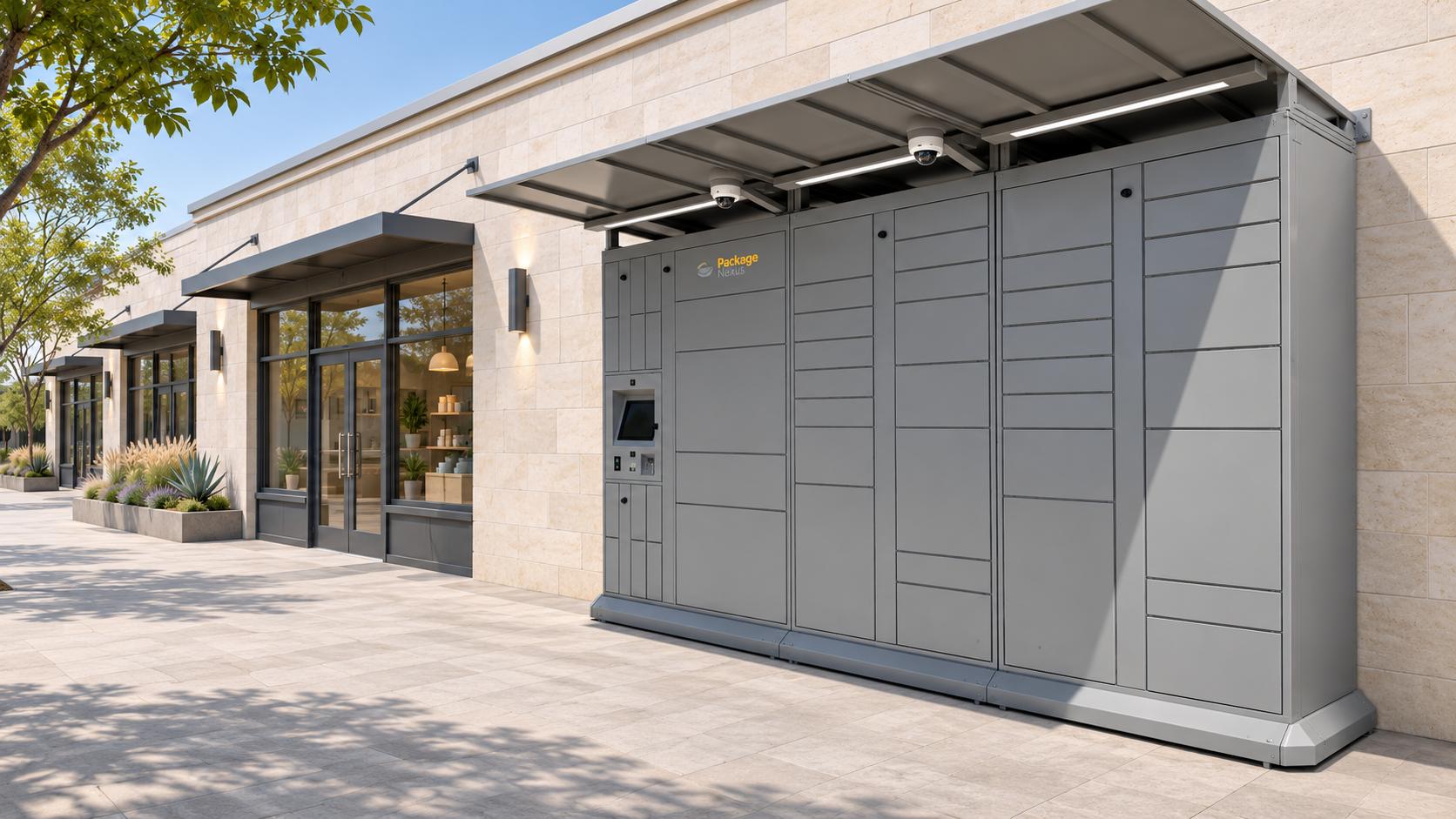
Purpose-designed outdoor smart parcel lockers can serve properties with limited indoor space and support pickup without opening the main building. Consider an entrance approach, common amenity area, or approved retail pickup plaza with an accessible, well-lit path. Select the enclosure, finish, electronics, foundation, anchoring, and any canopy for the actual exposure.
Review direct sun on the display, summer heat, winter conditions, rain, snow accumulation, drainage, and coastal corrosion. A canopy improves shelter but does not convert an indoor-only locker into an outdoor-rated system. Confirm the quoted model’s operating limits and installation requirements instead of assuming that a covered location is sufficient.
Existing buildings and new construction
Existing storage rooms, underused alcoves, or enlarged mailrooms may become effective package destinations after a site review. Check the installation route as carefully as the final location: door openings, elevators, turns, overhead clearance, and equipment handling space can determine feasibility. In new construction, coordinate the locker layout, utilities, access control, and future expansion area before the surrounding finishes are finalized.
Locations that extend service beyond a front desk
Retail stores and grocery pickup
Position smart lockers for retail pickup near the customer arrival route and close enough to fulfillment staff for efficient loading. A separate pickup vestibule can support extended hours if building access permits. Where groceries or other sensitive goods are part of the service, specify temperature-controlled smart lockers with the required temperature range, capacity, ventilation, monitoring, and response procedures. An ambient locker provides secure storage; it does not provide refrigeration.
Libraries and campuses
Well-placed library pickup lockers can make reserved materials available outside staffed service hours. For student housing, place stations near residence halls or the campus mail center and plan for semester peaks. Verify the connection between the locker workflow and the institution’s circulation or recipient-management system before promising a particular integration.
Workplaces and guest services
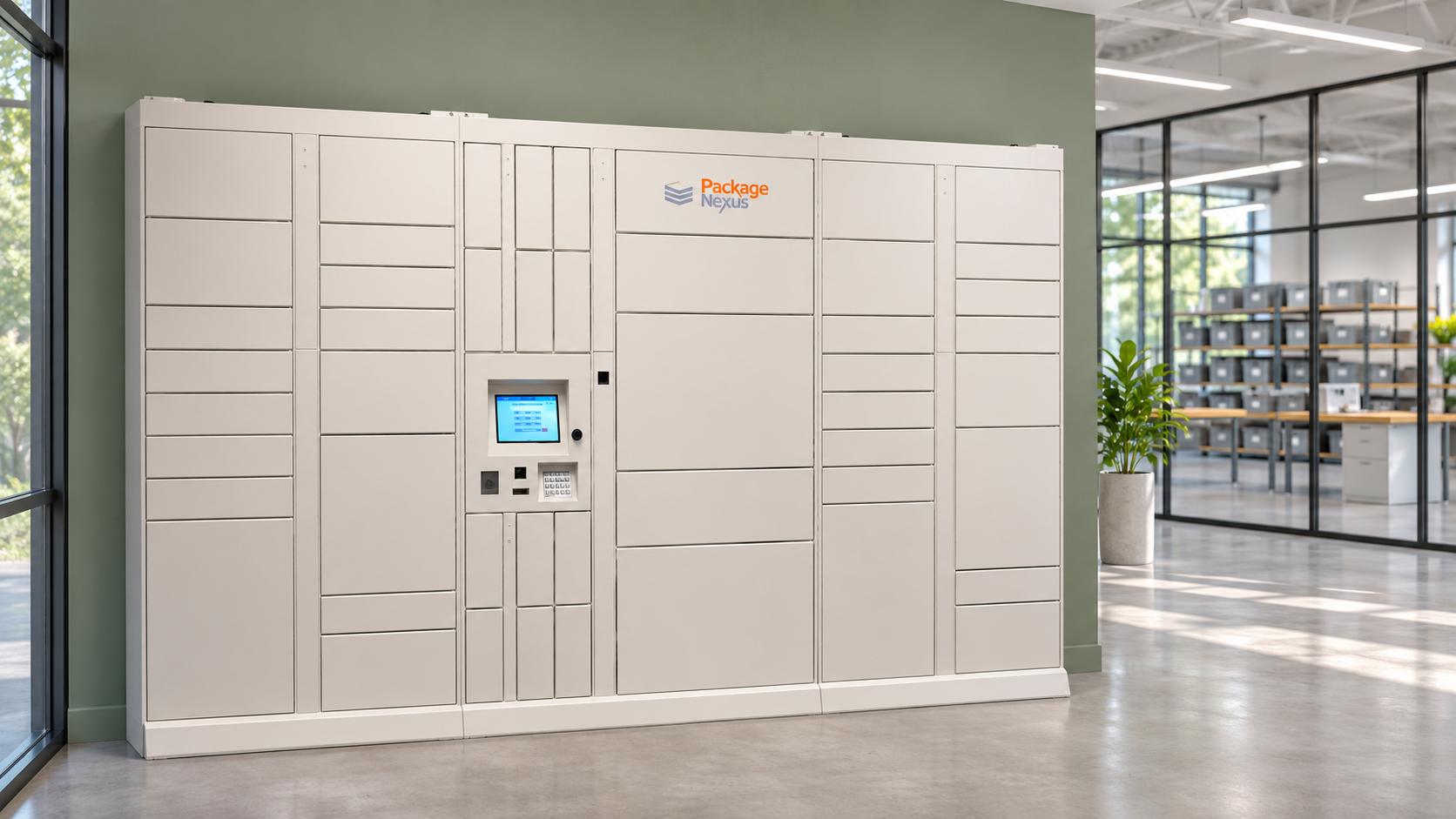
For workplaces, corporate mailroom lockers can provide employee pickup while preserving a controlled boundary around office space. Hotels can locate lockers beside guest services, with procedures for arrivals and departures. Warehouses and service businesses can create a pickup point outside active handling areas. Each use needs its own recipient records, retention rules, and exception process; the locker location should support those procedures.
What a site needs before installation
Successful smart parcel locker installation planning connects the physical layout to the operating workflow. Use the following checklist before approving a location or issuing construction instructions.
1. Clear access for carriers and recipients
Walk both routes from arrival to departure. Confirm delivery hours, building-entry credentials, signs, legal vehicle stopping arrangements, and a safe way to move parcels. A system behind a locked door still depends on someone providing access unless the entry process has been planned.
2. A suitable base and secure installation
Confirm the cabinet layout, installed weight, floor or slab capacity, level surface, and anchoring method. Outdoor locations also need drainage and site-specific foundation review. Obtain the final equipment drawing and installation instructions before fixing the slab or mounting points.
3. Power and tested connectivity
Confirm voltage, circuit capacity, outlet location, cable routing, and connectivity requirements for the quoted configuration. Test the network at the kiosk location. Refrigeration and other specialized equipment may change the electrical design. Agree on what remains available during a power or internet interruption and how service is restored.
4. Room to open doors and move packages
Allow for compartment door swing, wheelchair approach, turning, carts, queues, and maintenance. Keep exits, fire equipment, electrical panels, and required circulation clear. A visually neat row of cabinets can still be difficult to use if there is no space to step back with a large box.
5. Accessibility as part of the whole route
Plan accessible entry, clear floor space, reachable controls and assigned compartments, and usable door hardware. Common U.S. accessibility provisions include a 30-by-48-inch clear floor space and an unobstructed reach range of 15 to 48 inches. These are starting points, not a complete layout approval; alcoves, obstructions, turning space, and applicable scoping rules can require more.
6. Lighting visibility and exposure
Provide readable screen conditions, sufficient barcode-scanning light, useful camera sightlines, and safe nighttime access. Match the equipment to moisture, heat, cold, dust, and sun exposure. Avoid secluded locations that make users uncomfortable or leave the installation difficult to observe.
7. Clear ownership of daily operations
Assign responsibility for recipient-list updates, overdue parcels, carrier instructions, notification issues, cleaning, and unresolved incidents. Automated delivery and pickup do not remove the need to maintain accurate recipient information or a functioning building network.
8. A practical commissioning demonstration
Test actual carrier labels, small and flat parcels, representative box sizes, delivery notifications, pickup, and the exception scenarios the system is intended to resolve. Confirm that the accessible workflow and any package room or temperature-controlled equipment operate as specified.
Capacity that can grow with the property
Size the installation around parcels and pickup behavior, not unit count alone. The useful inputs are average and peak deliveries, package dimensions, the time parcels remain before collection, and how many compartments are unavailable for maintenance or special assignments.
A useful first estimate
For an initial one-package-per-compartment estimate, multiply average daily locker deliveries by average pickup dwell time in days. Then test that estimate against peaks, size distribution, and operating reserve. This is a planning calculation, not a final engineering specification.
Illustrative example: 45 locker deliveries per day × 1.5 days before pickup = about 68 occupied compartments on average. Adding a 25% planning reserve gives about 85 compartments. A holiday surge or shortage of large compartments could require more, even if small compartments remain empty. These figures are assumptions for illustration, not a recommended size for a particular property.
Plan the next phase before the first installation
Package Nexus lockers are 100% modular and can be expanded as the community or package volume grows. Plan modular locker expansion by reserving usable wall or floor space, reviewing electrical and network capacity, and keeping service access clear. Compatible modules can be added at a later phase; the final arrangement still needs enough physical space and an approved configuration.
A larger central bank may suit a compact building. A spread-out property may benefit from separate stations near different entrances. Compare carrier travel, resident walking distances, utilization, and the cost of maintaining additional locations before choosing a layout.
Include overflow and special storage
Package sizes matter as much as package counts. Provide an agreed route for parcels that exceed the usable compartment opening, and decide how to handle uncollected items during busy periods. Refrigerated, freezer, or heated compartments should be sized for the relevant delivery stream and holding time. Adding a package room can improve flexibility for bulky items without using every locker compartment for an oversized delivery.
| Planning input | Why it changes the layout |
|---|---|
| Daily and peak delivery counts | Determine normal workload and surge capacity. |
| Pickup dwell time | Longer storage time keeps more compartments occupied. |
| Parcel dimensions and mix | Determine the balance of small, medium, large, and special compartments. |
| Entrances and walking routes | Determine whether one hub or several locations are more convenient. |
| Future occupancy and available space | Determine the expansion path and utility provisions. |
Selecting lockers or a package room
Package Nexus offers three useful approaches: individually secured smart parcel lockers, an Integrated Package Room, and a Standalone Package Room. The choice depends on available space, budget, package sizes, and the level of parcel-by-parcel accountability the property needs.
Third Generation smart parcel lockers
Package Nexus uses Third Generation, or Gen3, to describe its combination of patented sensing, intelligent hardware, and automated workflows. The objective is complete transparency and accountability for supported delivery and pickup events: the system connects an authorized transaction and a specific compartment with evidence that a package is present or has been removed.
That is materially stronger than recording that someone entered a shared room. Presence sensing does not identify the contents of a sealed parcel or correct an incorrectly selected recipient by itself. Accurate recipient selection, controlled access, and reliable transaction records remain part of the complete process.
An integrated solution for different package types
The Integrated Package Room can bring ambient smart lockers, refrigerated smart lockers, other temperature-controlled smart lockers, and a Smart Package Room under a centralized computer system. Ordinary parcels can use individual compartments while oversized items or overflow use the room. This provides a coordinated package management solution across storage types, with the exact equipment and workflows specified for the project.
A computerized room when space or budget is limited
The Standalone Package Room uses an exterior access computer and controlled entry to organize deliveries in an existing room. The carrier selects a specific shelf-zone during delivery, and the recipient uses the pickup credential and zone information to find the parcel. Matching digital zone names to clear shelf labels makes collection easier and reduces searching.
This is a practical, organized option when there is insufficient space or budget for an appropriate locker installation. It also accommodates bulky parcels. Entry photos, access records, and optional interior cameras can improve visibility, but shared shelves inherently lack the individual isolation and automatic package-removal verification of a sensor-equipped compartment.
| Capability | Gen3 locker compartment | Shared package room |
|---|---|---|
| Physical access | Authorized access to the assigned compartment | Authorized entry into shared storage |
| Location of the parcel | Associated with a specific compartment | Associated with a selected zone or shelf |
| Delivery and removal evidence | Package-presence sensing supports verification | An entry record alone does not verify a particular parcel |
| Best fit | Individual security and automated transaction accountability | Bulky items, overflow, or constrained projects |
Why automatic verification matters in every location
Moving packages out of a lobby does not solve inaccurate delivery records. A locker that relies on a final yes-or-no response can record the wrong outcome when a courier rushes, a recipient misunderstands a prompt, or a session times out. The package may remain inside even though the system marks the compartment empty, or a completed delivery may fail to produce the expected pickup instructions.
Package Nexus estimates that required user inputs can be wrong or missing in 10–20% of interactions in workflows that rely on manual confirmation. This is a company estimate, not an independently established error rate for every vendor or installation. The practical concern is clear even without applying a universal percentage: a confirmation is a statement about an event, while sensing supplies evidence of the physical state.
From detecting a parcel to completing the workflow
Package Nexus describes its patented On-Auto-Pilot technology as the only smart parcel locker solution offering its worldwide-patented combination of package detection and autonomous correction of supported delivery and pickup errors. The company reports patent protection in the United States, Australia, and 18 European countries. Its worldwide-patented description refers to that international portfolio, with rights applying in the jurisdictions where protection exists.
The company describes automatic package detection across large, medium, small, and flat parcels, rather than dependence on a final user answer. The benefit comes from connecting that detection to the transaction: determine whether a parcel is present, reconcile the recorded event, complete or correct the supported workflow, and update pickup access and compartment availability appropriately.
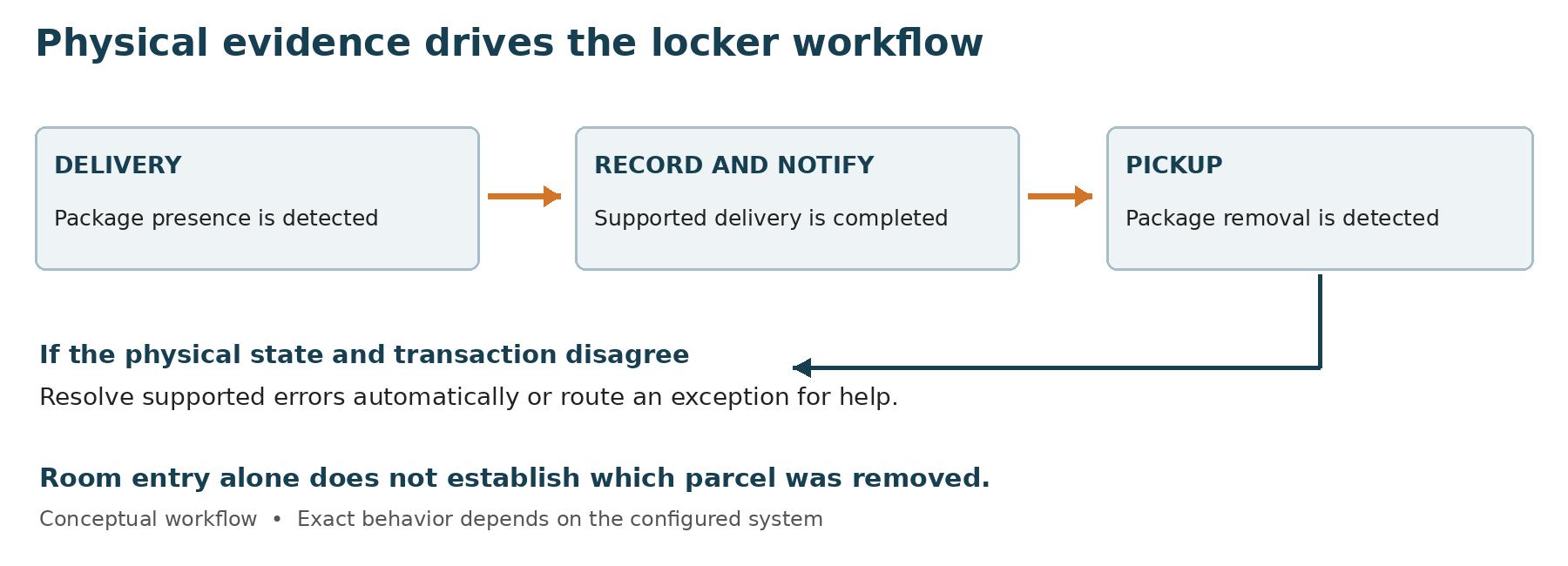
Sensing supports the transaction record. A camera or door-entry log alone does not establish parcel removal.
Less routine troubleshooting for site managers
For the confirmation errors and unfinished transactions the system can resolve automatically, On-Auto-Pilot removes the need for a site manager to visit the lockers and manually reconcile each incident. Staff can focus on leasing, resident service, or business operations. Systems that leave those exceptions unresolved can shift the work back to the property team. Compare the actual recovery behavior in a demonstration; equipment faults, incorrect recipient data, and unresolved incidents still require an appropriate support path.
Why cabinet construction matters at the chosen site
Parcel lockers are shared infrastructure. Doors are opened repeatedly, boxes contact cabinet edges, and outdoor installations face additional environmental exposure. Package Nexus specifies heavy-duty 12-gauge steel in its comparison materials, with galvanized construction and powder coating described for its cabinets. This is a substantial construction choice when evaluating alternatives that specify 16- or 18-gauge panels.
What the gauge difference means
| Gauge | Nominal mild steel thickness | Nominal galvanized sheet thickness |
|---|---|---|
| 12 | 0.1046 in | 2.657 mm | 0.1084 in | 2.753 mm |
| 16 | 0.0598 in | 1.519 mm | 0.0635 in | 1.613 mm |
| 18 | 0.0478 in | 1.214 mm | 0.0516 in | 1.311 mm |
These are nominal chart values, with millimeters converted from inches and rounded. Actual supplied thickness varies with the material specification and tolerances. Request decimal thickness and identify which cabinet, door, and shelf components use the stated gauge.
For the mild-steel values above, 12 gauge is about 75% thicker than 16 gauge and 119% thicker than 18 gauge. The galvanized-chart comparisons are approximately 71% and 110%, respectively. Those are thickness comparisons, not percentages of security improvement.
With comparable material and panel design, greater thickness can improve resistance to denting, bending, and deformation from repeated use or impact. A stiffer door and cabinet can also help preserve alignment around hinges and locks. These advantages are particularly relevant in busy multifamily buildings, public-facing pickup areas, and service environments where equipment must tolerate frequent handling.
Security depends on the assembled system: lock design, hinges, reinforcement, seams, anchoring, and installation all matter. Thickness alone does not establish a forced-entry certification or a guaranteed service life. Twelve-gauge steel also adds weight and material cost, which should be included in handling and floor-load planning. Compare the specified construction of each proposed system rather than assuming that every other supplier uses thinner steel.
Match the finish and electronics to the environment
Galvanizing and a suitable powder-coated finish help protect steel against corrosion, but local exposure and maintenance still matter. Outdoor siting should account for water paths, standing moisture, salt exposure, and coating damage. Package Nexus also identifies a fanless industrial PC, industrial touch display, dedicated barcode scanner, cameras, keypad, and compartment lighting in its published hardware materials. Confirm the supplied components and environmental limits for the actual installation.
Specify a complete operating solution
A useful specification connects each published feature to a decision about the site. The following Package Nexus capabilities provide a starting point; the final proposal and equipment schedule determine the delivered configuration.
| Published feature | Installation and procurement detail |
|---|---|
| Modular cabinet system | Confirm total dimensions, usable door openings, compartment mix, installed weight, anchoring, and expansion area. |
| 12-gauge steel construction | Confirm the material and decimal thickness of doors, cabinet panels, and shelves, plus finish and corrosion protection. |
| Industrial computing and display | Published multifamily materials identify an industrial PC and 15-inch touchscreen. Confirm the quoted indoor or outdoor display and operating limits. |
| Dedicated scanning and input devices | Comparison materials identify a Honeywell 3320G scanner and Braille keypad. Confirm the supplied models and test representative carrier labels. |
| Sensors and On-Auto-Pilot workflows | Demonstrate small and flat packages, unfinished delivery sessions, and a pickup attempt in which the parcel remains inside. |
| Notifications and management tools | Confirm supported notification channels, recipient-data maintenance, administrative access, reporting, and integration scope. |
| Cameras and compartment lighting | Confirm camera coverage, recording or image-capture behavior, retention settings, lighting, and authorized access to records. |
| Special storage and room control | Confirm temperature ranges, electrical loads, ventilation, alarms, door access, shelf-zone labeling, and centralized control scope. |
A technology partner owned and operated in the US
Package Nexus is 100% U.S.-owned and operated. For owners who value a domestic supplier relationship, this can simplify discussions about project planning, support responsibilities, future expansion, and product accountability. U.S. ownership is a distinct attribute from the country of origin of every component; evaluate the offered hardware, service terms, and support arrangements together.
Measure value in daily operations
The return on a well-planned installation comes from fewer manual handoffs, less time spent searching for parcels, easier pickup, and less routine correction of avoidable workflow errors. Compare total ownership cost—including site work, utilities, service, maintenance, software, and staff time—and measure delivery success, pickup dwell time, overflow, and staff interventions after installation.
To request a site-specific proposal, provide photos or a floor plan, available dimensions, average and peak package volume, typical parcel sizes, intended access hours, and power and network information. Package Nexus can help evaluate indoor or outdoor lockers, an integrated arrangement, or a standalone room around the needs of the property.
Frequently asked questions
Can smart parcel lockers be installed outside
Yes. Outdoor installation is practical when the selected equipment is designed for the site’s exposure and installed on an appropriate base. Review temperature limits, sun, rain, drainage, snow, wind, corrosion, power, connectivity, and anchoring. A sheltered position can improve the pickup experience, but a roof or canopy does not make an indoor-only model suitable for outdoor use.
Where is the best place for lockers in an apartment building
An entrance vestibule, lobby-adjacent area, mailroom, or dedicated package space is often a useful starting point. The best option allows couriers to deliver reliably and residents to collect conveniently while respecting the building’s access boundary. Compare actual routes and opening hours. For a large property, several locations may serve residents better than one distant station.
Can lockers be installed in a garage
Yes, if the specific garage location meets the equipment and site requirements. Provide a protected pedestrian area, appropriate lighting, safe vehicle separation, clear circulation, and suitable power and networking. Consider moisture, dust, exhaust, and temperature variation. Some garages need outdoor-suitable equipment even though they have a roof.
How much space is required
There is no universal footprint. Required space includes the selected cabinets, door swing, accessible approach, turning and circulation space, maintenance access, and any future modules. The usable compartment opening also matters when sizing for large boxes. Obtain a dimensioned layout and review the delivery and installation route before approving the space.
Can an existing building add smart lockers
Yes. Existing mailrooms, storage rooms, entrance areas, or exterior locations can be assessed for a retrofit. Review electrical and network access, floor conditions, anchoring, access control, and the route used to move equipment into place. A location that appears suitable on a floor plan may need adjustments to door clearance, circulation, or utility routing.
Will residents be able to collect packages 24 hours a day
They can when both the locker service and the route to it are available around the clock. Lockers inside a building that closes at night do not automatically create 24-hour pickup. Set the building access schedule, credential policy, lighting, and support process to match the hours promised to users.
Can Package Nexus lockers expand later
Yes. Package Nexus describes its lockers as 100% modular, allowing compatible capacity to be added as demand grows. Reserve space and review infrastructure during the initial design. Expansion should respond to measured package volume, size mix, and dwell time, and the final module arrangement must remain compatible with the site and system configuration.
Can refrigerated lockers share a location with ambient lockers
Yes. Package Nexus offers ambient and temperature-controlled storage, and an integrated configuration can combine them with package room access under centralized computer control. Specify the required temperature range, holding time, power, ventilation, monitoring, and response procedure. Cooling electronics in an outdoor cabinet is different from refrigerating the parcel compartment.
Is a package room as accountable as an individual smart locker
A controlled package room improves organization and records who enters, but that entry alone does not prove which parcel was deposited or removed. Individually secured compartments with presence sensing provide stronger evidence about a specific delivery and pickup event. A package room remains useful for large items and overflow; select it with a clear understanding of that difference.
How do shelf zones help in a Standalone Package Room
During delivery, the carrier selects a zone and places the package in the matching area. The resident then uses the pickup workflow to enter and locate the parcel. Clear physical labels are essential so the digital location matches the room. Zones improve findability; they do not individually lock each parcel or independently establish its removal.
Why does sensing matter for small or flat packages
A workflow cannot confidently mark a compartment occupied or empty if it cannot detect the items it is intended to handle. Package Nexus describes sensing for small, large, and flat parcels, with software that uses the result to complete or correct supported transactions. Demonstrate the actual package mix during procurement, including a flat mailer and a pickup where the parcel is left inside.
What should we send Package Nexus for an installation assessment
Send the site address, photos or a floor plan, available width and depth, ceiling and doorway clearances, user count, daily and peak parcel volumes, package-size mix, and expected pickup timing. Include indoor or outdoor exposure, power and network information, desired access hours, and requirements for oversized or temperature-sensitive deliveries. Those details support a useful location and configuration recommendation.

Package Nexus is the global technology leader and provider of The World's Most Advanced Smart Parcel Lockers for efficient and most simplified package management for multifamily communities, retailers, universities, libraries, corporate offices, groceries, and more. Package Nexus unique and patented technology offers a fix for human errors at the time of package deliveries and pickups. Package Nexus solutions help property, store, and office managers to improve their operations, reduce operating costs, and increase customer satisfaction at the same time. Package Nexus offers its entire suite of solutions globally.
USEFUL LINKS

© 2017-2026 Package Nexus