


Why Package Detection Is Essential to Parcel Locker Workflows?
Accurate delivery and pickup records begin with knowing whether a package is actually inside the compartment. That knowledge should drive the workflow, the resident notification, and the decision to make the locker available again.
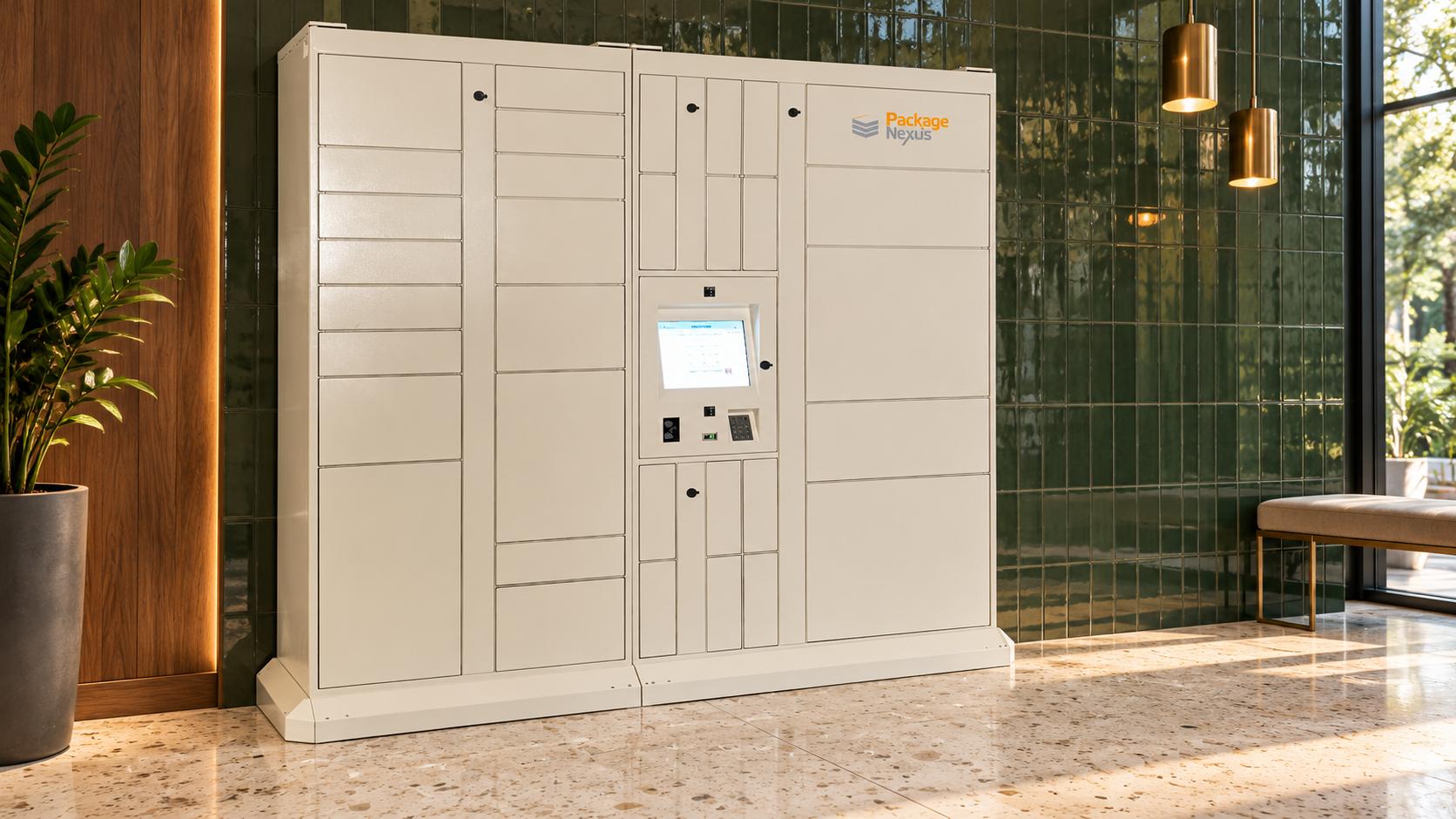
The direct answer
Package sensing matters because a button press, a door opening, and a completed package transfer are different events. A reliable parcel locker workflow checks physical package presence during delivery and package absence during pickup, then combines that evidence with the recipient assignment and door status before advancing the transaction. This prevents a missing or incorrect confirmation from becoming the sole basis for an alert, a pickup record, or an available compartment.
Package Nexus combines patented On-Auto-Pilot technology with automated transaction handling to address this problem. The aim is to remove routine confirmation errors from the property team’s workload and give residents a pickup experience that matches what is actually happening inside the locker.
What a package sensor tells the system?
Package presence detection establishes whether an object occupies the compartment. The software uses changes in that physical state as evidence of placement or removal. A door sensor answers a different question: whether the door is open or closed. Neither a touchscreen response nor a door event alone establishes that a parcel changed hands.
| Signal | What It Establishes | What It Does Not Establish by Itself |
|---|---|---|
| User selects Done | The user submitted a response. | That a package was placed inside or removed. |
| Door opens or closes | The access cycle changed. | That the compartment is occupied or empty. |
| Package present or absent | The sensed occupancy state. | The parcel’s identity, owner, contents, or condition. |
| Recipient and parcel association | Which delivery belongs to which account. | That the physical handoff occurred. |
| Combined workflow evidence | A basis for advancing or holding the transaction. | A guarantee against every misuse or hardware fault. |
The strongest workflow combines these signals. It knows which recipient the delivery belongs to, checks the relevant package state, verifies that the compartment has been secured, and records the outcome. If evidence is missing or contradictory, the transaction needs an unresolved state and a defined recovery path. Treating uncertainty as success merely moves the problem to the next user.
Why package size and shape matter?
Real deliveries include flat document envelopes, padded mailers, small accessory boxes, soft bags, tubes, and large cartons. Packages can sit near an edge, lie flat on the floor of the compartment, or occupy only a small part of its volume. A demonstration using one large cardboard box does not establish dependable detection for that entire mix.
The business requirement is consistent detection across the supported package sizes, shapes, materials, and placement positions. If a system overlooks thin or small items, it may offer automation for a large carton while returning to manual confirmations for another everyday delivery. That leaves the property with the same category of error the technology was supposed to remove.
Package Nexus states that its sensing technology detects large, medium, small, and thin or flat parcels. Buyers should see that capability demonstrated with their own representative items, inside the proposed compartment sizes. Detection coverage and physical fit are separate requirements: an oversized object still needs a compartment or room that can safely accommodate it.
How verified delivery and pickup should work?
During delivery, the system associates the parcel with the intended recipient and opens an appropriate available compartment. Sensing establishes that the package was deposited; the door and transaction controls establish whether the delivery can be finalized. Only then should the recorded delivery trigger its pickup notification.
During pickup, the recipient authenticates and opens the assigned compartment. The workflow checks whether the parcel has actually been removed. If the person closes the door without taking it, the record should continue to show an outstanding package. If removal is verified, the software can complete the pickup and return the secured compartment to service.
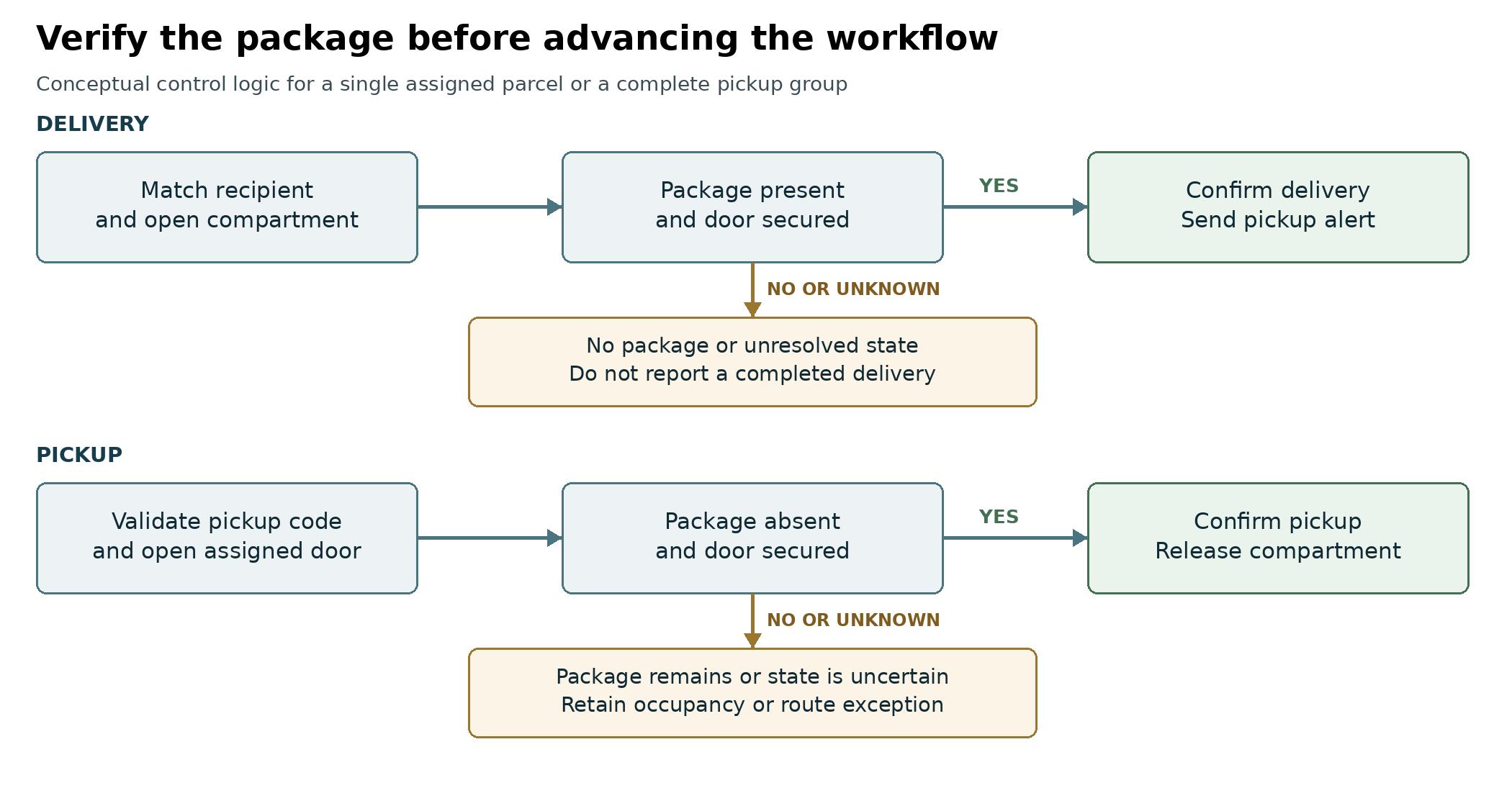
A timeout should trigger a review of the available evidence, not an automatic assumption that the parcel was delivered or collected. Likewise, sensing a package behind an open door does not mean the delivery is secure. The system must handle occupancy, access, and completion as related but distinct parts of the transaction.
The failures that physical verification helps prevent
The value of reducing delivery errors becomes clearest when the normal sequence is interrupted. The following examples describe failure mechanisms in workflows that rely on confirmations or access events without adequate physical verification; they are not a claim that every other product behaves the same way.
A pickup alert points to an empty compartment
A courier opens a door but discovers that the parcel will not fit, changes plans, or accidentally confirms delivery before depositing it. If that response becomes the delivery record, a resident may receive an alert for an empty locker. A package-present check gives the workflow an opportunity to stop the false completion and guide the courier to the correct next step.
A real delivery is left without a completed record
The reverse can happen when a parcel is deposited but the courier walks away, misses the final screen, or experiences a session timeout. The physical package exists while the digital record remains unfinished. Sensing can reveal that mismatch and support recovery using the recipient and transaction information already captured. If the recipient was never identified, presence sensing alone cannot supply that missing identity.
A resident closes the door before collecting the parcel
Opening a door does not prove pickup. A resident may shut it accidentally, become distracted, or decide to return later. If the software completes pickup based only on access or an incorrect Yes response, the resident can lose the expected retrieval path while the package remains inside. Keeping the package active until removal is verified protects the integrity of that record.
An occupied compartment is assigned to another delivery
A false empty status can direct a new courier to a compartment that still contains someone else’s parcel. That creates a delivery interruption and may expose an existing package during an unrelated transaction. Occupancy checks help prevent reassignment when the physical space is still in use.
An empty compartment remains unavailable
A resident may collect a parcel and miss the final confirmation. If the record continues to show occupancy, a useful compartment becomes unavailable even though it is physically empty. Accurate removal detection can restore that capacity promptly. Across a busy property, correcting these mismatches can improve usable capacity without adding a tower.
Several parcels are treated as one unidentified object
Presence sensing is especially important when multiple parcels share a compartment, but a simple occupied-or-empty signal cannot count them or identify which one was removed. Consolidated delivery therefore needs item associations and a defined complete-group or partial-pickup workflow. A trustworthy design preserves individual records instead of inferring that every parcel was collected merely because the door opened.
What a 10 to 20 percent confirmation problem can mean
Package Nexus estimates that user inputs can be incorrect or missing in 10–20% of relevant confirmation interactions. This company-supplied estimate should be understood as a workflow concern, rather than a universal measured error rate for all locker systems. The practical lesson is that even a modest rate of unreliable responses can create repeated discrepancies when confirmation prompts control package status.
Consider an illustrative property handling 100 package deliveries and 100 pickups per day. If each transfer requires one final manual confirmation, the system processes 200 confirmation opportunities. Applying the estimate produces the following sensitivity example.
| Incorrect or Missing Input Rate | Confirmation Opportunities per Day | Incorrect or Missing Responses per Day |
|---|---|---|
| 10% | 200 | 20 |
| 15% | 200 | 30 |
| 20% | 200 | 40 |
These are response errors, not necessarily lost packages, unique incidents, or staff tickets. If every affected response in this scenario required three minutes of follow-up, the modeled workload would be 60–120 minutes per day. Some errors would resolve without staff; others could require more investigation. Actual results must come from the property’s transaction and support records.
The architectural advantage of physical verification is that it removes the final confirmation as a single point of failure. People still identify recipients, select suitable storage, and handle parcels. The technology takes responsibility for checking a physical action that a user may otherwise report incorrectly or forget to report at all.
How Package Nexus puts sensing to work?
Package Nexus describes itself as the only smart parcel locker provider with worldwide-patented technology that can detect package presence or absence across package sizes and shapes and use that evidence to drive its On-Auto-Pilot workflows. The company describes its patent protection as U.S. and international. This is Package Nexus’s stated product differentiation; the practical purchasing test is the demonstrated sensing and recovery behavior of the proposed configuration.
On-Auto-Pilot connects package detection with transaction logic. Package Nexus describes automated handling of supported delivery and pickup errors, including unfinished sessions and timeouts. The benefit comes from the complete sequence: detect the physical state, reconcile it with the transaction, perform the supported correction, and preserve an accurate record for the next user.
For the confirmation-related mistakes the workflow can resolve automatically, this removes the need for site managers to investigate and manually reconcile each event. Property teams can spend that time on residents, leasing, building operations, and service delivery. Equipment faults, incorrect recipient data, misuse, and genuinely unresolved incidents still need an appropriate support path.
These are practical staff productivity tools for locker operations: fewer routine reconciliation tasks, clearer status information, and less dependence on the leasing office as the place where every incomplete interaction must be repaired. Buyers should evaluate the number of interventions their team actually performs after installation, alongside delivery throughput and resident satisfaction.
Hardware and configuration that support the workflow
Package Nexus offers indoor smart parcel lockers with configurable compartment sizes and electronic access control. Its published hardware descriptions include the following elements. The final proposal should identify the specific equipment, dimensions, and options selected for the installation.
| Published Feature | Operational Purpose |
|---|---|
| Package presence sensing | Supports verification of deposits and removals, including small and thin or flat parcels. |
| Industrial fanless computer and local processing | Runs the kiosk and transaction workflow at the installation. |
| Industrial touchscreen | Provides guided carrier and recipient interaction; a 15-inch display is among the published options. |
| Honeywell 3320G barcode scanner | Supports the configured barcode intake and access workflows. |
| 12-gauge galvanized steel and powder coating | Provides substantial compartment construction and a protected finish. |
| Electronic locks and pickup credentials | Controls access to assigned compartments. |
| Embedded cameras and transaction records | Adds visual context and an activity record for authorized review. |
| Braille keypad, audio prompts, and compartment lighting | Supports usable interaction; installation design also affects accessibility. |
| Cloud-connected management and integration options | Supports administration and the agreed resident-data workflow. |
A scanner establishes an identifier; a camera can provide visual context; a package sensor reports occupancy. Their roles complement one another. None should be substituted for a capability it does not provide. Ask for the actual workflow when connectivity is interrupted, when a sensor reports uncertainty, and when a door does not secure correctly.
Choose the right combination of lockers and package rooms
The package mix should determine the storage design. Standard parcels, groceries, unusually large boxes, and seasonal overflow do not all need the same environment. Package Nexus offers individual lockers, an integrated locker-and-room approach, and a standalone computerized room.
Individual On Auto Pilot smart parcel lockers
Individual compartments suit properties that want recipient-specific physical separation and compartment-level package verification. They support self-service delivery and collection without making staff the normal handoff point. The correct mix of small, medium, large, and other available compartments should reflect actual deliveries and the time parcels remain stored.
An integrated solution for varied deliveries
The Integrated Package Room combines ambient smart lockers, refrigerated lockers, other temperature-controlled smart lockers, and a Smart Package Room under a centralized computer system. This gives a property a coordinated way to route ordinary parcels to lockers, eligible temperature-sensitive deliveries to the appropriate configured storage, and oversized items or overflow to the room.
Compartment sensing remains relevant in the locker portion of that system. Room access and parcel-location records support the room portion. A central management platform can coordinate both while preserving the differences between a physically verified compartment state and a recorded room delivery. Package presence detection also does not replace temperature monitoring or the handling requirements of a temperature-sensitive item.
A standalone room with organized shelf zones
The Standalone Package Room offers sophisticated computerized access for properties that can repurpose an existing room and may have limited space or budget for a full locker installation. A computer outside the door manages entry for carriers and residents. During delivery, the carrier selects a specific shelf zone, giving the recipient a clear location to find the parcel.
Residents receive a unique pickup code. An embedded camera at the exterior computer captures a photo of the person entering; optional interior cameras and large monitors can extend visibility inside the room. Clearly labeled zones, sensible shelf heights, and clear circulation turn a general storage area into a more organized delivery destination.
A shelf zone is a location assignment, and an entry record establishes room access. Neither independently proves that a particular parcel was removed from a shared shelf. The room should use its configured parcel-record and retrieval procedures rather than imply that it provides the same compartment-level proof as a sensing-equipped locker. Both approaches can reduce routine staff handling when matched to the property’s needs.
| Solution | Best Fit | Core Verification Approach |
|---|---|---|
| On-Auto-Pilot lockers | Individual secure compartments and frequent standard-size deliveries. | Package state combined with access and transaction records. |
| Integrated lockers and room | Mixed parcels, temperature requirements, oversized items, and overflow. | Compartment sensing plus the room’s configured access and parcel records. |
| Standalone Package Room | An existing usable room and a need for organized storage within project constraints. | Controlled entry, shelf-zone assignments, and recorded delivery and pickup procedures. |
Expand capacity as the community grows
Package Nexus lockers are 100% modular and can be expanded as the community or package volume grows. A property can start with an appropriate configuration and add compatible towers or storage options later, with expansion planned around available space, utilities, circulation, and the selected system configuration.
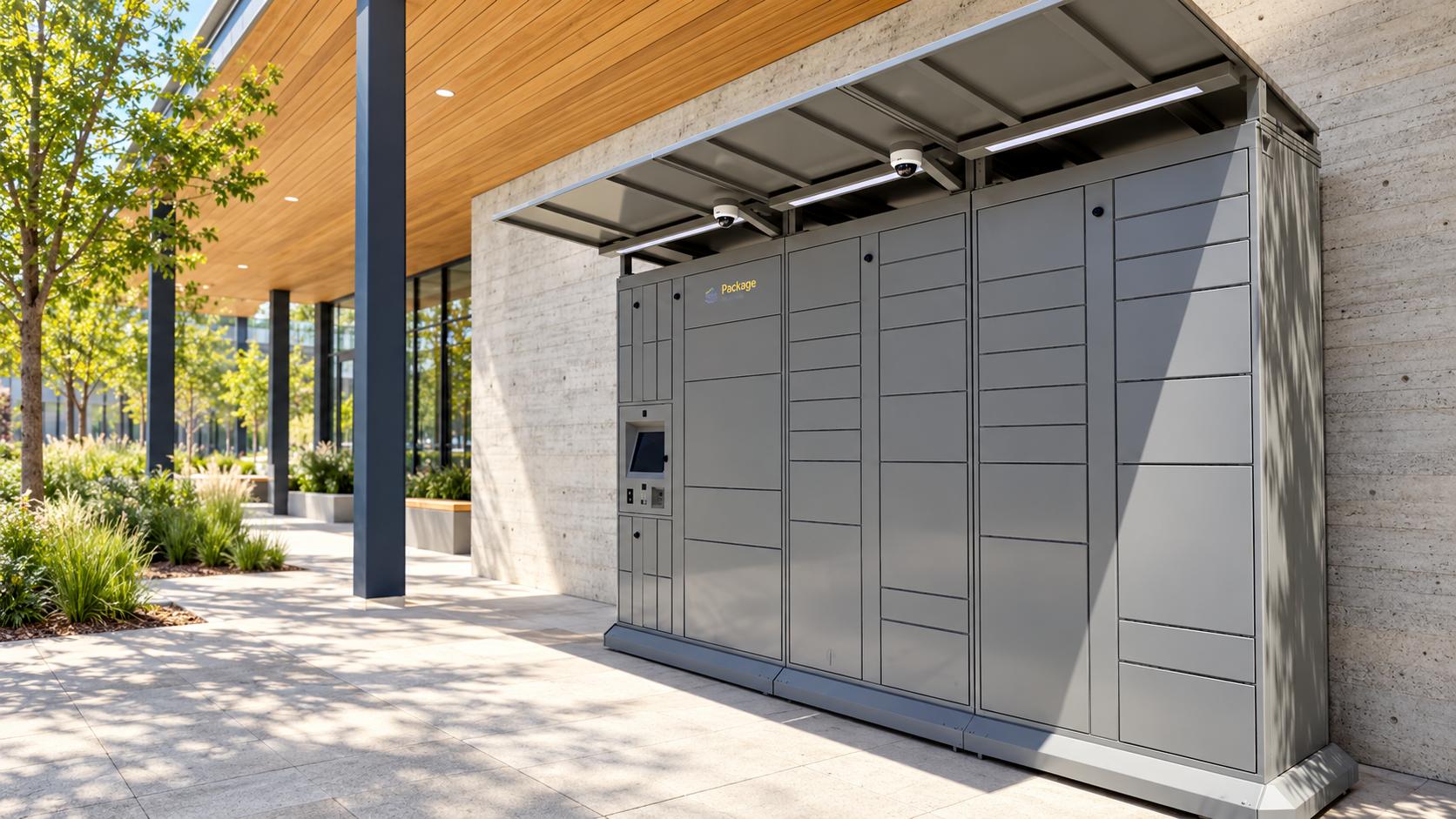
Indoor and outdoor smart parcel lockers give project teams additional placement options. Choosing a protected, visible, convenient location can encourage prompt collection. Expansion planning should consider both delivery peaks and how long parcels occupy compartments; a large installation can still feel full when records are wrong or parcels remain uncollected.
Accurate occupancy records support better sizing decisions. Measure the available capacity by compartment size and the number of completed package transfers, not only the number of doors installed. If consolidated storage is used, distinguish parcel count from compartment count and retain a reliable record for each delivery.
Benefits across properties and business settings
In multifamily communities and student housing, verified transfers help prevent confusing alerts and unnecessary visits to the management office. For package management for corporate campuses, the same principle supports employee deliveries and internal handoffs. Libraries can apply it to the deposit and collection of reserved materials, while retailers can use it for order pickup.
Warehouses benefit when equipment or supplies have a clear issue-and-return status. Hotels can offer guests a more flexible parcel handoff without routing every collection through reception. Each setting needs its own identity, access, and handling rules, but the operational question is consistent: did the physical transfer actually occur?
Field research on common-carrier lockers supports the value of consolidating deliveries: one residential-building study found a statistically significant reduction in time couriers spent inside the building, while the vehicle dwell-time reduction was not statistically significant. Related research also emphasizes capacity configuration, pickup timing, and adoption. These findings support careful operational design; they are not a measurement of Package Nexus sensor accuracy or a guaranteed savings figure.
A US owned and operated technology partner
Package Nexus is 100% U.S.-owned and operated. For organizations that value domestic ownership and a direct relationship with their technology provider, that is an additional reason to include Package Nexus in a project evaluation. Ownership, product performance, support responsibilities, and expansion plans can all be considered together when selecting a long-term package management partner.
The most useful demonstration shows how the system behaves when a user makes a mistake. Package Nexus’s emphasis on sensing and automatic recovery is relevant to buyers who want package handling to demand less continuing attention from their own teams.
What to test before choosing a system
Bring realistic packages and intentionally interrupt the normal process. A useful demonstration should show the physical item, the kiosk response, the notification, the manager record, and the resulting availability state for each test.
- Place a thin envelope, small box, padded mailer, and irregular parcel in different supported positions. Confirm both deposit and removal detection.
- Open and close an empty compartment during a delivery attempt. Check that an unsupported completed-delivery alert is not generated.
- Deposit a parcel after the recipient is identified, then leave the final screen or allow the session to time out. Observe the supported recovery behavior.
- Open a pickup compartment and close it with the parcel still inside. Check that the record continues to reflect an outstanding package.
- Complete a real pickup without answering a final confirmation prompt. Verify how the record and compartment availability are reconciled.
- Test a door left open, an uncertain sensor state, and interrupted connectivity. Confirm what resolves automatically and what requires support.
- For a shared compartment or package room, check the individual parcel records and the exact procedure for partial collection.
After installation, track false-ready alerts, occupied-versus-record mismatches, completion without assistance, manager interventions per 1,000 transactions, average pickup time, and peak occupancy by compartment size. Define each metric consistently. These measures reveal whether the system is reducing work as well as storing packages.
To evaluate the fit for your property, request a Package Nexus demonstration using your actual parcel mix and common exception scenarios. Review the On-Auto-Pilot locker workflow, the room options, and the modular growth plan together so the solution matches both today’s deliveries and tomorrow’s demand.
Frequently asked questions
Why is sensing a package more reliable than asking a user to confirm
Sensing supplies independent evidence of the compartment’s physical state. A person can press the wrong button, leave before answering, or misunderstand a prompt. Combining package state with recipient and door information reduces dependence on that response and gives the workflow a basis for checking whether the intended transfer actually happened.
Is a door sensor the same as a package sensor
No. A door sensor reports an access condition, such as open or closed. A package sensor reports occupancy. A person can open and close a door without depositing or removing anything, which is why door activity alone should not be treated as proof of delivery or pickup.
Can smart lockers detect small packages and flat envelopes
The answer depends on the sensing technology and its coverage. Package Nexus states that its system detects small, medium, large, and thin or flat parcels. Test the proposed configuration using representative sizes, materials, and placements. Package fit, safe loading, and the supported detection envelope remain part of the installation requirements.
Does detecting an object prove that the correct package was delivered
No. Occupancy evidence establishes presence or absence, not identity. A complete workflow also needs an accurate association between the parcel, its recipient, and its storage location. Barcode records and the configured intake process can support that association. The sensing result helps verify the physical step within that larger process.
What happens if the courier leaves before completing the screen prompts
A workflow that only trusts the final response may leave the delivery unfinished. Package Nexus describes On-Auto-Pilot recovery for supported incomplete and timed-out transactions by using the available sensing and transaction information. If an essential detail such as the recipient is missing, the system needs a defined exception process rather than inventing it.
What if a resident closes the locker without taking the package
The package should remain recorded as present until its removal is verified. This protects against a false pickup completion and premature compartment reassignment. During a demonstration, ask how the resident continues the retrieval process and what the manager record shows after this exact event.
Are 10 to 20 percent of packages lost because of manual confirmations
No such conclusion follows from the estimate used here. The 10–20% figure is Package Nexus’s estimate of incorrect or missing user inputs, not a measured package-loss rate. One package can involve multiple interactions, and some incorrect responses resolve without intervention. Use actual site data to measure incidents, staff time, and losses separately.
Does On Auto Pilot eliminate every possible support incident
It is designed to eliminate routine manual reconciliation for the supported confirmation and workflow errors it can resolve. That can materially reduce ongoing manager involvement. Physical damage, incorrect recipient information, hardware problems, and unresolved exceptions still require the appropriate service or management response. The scope of automatic recovery should be demonstrated and documented.
Can sensing improve capacity without installing more lockers
It can help recover capacity that is physically empty but incorrectly recorded as occupied, and help keep occupied compartments from being reassigned. Actual storage capacity still depends on compartment dimensions and availability. Pickup timing, package mix, consolidated-delivery rules, and peak demand also affect how efficiently the installation is used.
Can several packages share one compartment
A configured consolidated-delivery workflow can associate several parcels with one compartment, but the design must preserve the relevant parcel records and access rules. An occupied-or-empty sensor alone cannot identify which parcel was removed during a partial pickup. Ask how the system handles that situation before relying on consolidation for capacity planning.
What makes the Package Nexus patent position distinctive
Package Nexus positions itself as the only provider with its worldwide-patented package-sensing and On-Auto-Pilot workflow technology, described by the company as U.S. and international patent protection. The practical distinction to evaluate is how sensing works together with automated recovery across the supported parcel mix. Buyers can request the applicable patent details and a live workflow demonstration.
How do the integrated and standalone package rooms differ
The integrated approach coordinates ambient lockers, refrigerated and other temperature-controlled lockers, and a package room through a central computer system. The standalone room uses an exterior access computer, carrier-selected shelf zones, and unique resident pickup codes to organize an existing space. It can suit projects whose package mix, available room, or budget favors room storage.
Does a package room verify pickup in the same way as an individual locker
Room entry logs and shelf-zone assignments do not independently verify removal of a particular parcel. The room uses its configured delivery and retrieval procedures, supported by access controls and available camera records. Individual sensing-equipped compartments offer a different form of physical verification because their occupancy can be associated with a restricted storage location.
Can Package Nexus lockers expand as demand grows
Yes. Package Nexus describes its lockers as 100% modular and expandable as community size or package volume increases. Plan expansion space and utility needs early, then adjust the compartment mix or discuss room capacity as delivery patterns change. A staged project should preserve convenient access and clear circulation at each phase.
Is Package Nexus a US owned company
Yes. Package Nexus is 100% U.S.-owned and operated. That gives buyers who prioritize domestic ownership a relevant option alongside the company’s sensing technology, automated workflows, locker configurations, package room choices, and support offering. Ask for a project-specific proposal that brings those elements together.

Package Nexus is the global technology leader and provider of The World's Most Advanced Smart Parcel Lockers for efficient and most simplified package management for multifamily communities, retailers, universities, libraries, corporate offices, groceries, and more. Package Nexus unique and patented technology offers a fix for human errors at the time of package deliveries and pickups. Package Nexus solutions help property, store, and office managers to improve their operations, reduce operating costs, and increase customer satisfaction at the same time. Package Nexus offers its entire suite of solutions globally.
USEFUL LINKS

© 2017-2026 Package Nexus