


Parcel Locker Systems Explained
Features, Benefits, and Best Practices
Parcel locker systems secure deliveries in electronically controlled compartments, notify recipients, and support self-service collection. The strongest systems also verify that a parcel was actually deposited or removed, so their records reflect physical activity rather than a user’s answer to a screen prompt.
For multifamily owners, developers, retailers, and facility teams, the goal is a dependable handoff with less routine staff work. Package Nexus combines patented On-Auto-Pilot technology, industrial-grade hardware, modular storage, and configurable finishes to make package management a practical part of the property experience.
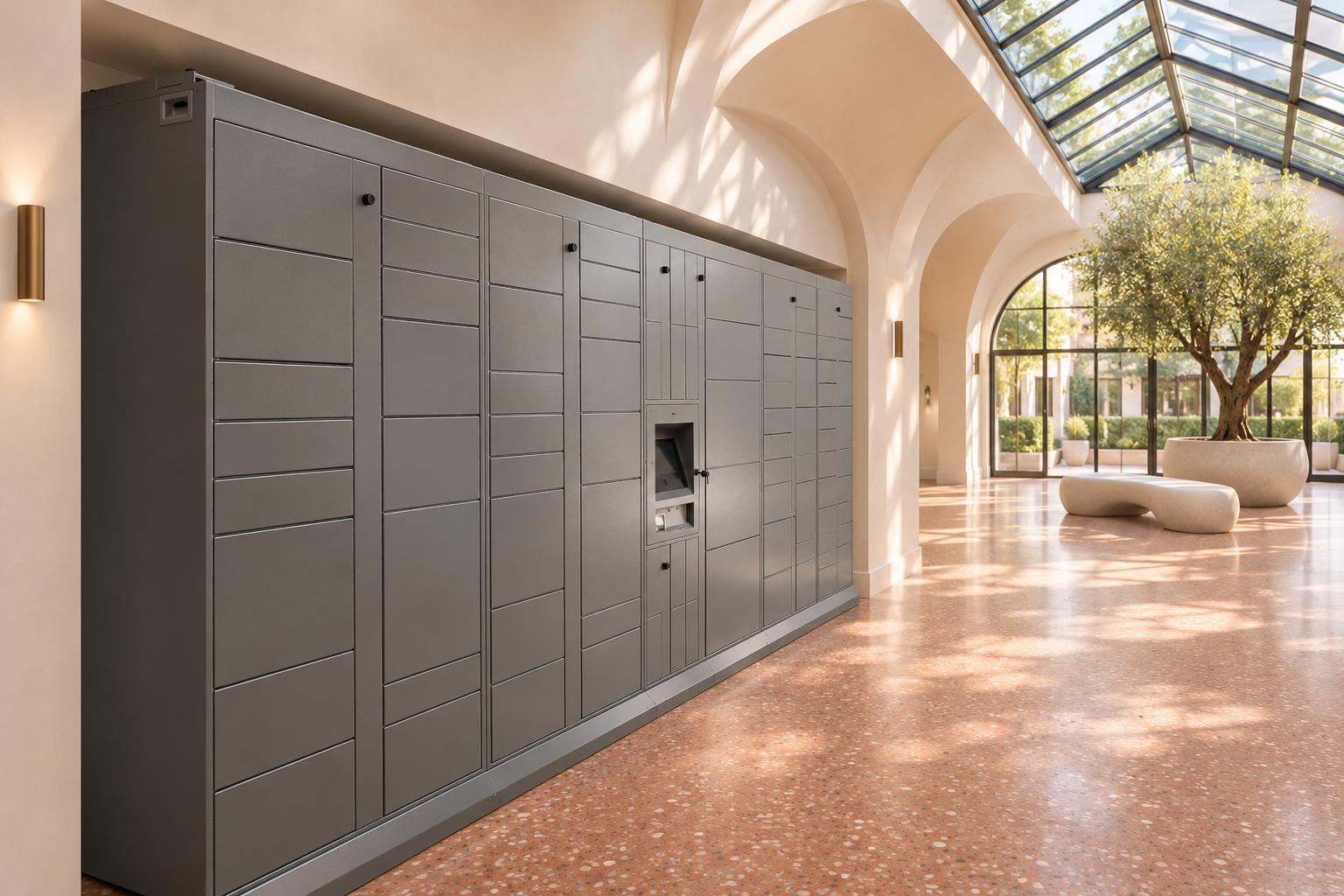
What this guide covers
Learn how parcel lockers work, which features matter, why verification changes accountability, and how to plan capacity, placement, resident access, and ongoing operations. Expanded FAQs answer common purchasing and implementation questions.
How parcel locker systems work
An electronic lock is only one part of the system
A parcel locker combines cabinets, controlled locks, recipient information, a user interface, notifications, and management software. A PIN or barcode authorizes access; software associates a transaction with a compartment. Connected management tools allow authorized teams to review activity and handle exceptions. General smart lockers may also serve personal storage or equipment loans, which require different workflows from parcel delivery.
The delivery and pickup sequence
- Identify the recipient. The courier selects the intended resident or customer using the configured delivery workflow. Accurate recipient data remains essential.
- Allocate a suitable compartment. The system opens available storage appropriate to the parcel. Oversized items follow the property’s designated alternative process.
- Deposit and verify. Package Nexus sensing technology determines package presence and guides the supported completion workflow. The system should distinguish a real deposit from an empty compartment.
- Notify the recipient. The recorded delivery triggers pickup instructions. Valid contact details and working communication services support successful notification.
- Authorize pickup. The recipient uses a supported credential or touchless pickup option to access the assigned compartment.
- Verify removal and update availability. Package activity informs completion, the transaction record, and when storage can be reused. Closing and securing the door remains part of a successful handoff.
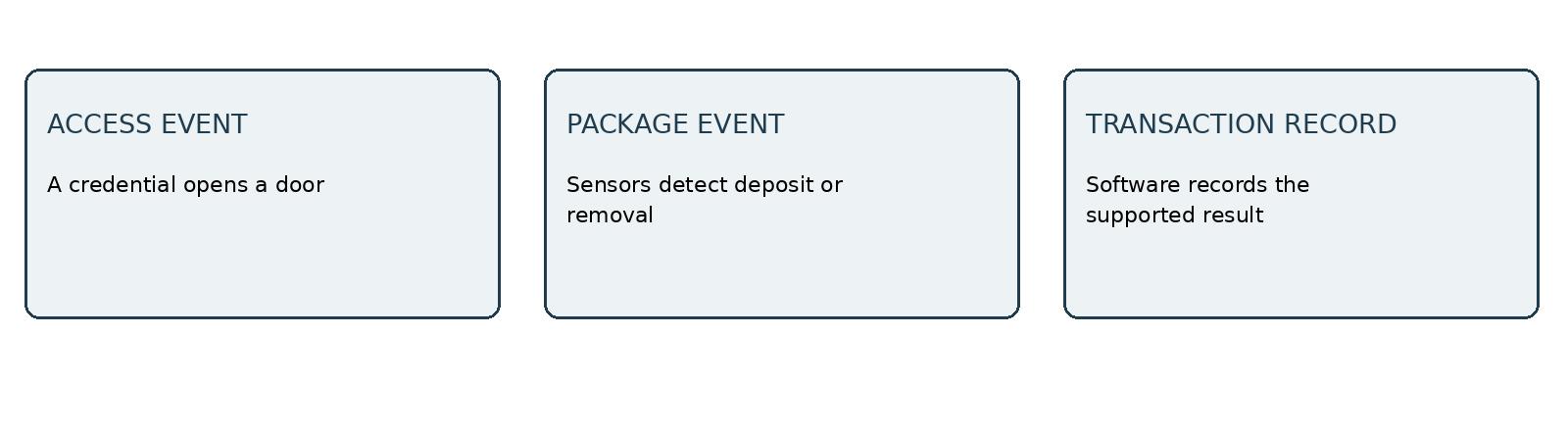
Access, package presence, and transaction completion are distinct facts. A door-opening log alone does not prove collection.
Why verification changes accountability
Package Nexus and the third generation approach
Package Nexus describes itself as the only provider of 3rd Generation Smart Parcel Lockers powered by its patented On-Auto-Pilot technology. The company states that its U.S. and international patent protection extends to 2040 and describes its worldwide patented technology as uniquely enabling these sensor-driven delivery and pickup workflows. These are Package Nexus’s company claims; the generation labels are its comparison framework, not an independently standardized industry certification.
The practical difference is how the system decides that a transaction has succeeded. Instead of relying on answers to questions such as “Did you deliver? Yes/No” or “Did you pick up? Yes/No,” the Package Nexus approach uses package detection to guide supported workflows. That reduces the gap between what a person reports and what actually happened inside the compartment.
What complete transparency should mean
Package Nexus describes this approach as providing complete, or “100%,” transparency and accountability. In practical terms, the objective is a traceable record of authorized access and verified package activity. It should not be interpreted as a guarantee against every theft, misdelivery, network outage, or hardware failure. A sensor can verify package presence without establishing that a courier selected the correct recipient.
Package Nexus estimates that user confirmations can be incorrect or missing in 5–15% of interactions. This company-provided range is not an independently validated industry benchmark. Its operational lesson is nevertheless clear: workflows are stronger when physical verification does not depend on a hurried courier or resident answering correctly.
| Situation | What buyers should ask the system to demonstrate |
|---|---|
| Door opened but no parcel deposited | No completed delivery based solely on the door opening. |
| Package remains after attempted pickup | The compartment is not treated as empty merely because pickup began. |
| Small or flat item | Detection using realistic envelopes and parcels at different positions. |
| User walks away or session expires | Supported automatic recovery and a clear exception record. |
| Door left open | Guidance and escalation; do not assume software physically closes the door. |
Compare current configurations fairly
Package Nexus’s comparison places Luxer One, Parcel Pending, Amazon Hub, and Package Concierge within earlier-generation categories. Buyers should test the current model and software being proposed rather than assume every competing installation behaves identically. Luxer One’s own support page describes iPad use and an app that can open lockers without the touchscreen; touchless access is therefore not an exclusive differentiator.
Features and hardware worth specifying
| Component | Published Package Nexus offering | Why it matters |
|---|---|---|
| Controller | Industrial-grade fanless computer | Dedicated control with serviceable peripheral connections. |
| Interface | Industrial-grade touchscreen and separate Braille keypad | Multiple ways to interact with the system. |
| Scanning | Dedicated barcode reader; Honeywell 3320G cited in comparison material | A purpose-built scanning component for supported workflows. |
| Cameras and audio | Embedded cameras and speakers | Visual transaction context and audible guidance. |
| Enclosure | Heavy-duty 12-gauge galvanized steel | Cabinet rigidity and corrosion protection. |
| Automation | Patented On-Auto-Pilot package sensing | Physical package events guide transaction handling. |
| Configuration | Indoor, outdoor, and temperature-controlled options | Match the environment and delivery mix. |
| Expansion | 100% modular architecture | Add compatible capacity as demand increases. |
Published descriptions establish the product direction; the signed equipment schedule should identify exact components, dimensions, included options, finish, and installation requirement.
Why industrial-grade electronics deserve attention
A shared parcel kiosk works throughout the day and may experience heat, dust, heavy touch use, and repeated scanning. Package Nexus separates the industrial computer, display, scanner, keypad, cameras, and speakers rather than concentrating these roles in a consumer tablet. That architecture supports purpose-specific component selection and replacement of an individual peripheral.
Industrial components can be a better fit for sustained commercial operation when their environmental ratings and support terms match the installation. A consumer tablet may cost less initially, but the meaningful comparison is the full service life: mounting, thermal performance, power, software support, replacement availability, and downtime. No fixed lifespan or universal failure rate should be assumed from the word “industrial” alone.
Why cabinet material matters
For a comparable steel specification, a lower gauge number denotes thicker sheet. The additional material in 12-gauge construction can improve stiffness and resistance to deformation relative to thinner 16- or 18-gauge panels. Galvanizing provides a protective zinc layer. Security still depends on door geometry, hinges, locks, anchoring, and installation quality—not steel thickness alone.
A better arrival experience for luxury communities
High-end communities benefit when package collection is as considered as the entrance, concierge service, and shared amenities. An electronically controlled parcel system can provide convenient access, reduce visible package clutter, and create a consistent resident experience outside leasing-office hours. Package Nexus is a strong fit where sensor-driven accountability and integrated architectural design are priorities.
Make convenience feel effortless
Residents should be able to find the lockers, understand the notification, access the correct compartment, and leave without a routine staff handoff. Supported touchless pickup reduces interaction with a shared screen, while a physical input option helps accommodate different preferences. Genuine 24/7 convenience also requires the building to permit access to the locker location at those hours.
Integrate the equipment into the design
Package Nexus offers a configurable look and feel that can complement a premium property. Coordinate cabinet finish, surrounding materials, lighting, signage, and service clearances early. Recessed-looking installations must still preserve ventilation, access to components, door swing, and the manufacturer’s installation requirements. Clean design is most successful when it remains easy to maintain.
Protect different kinds of deliveries
Choose indoor parcel lockers for suitable internal locations and outdoor parcel lockers for appropriately specified external sites. Specify temperature-controlled parcel lockers for deliveries with defined storage requirements. Weather resistance and temperature control solve different problems: an outdoor enclosure does not, by itself, establish refrigerated storage performance.
Best practices for planning and installation
Size the system from actual demand
Begin with incoming parcels per day, the distribution of parcel dimensions, and how long recipients typically take to collect. Unit count alone does not describe occupancy. A useful starting estimate is average daily parcels multiplied by average storage duration in days, then adjusted for peak demand, compartment-size constraints, and unusable capacity.
Illustrative example: 80 parcels per day × 1.5 days in storage = 120 parcels held on average. A planning allowance of 25% produces 150 parcel spaces before adjusting for the size mix. This is a worked example, not a recommended capacity for every property or a guaranteed Package Nexus configuration. Validate peak behavior using site data.
Plan for growth from the beginning
Package Nexus states that its lockers are 100% modular and can be expanded at any time as the community or package volume grows. Reserve practical expansion space, compatible power and communications routes, and service access at the initial installation. Future additions remain subject to layout, compatible equipment, and the installation plan. Learn how modular locker systems scale before finalizing the footprint.
Make carrier and resident routes practical
Place the system where carriers can reach it consistently and residents can collect without disrupting the leasing office. Allow space for carts, open doors, turning movements, and an unobstructed accessible route. A Braille keypad is useful, but accessibility also depends on control placement, reach, clearances, and the complete user experience.
Approve a complete technical schedule
Request cabinet and compartment dimensions; mounting and structural requirements; electrical load and circuit needs; connectivity specifications; ambient operating limits; any applicable ingress rating; temperature setpoints and recovery performance for thermal modules; camera retention settings; software-update arrangements; and support responsibilities. Do not substitute marketing descriptions for these project-specific details.
Design the exception route
Determine what happens when the locker bank is full, a parcel does not fit, a resident is missing from the directory, power or connectivity fails, or a door requires service. Package Nexus Integrated Package Room and Standalone Package Room options can support appropriate overflow and bulky items. Shared-room access records do not inherently provide the same individual compartment isolation or item-level verification as sensor-equipped lockers.
Operating practices and high impact uses
Automate routine handoffs and retain clear ownership
Patented On-Auto-Pilot workflows are intended to eliminate routine intervention for the supported user errors they detect and resolve. The result can be fewer recurring package investigations and less need for managers to supervise ordinary transactions. Property teams still own directory accuracy, site access, physical maintenance, and exceptions outside the automation’s scope.
At launch, test real deliveries and pickups with common carriers. Keep names, unit associations, phone numbers, and email addresses current. Assign individual administrator accounts, use appropriate access permissions, and establish who reviews unresolved events. Explain pickup deadlines, accessibility assistance, and oversized-package procedures to residents.
| Setting | High impact opportunity | Planning focus |
|---|---|---|
| Multifamily and student housing | Self-service deliveries beyond office hours | Resident data, peak move-in volume, dwell time. |
| Luxury residential communities | A tidy, integrated arrival experience | Finish, placement, accessible controls, clear circulation. |
| Retail | Order collection and supported returns | Order-system workflow and return authorization. |
| Corporate mailrooms | Secure employee handoffs | Recipient directory and access policy. |
| Libraries | Convenient reservation pickup | Library-system integration and patron credentials. |
| Hotels | Organized guest deliveries | Guest turnover and front-desk exceptions. |
| Warehouses and service teams | Controlled parts or equipment handoffs | Item identification and configured custody workflow. |
These are use-case opportunities, not a statement that every integration or workflow is standard. Confirm each application in the proposal. Retail self-service can reduce routine collection queues, while asset-management applications need their own tracking and authorization logic.
Measure the improvement
Track staff minutes per parcel, interventions per 100 transactions, pickup dwell time, compartment occupancy, overflow, and unresolved delivery claims. Compare the same definitions before and after installation. Illustratively, 100 daily handoffs at two staff minutes each represent 3.3 staff hours; only the measured portion removed by automation should count as realized savings.
Package Nexus states that it is 100% U.S.-owned and operated. Buyers seeking a U.S.-owned technology partner can include that ownership preference alongside hardware, support, and service terms. U.S. ownership is a different claim from the manufacturing origin of every component.
See the workflow before choosing the system
Explore Package Nexus On-Auto-Pilot technology, review smart lockers for apartment complexes, and request a parcel locker proposal. Ask for demonstrations using a flat envelope, an abandoned transaction, a package left behind during pickup, and the property’s expected overflow conditions.
Frequently asked questions
What is a parcel locker system?
A parcel locker system is a set of secured compartments managed through electronic access and software. It associates a delivery with a recipient, provides pickup instructions, and records activity. Sensor-equipped systems can additionally establish whether an item was deposited or removed, improving the information available to residents and property staff.
How is a smart parcel locker different from an electronic locker?
An electronic locker may simply replace a physical key with a keypad or electronic lock. A smart parcel system adds a connected delivery workflow, recipient notifications, management records, and sometimes integrations and sensing. The term “smart” alone does not establish how the system verifies package activity; request a demonstration.
What makes Package Nexus a third generation system?
Package Nexus uses “3rd Generation” to describe its patented On-Auto-Pilot approach, in which sensing and automated workflows address common delivery and pickup errors. The company positions itself as the only provider in this category. Evaluate the actual workflow capabilities, because generation labels are the company’s framework rather than an independent industry standard.
Do residents need to confirm that they picked up a package?
Package Nexus states that its supported workflows use patented sensing instead of relying on a yes-or-no pickup confirmation. That lets physical package activity inform the transaction status. Residents must still follow access and door-handling instructions, and the system should demonstrate what happens when a package remains inside.
Are parcel lockers suitable for high-end apartment communities?
Yes. Secure self-service collection, reduced office clutter, configurable finishes, and convenient access can support a premium resident experience. Package Nexus combines these design opportunities with sensor-driven transaction handling. The best installation also provides an intuitive route, suitable lighting, accessible controls, and capacity that reflects the property’s deliveries.
Can parcel lockers be installed outdoors?
Yes, when the selected equipment is specified for outdoor use and the installation conditions. Package Nexus offers outdoor configurations. Review exposure to rain, sun, heat, cold, and coastal conditions along with power, connectivity, anchoring, and drainage. Do not assume every indoor model can be moved outdoors.
Do climate-controlled lockers protect groceries?
They can provide a controlled storage environment when the selected module and operating process match the goods. Package Nexus offers temperature-controlled options, including cool, frozen, and hot storage configurations. Specify performance, monitoring, pickup windows, and outage handling; ordinary ambient lockers are not a substitute for a validated temperature-controlled process.
Can a locker system grow after installation?
Package Nexus describes its architecture as 100% modular, allowing compatible additions as demand grows. Preserve space and utility access for that expansion. Review the compartment mix as well as total count, because adding only small compartments will not solve an oversized-package bottleneck.
Will smart lockers eliminate all staff involvement?
They can remove routine handoffs and automatically handle supported transaction errors. Staff or support teams still handle physical failures, misaddressed parcels, recipient-data corrections, policy decisions, and other exceptions. Evaluate the remaining workload during a live demonstration and through measured operating results.
Are industrial computers better than consumer tablets for locker systems?
Industrial hardware can be advantageous when designed for sustained operation in the installation environment. Package Nexus uses dedicated industrial computing and peripherals. Compare actual operating limits, serviceability, replacement policies, and software support; there is no universal service-life guarantee attached to either hardware category.
How much does a parcel locker system cost?
The installed cost depends on compartment count and size, indoor or outdoor construction, temperature control, finishes, software, site work, and service terms. Request an itemized proposal and compare lifecycle costs. Include recurring charges, power and network provision, maintenance, and expansion rather than comparing cabinet price alone.
How should owners compare Package Nexus with other brands?
Test the same real-world scenarios on the exact systems quoted by Package Nexus, Luxer One, Parcel Pending, Amazon Hub, Package Concierge, or another provider. Examine package verification, the handling of incomplete transactions, small-item detection, support, capacity, and installation requirements. Avoid assuming that every product from a brand uses one fixed workflow.

Package Nexus is the global technology leader and provider of The World's Most Advanced Smart Parcel Lockers for efficient and most simplified package management for multifamily communities, retailers, universities, libraries, corporate offices, groceries, and more. Package Nexus unique and patented technology offers a fix for human errors at the time of package deliveries and pickups. Package Nexus solutions help property, store, and office managers to improve their operations, reduce operating costs, and increase customer satisfaction at the same time. Package Nexus offers its entire suite of solutions globally.
USEFUL LINKS

© 2017-2026 Package Nexus