


Why are Apartment Communities Installing Smart Parcel Lockers?
Secure deliveries • Flexible access • Less routine staff handling
Apartment communities are installing smart parcel lockers to secure deliveries, give residents convenient pickup access, reduce leasing-office interruptions, and keep entrances and common areas organized. The greatest operational value comes from systems that also verify package activity and resolve routine transaction mistakes automatically.
Package Nexus brings these priorities together through its patented On-Auto-Pilot Smart Parcel Lockers, with indoor and outdoor configurations, ambient and temperature-controlled storage, modular expansion, and a commercial hardware platform. A well-planned installation makes package service part of the community’s infrastructure rather than another task on the leasing team’s desk.
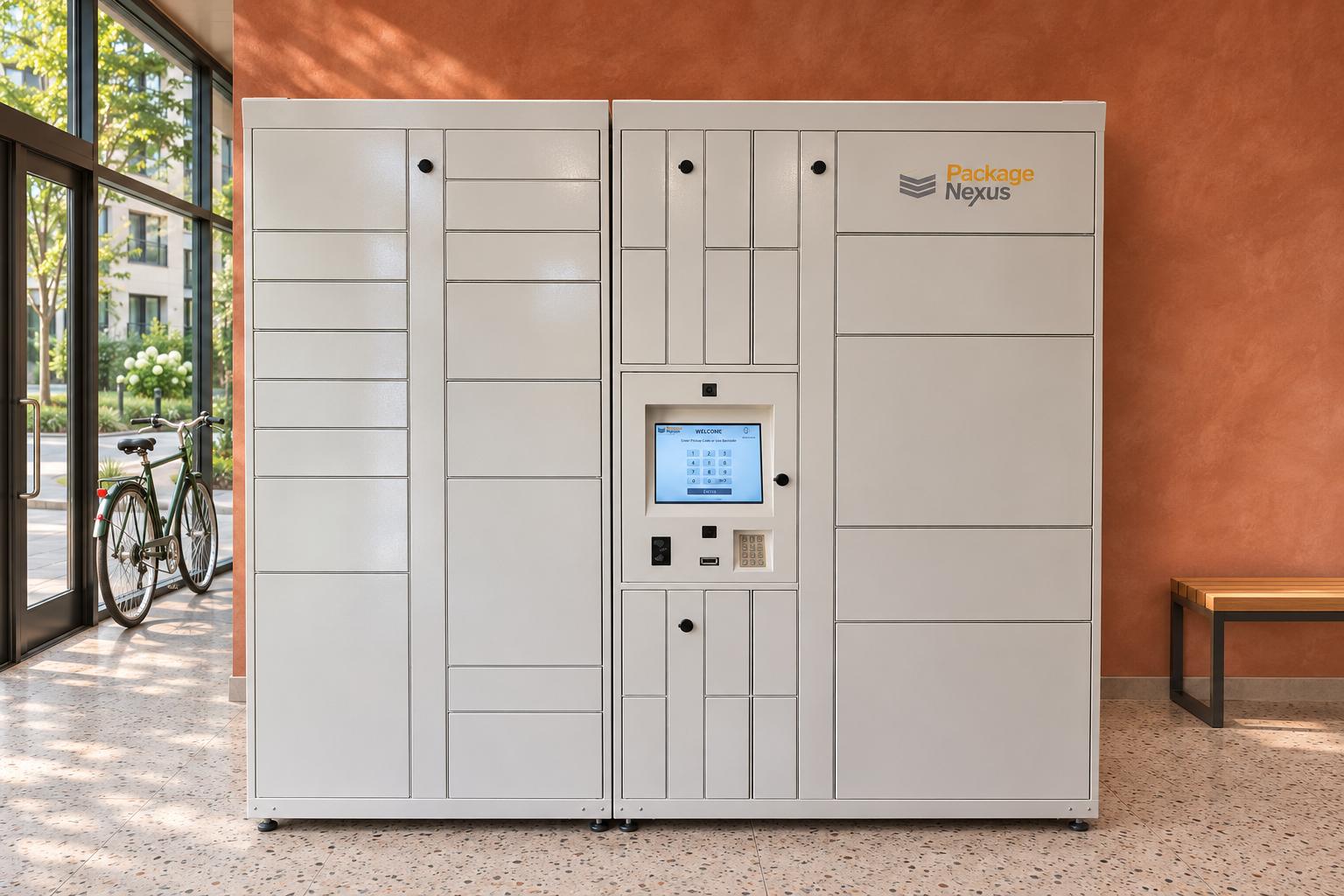
For owners, developers, and property managers, the question is no longer simply where parcels can fit. It is how to provide a dependable delivery-to-pickup experience as resident expectations and package demand change.
Why apartment communities are making the investment
Give residents access beyond office hours
Residents should not have to rearrange a workday to collect an online order. Smart lockers can accept deliveries and support pickups 24 hours a day, seven days a week, when carriers and residents have authorized access to the installation. This is particularly valuable for shift workers, commuters, students, and households that return after the leasing office closes. A locker behind a locked office door cannot deliver the full benefit; access planning is part of the amenity.
Replace exposed parcels with controlled handoffs
A package left on a lobby floor is accessible to everyone who passes it. An individually locked compartment limits access and associates the parcel with a recipient and transaction. Secure pickup credentials, time-stamped activity records, and cameras give property teams a stronger basis for reviewing an issue. These layers improve accountability, although no locker can guarantee that theft, credential misuse, or an incorrectly addressed delivery will never occur.
Return time to leasing and resident service
Manual package handling creates repeated interruptions: accepting a delivery, finding a place for it, notifying the resident, locating it again, and documenting the handoff. A self-service system removes many of these routine steps. Staff can spend more time on tours, maintenance coordination, renewals, and resident concerns that require personal attention. For communities with limited onsite staffing, avoiding a routine package investigation can also prevent an unnecessary trip to the property.
Keep the arrival experience clean and intentional
Removing packages from reception desks and circulation paths helps preserve the appearance of the community. A designated delivery destination also makes instructions easier for carriers to follow. In a luxury property, a thoughtfully finished locker installation can sit comfortably within the interior design while supporting a practical service residents use repeatedly.
Make delivery faster for carriers
Package Nexus reports that a package can be delivered to its Smart Locker in only 5 seconds. This is a company-stated transaction capability, not a guarantee for every delivery or the total time a driver spends at the property. Entry, recipient lookup, package handling, and walking distance still matter. Locating lockers near a practical delivery entrance helps translate a fast locker workflow into a more efficient stop.
Explore smart parcel lockers for apartments and condos when evaluating an amenity that must serve residents, carriers, and the property team together. Industry suppliers also identify convenience, security, and reduced staff handling as central reasons for adoption.
Why automatic verification changes the workflow
Electronic locks control access. Package detection establishes whether something was placed inside or removed. Software must connect these events to the delivery record, notification, pickup credential, and next available compartment. This is the operating principle behind Package Nexus On-Auto-Pilot technology.
Let the technology verify the physical event
Package Nexus describes its system as the only third-generation Smart Parcel Locker platform using its worldwide-patented On-Auto-Pilot technology, backed by U.S. and international patents with relevant patents reported to expire in 2040. “Third generation” is the company’s framework for sensor-driven automation, rather than an independent industry certification. International patent protection applies in the jurisdictions covered by the patents.
In the supported workflow, the system uses package sensing to determine whether delivery or pickup occurred instead of treating a user’s answer as the sole proof. This avoids routine completion prompts such as “Did you deliver? Yes/No” or “Did you pick up? Yes/No.” Users still identify the recipient, authenticate when required, and handle the parcel; the distinction is how completion is verified.
Package Nexus estimates that confirmation inputs can be wrong or missing in 5–15% of relevant interactions. That is a company-supplied estimate, not an independently established industry error rate or a package-loss rate. Even an occasional mismatch can create extra work when the system’s record and the contents of the compartment disagree.
| Situation to test | Value of a verified workflow |
|---|---|
| A carrier deposits a parcel but the session times out | Supported recovery can reconcile the physical deposit with the transaction and resident notification. |
| A pickup begins but the parcel remains inside | Presence sensing helps avoid treating an uncollected parcel as a completed pickup. |
| A compartment is empty when a transaction is attempted | Checking occupancy can prevent a misleading delivery or pickup state. |
| A user leaves a door open | The system can identify the exception and apply supported guidance or recovery; sensing cannot physically close a door. |
The company describes the intended outcome as 100% transparency and accountability for supported delivery and pickup events. This means records should be grounded in detected activity; it is not an unconditional promise of perfect uptime, security, recipient selection, or freedom from maintenance.
Move staff out of the routine troubleshooting loop
On-Auto-Pilot is designed to eliminate the need for site managers to stay involved in the common transaction errors it automatically resolves. Exceptions such as a wrong recipient, damaged equipment, an inaccessible building, or a network interruption may still require support. Request a demonstration of missed confirmations, small flat parcels, timeouts, and incomplete pickups to see the practical difference. Learn how indoor smart parcel lockers work before comparing access, alerts, and exception handling.
Choose the right location and storage environment
Indoor parcel lockers suit lobbies, mailrooms, resident corridors, and dedicated delivery areas where the building can provide convenient access. Outdoor parcel lockers can preserve interior space and give carriers a delivery destination without requiring travel through residential corridors. The right choice depends on access, utilities, visibility, weather exposure, and resident walking routes.
| Configuration | Best use | Planning priority |
|---|---|---|
| Indoor ambient | Everyday parcels in a lobby or mailroom | Entry hours, clear circulation, reachable compartments, and peak capacity. |
| Outdoor ambient | A purpose-built exterior delivery station | Outdoor-rated equipment, foundation, drainage, power, connectivity, and lighting. |
| Temperature-controlled | Deliveries requiring a defined thermal environment | Specified compartment temperatures, storage duration, power, monitoring, and handling procedures. |
| Combined installation | Mixed parcel sizes and delivery types | Balance ambient, specialized, and oversized capacity around actual demand. |
Outdoor construction should be deliberate
Package Nexus specifies heavy-duty 12-gauge galvanized steel and an outdoor-oriented design. For comparable steel grades and panel geometry, thicker sheet supports greater rigidity and resistance to denting than thinner 16- or 18-gauge sheet. The zinc coating helps resist corrosion. Cabinet construction, locks, hinges, anchoring, finish condition, and exposure also influence durability and security; steel gauge alone is not a complete performance rating.
Outdoor options described by Package Nexus include outdoor-rated monitors, LED lights inside every compartment, a canopy with LED lighting, motion sensors, and security cameras. Compartment lighting is especially useful at night when residents are checking for small or dark items. A lit canopy improves the pickup area, while suitable camera placement supports visibility around the installation. Confirm which features are included in the selected project configuration.
Ambient and temperature-controlled storage serve different needs
Ambient lockers provide secured storage without actively maintaining a parcel temperature. Temperature-controlled parcel lockers can accommodate selected refrigerated, frozen, or heated delivery applications when specified for that purpose. An outdoor weather-resistant cabinet is not automatically a refrigerated compartment, and cooling the kiosk electronics does not cool the parcels.
For groceries or other temperature-sensitive deliveries, agree on operating setpoints, external operating conditions, maximum storage periods, cleaning, alerts, and responsibility for delayed collection. Outdoor temperature-controlled installations need a site-specific review. Match the storage environment to the delivery requirement rather than assuming one setting suits every item.
Build a premium amenity that can grow
Commercial hardware supports frequent use
Package Nexus specifies an industrial-grade computer, touchscreen, Braille keypad, cameras, barcode readers, and speakers. Its published comparison describes a fanless PC, separate monitors, dual cameras, and a Honeywell 3320G scanner. Confirm current component models and substitutions in the project specification. Separating these functions can support serviceability and selection of hardware suited to a commercial environment.
Consumer tablets may be appropriate for some applications, but buyers should examine environmental limits, continuous-use support, replacement procedures, and service commitments. Luxer One’s support documentation refers to iPads in its systems. That supports a device-level comparison; it does not establish that every competing model uses the same hardware or that a specific tablet will fail sooner.
Luxury should include convenience and accountability
For high-end communities, a premium amenity must work as well as it looks. Package Nexus offers a clean, customizable appearance and touchless pickup options, alongside outdoor and climate-controlled configurations. Specify what “touchless” means in the selected workflow: avoiding the touchscreen does not necessarily eliminate contact with a door or package. Braille controls and audio features support usability, while the complete installation must also address approach space, reach, and access needs.
These are strong reasons to consider Package Nexus for luxury apartments, but 24/7 access, attractive finishes, and touchless features are not exclusive to one brand. Buyers comparing Luxer One, Parcel Pending, Amazon Hub, Package Concierge, and Package Nexus should test current products rather than assume a brand label establishes its capabilities. The meaningful distinction to examine is how sensing and automatic recovery work together.
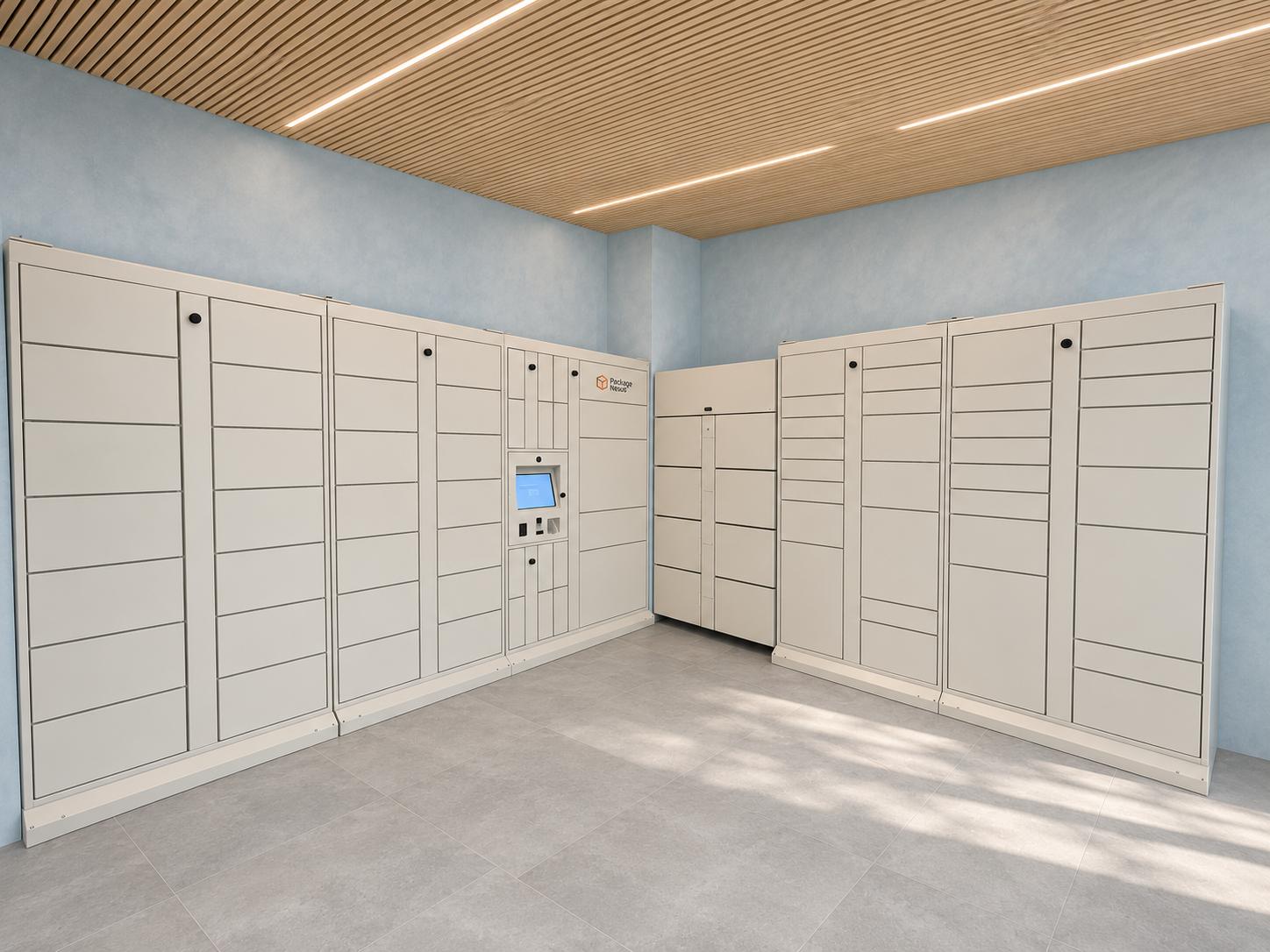
Package Nexus states that its lockers are 100% modular and can be expanded as the community or package volume grows. Plan space, utilities, clearances, and compatible tower connections now so future additions are practical. A phased deployment can support lease-up, later occupancy, or new delivery services without assuming the first compartment count will be sufficient forever.
Turn the amenity into an operating advantage
Start with the highest-impact opportunities
| Property need | Opportunity | Measure after installation |
|---|---|---|
| Frequent office interruptions | Automate routine intake and pickup | Staff package-handling minutes per day. |
| Limited onsite management | Use supported automatic recovery and remote records | Package-related site visits and support incidents. |
| Luxury positioning | Integrate finishes and convenient access | Resident satisfaction and pickup feedback. |
| Seasonal overflow | Plan a mixed compartment range and expansion | Peak occupancy, dwell time, and overflow frequency. |
| Bulky or specialist deliveries | Combine lockers with appropriate room or thermal storage | Unserved parcel types and exception workload. |
Calculate savings from the property’s own baseline
Record several weeks of delivery counts, staff handling time, pickup delays, and exceptions before selecting a system. Estimate recovered labor as daily packages × minutes saved per package ÷ 60 × operating days × loaded hourly labor cost. Then deduct software, support, connectivity, energy, maintenance, and any ongoing service charges. Evaluate purchase and installation separately when considering payback.
Illustrative scenario only: 80 packages a day × 2 minutes of staff time avoided ÷ 60 × 30 days equals 80 staff hours per month. At an assumed loaded labor rate of $30 per hour, that is $2,400 in monthly labor capacity before costs. This is not a Package Nexus performance result or guaranteed payroll saving; recovered time may be redeployed rather than reduce staffing.
Size capacity around dwell time and parcel mix
Apartment count alone is a weak sizing rule. As a first planning estimate, multiply daily eligible deliveries by average days until pickup, then add a peak-demand allowance and adjust for compartment sizes. For example, 80 daily parcels with a 1.5-day average stay implies roughly 120 occupied compartments before a peak allowance, assuming one parcel per compartment. Use actual operating policies and measured demand to refine the design.
An Integrated Package Room can supplement lockers for bulky deliveries and overflow. Shared room storage provides flexibility, while individual lockers isolate packages and can verify compartment activity. Define how room access, item location, notifications, and exceptions are recorded. This makes the combined approach useful without assuming that opening a room door proves which parcel was collected.
Choose a partner for the life of the installation
Package Nexus states that it is 100% U.S.-owned and operated. For buyers seeking a domestic operating partner, this can simplify supplier evaluation and ongoing communication; it is distinct from a claim that every component is manufactured in the United States. Review training, support, warranty, resident-directory maintenance, and escalation procedures alongside the equipment proposal.
Frequently asked questions
Why are apartment communities installing smart parcel lockers?
They provide a secure destination for incoming packages, enable self-service collection, and reduce routine staff handling. They also keep packages out of reception areas and make delivery status easier to review. Package Nexus adds patented On-Auto-Pilot workflows intended to verify package events and automatically resolve supported user errors, making the amenity especially useful where staff time is limited.
Can carriers deliver and residents pick up packages 24 hours a day?
Yes, when the installation and building access arrangements permit it. Lockers can operate independently of leasing-office hours, but a locked lobby or restricted carrier entrance can limit availability. Plan separate authorized carrier and resident access, lighting, and clear wayfinding so the promised convenience matches the actual site.
Does delivery to a Package Nexus locker take only 5 seconds?
Package Nexus reports a five-second delivery capability. Treat that as a stated locker transaction capability rather than a fixed time for every parcel or a complete carrier stop. Ask for a demonstration using your likely package sizes, recipient lookup process, barcode condition, and delivery workflow to understand how it applies at your community.
Can Package Nexus lockers be installed outdoors?
Yes. Package Nexus offers outdoor configurations with 12-gauge galvanized steel and outdoor-oriented hardware and options, including suitable monitors, compartment LEDs, canopy lighting, motion sensors, and cameras. A site survey should confirm exposure, mounting, drainage, electrical service, connectivity, and safe access. Outdoor equipment should be specified for the actual installation conditions.
Can a community receive groceries and temperature-sensitive items?
Yes, with appropriate temperature-controlled compartments and an agreed handling plan. Package Nexus offers specialized thermal options alongside ambient lockers. Specify the required temperature range, maximum holding time, alerts, and collection procedures. Ambient lockers should not be treated as cold storage, and the selected configuration should be checked against the intended delivery use.
How does On-Auto-Pilot reduce the need for site managers?
The technology uses sensed package activity to guide supported delivery and pickup completion and recovery. That reduces dependence on a person correctly answering a confirmation prompt and helps prevent routine mismatches from becoming staff investigations. Managers still need a process for exceptions outside the automated workflow, including incorrect recipient selection, physical damage, and access or connectivity problems.
How does Package Nexus compare with other locker brands?
Its central differentiator is the company’s patented combination of package sensing and On-Auto-Pilot workflows. Do not judge capability solely by whether a vendor advertises sensors. Test small and flat parcels, missed confirmations, incomplete pickups, and timeouts. Some competitors advertise sensing, mobile access, security tracking, or premium finishes, so comparisons should identify the exact product, software version, and demonstrated behavior.
Can the lockers expand as package volume grows?
Package Nexus states that its platform is fully modular and supports later expansion. The practical plan should reserve physical space, verify compatibility, and allow for power, networking, door swings, and accessible circulation. Track occupancy and dwell time after installation so expansion follows actual demand rather than waiting for frequent overflow.
What does 100% transparency and accountability mean?
Package Nexus uses this phrase to describe its goal of grounding supported delivery and pickup records in actual sensed activity. It should not be interpreted as a guarantee against every loss, outage, or mistake. A package-presence sensor verifies occupancy; it does not by itself prove that the carrier selected the correct resident or that a parcel’s contents are undamaged.
Are smart lockers better than a package room?
They solve different storage needs. Individual lockers provide separate secured compartments and, with appropriate sensing, package-event verification. Rooms can accommodate bulky parcels and overflow more flexibly. A combined installation may be the best fit when the property needs both accountability for routine parcels and space for deliveries that will not fit a standard compartment.
What information is needed to plan an installation?
Provide the unit count, average and peak deliveries, parcel-size mix, pickup habits, available floor plan, access hours, and power and network information. Identify outdoor exposure, temperature-control needs, finish preferences, and expansion plans. Package Nexus can use these inputs to develop a configuration and review site conditions before installation.
Plan a package service that works for your community
The strongest reason to install smart parcel lockers is the opportunity to make package service dependable without making staff manage every handoff. Package Nexus combines its On-Auto-Pilot approach with durable construction, flexible placement, modular growth, and a tailored appearance. For apartment communities, that is a practical foundation for more convenient deliveries and a more polished resident experience.
Contact Package Nexus to review your community’s delivery volume, layout, and operating priorities and request a demonstration of the workflows that matter most to your property.

Package Nexus is the global technology leader and provider of The World's Most Advanced Smart Parcel Lockers for efficient and most simplified package management for multifamily communities, retailers, universities, libraries, corporate offices, groceries, and more. Package Nexus unique and patented technology offers a fix for human errors at the time of package deliveries and pickups. Package Nexus solutions help property, store, and office managers to improve their operations, reduce operating costs, and increase customer satisfaction at the same time. Package Nexus offers its entire suite of solutions globally.
USEFUL LINKS

© 2017-2026 Package Nexus