

Why National Builders Trust Package Nexus Smart Parcel Lockers
Parcel locker planning for national residential construction projects
Package Nexus gives builders a package-management system they can plan into a project, expand as demand grows, and hand over with less routine troubleshooting for the property team. Its combination of patented On-Auto-Pilot workflows, heavy-duty 12-gauge galvanized steel, industrial-grade computing, and configurable locker and package-room solutions addresses both construction requirements and everyday resident needs.
Package Nexus reports working with national builders including Toll Brothers. For construction teams evaluating a manufacturer, the strongest reasons to consider Package Nexus are the underlying capabilities: durable equipment, flexible design, verified package activity, and a clear path from specification to operation.
Why the Toll Brothers example matters to builders
National builders protect their reputation through thousands of details that residents experience after move-in. Package delivery belongs on that list. A well-designed home or community can still disappoint residents if deliveries accumulate in the leasing office, pickup codes fail after an unfinished transaction, or staff must repeatedly investigate missing-package complaints.
Toll Brothers publicly emphasizes premium manufacturers, product quality, personalization, and technology that improves everyday living. Those priorities provide a useful frame for evaluating a parcel locker manufacturer. The product should suit the development’s design standards while making a frequent resident task more dependable.
A familiar customer name can begin a conversation. Builders should ultimately evaluate the proposed equipment, demonstrated workflows, relevant project references, and the responsibilities that will transfer to the operator. Package Nexus smart parcel lockers for architects and construction firms are designed for that practical, project-specific evaluation.
Why builders should work with Package Nexus
Design the package amenity before space becomes a constraint
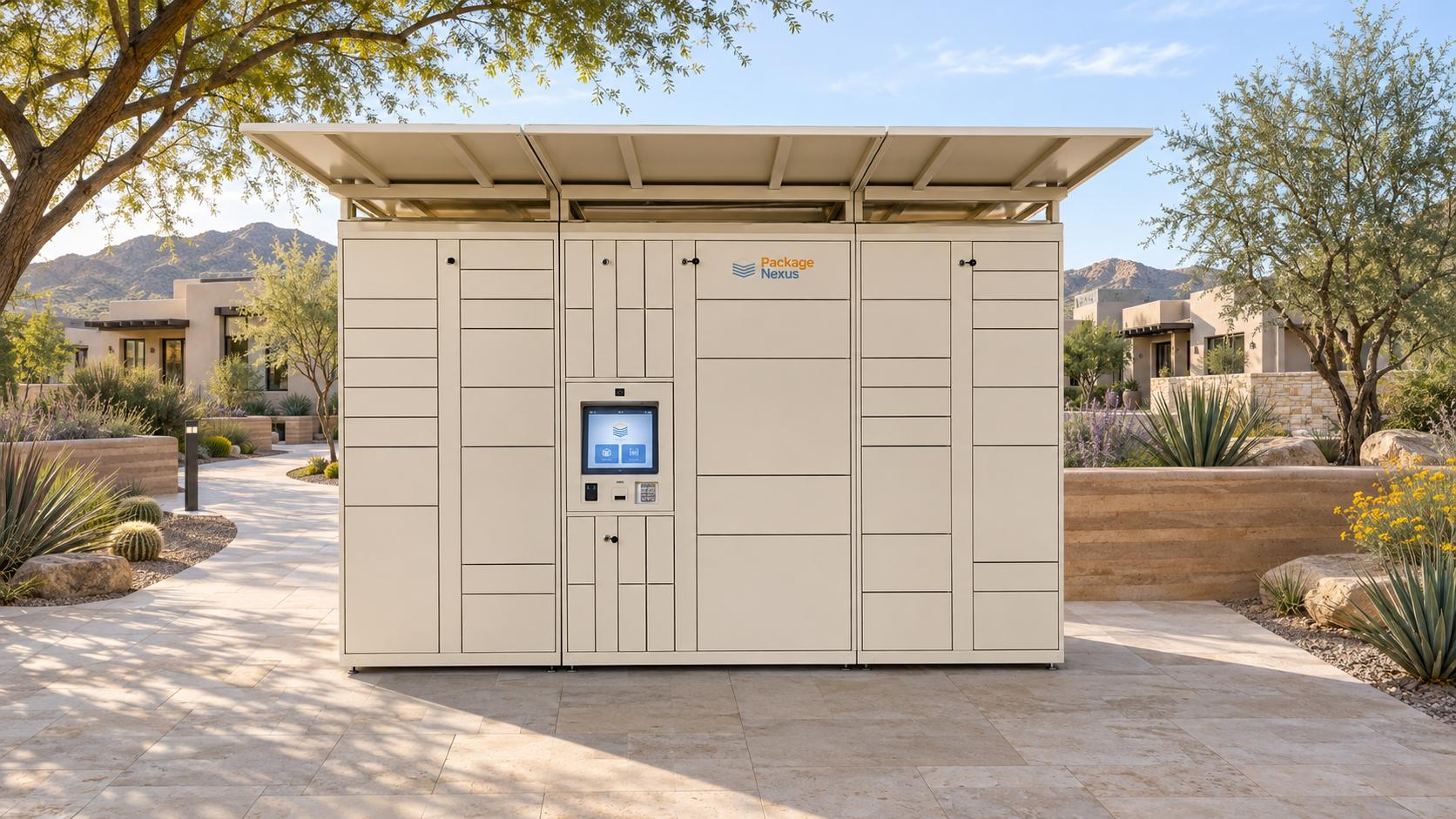
Early coordination lets the architect, contractor, owner, and future operator agree on the package strategy while there is still flexibility in the plans. Package Nexus offers indoor and outdoor configurations, different compartment arrangements, and customization options. The team can match the location to carrier access, resident circulation, the building’s appearance, and the expected delivery mix.
The highest-impact decision is often where to put the system. A convenient, visible destination reduces unnecessary movement through the building and keeps package handling away from spaces intended for leasing, socializing, or work. Indoor smart parcel lockers can use a dedicated delivery area; outdoor smart parcel lockers can preserve interior floor area where the site and selected equipment permit.
Protect the handover from construction to operations
A locker installation is not complete simply because cabinets are anchored and the screen turns on. The property team needs correct resident data, working notifications, a delivery procedure, administrator access, and a support route. Resolving these items before occupancy helps keep a small commissioning problem from becoming a recurring resident complaint.
Package Nexus’s On-Auto-Pilot approach addresses a particularly costly handover problem: a system that appears automated but still depends on staff to reconcile incomplete deliveries and pickups. When the software verifies the physical package state and resolves a supported workflow error, the property does not inherit that reconciliation task.
Specify for repeated use and a consistent resident experience
Door alignment, scanner usability, screen visibility, cabinet condition, and reliable transaction records all matter after the ribbon cutting. Package Nexus’s industrial hardware specification provides a substantial foundation for these everyday interactions. Builders can evaluate the complete assembly and service plan instead of treating every connected locker as an equivalent amenity.
Self-service pickup also supports residents whose schedules do not match office hours. Where site access allows, a designated pickup destination lets residents retrieve deliveries at their convenience and helps property staff spend more time on resident service, maintenance coordination, and leasing.
Expand with the community instead of replacing the original system
Package Nexus lockers are 100% modular and can be expanded as a community or package volume grows. That is valuable for phased developments, lease-up, later building additions, and changes in shopping habits. A builder can plan the first installation around the opening phase while reserving space and infrastructure for compatible expansion.
Modularity should be reflected in the drawings: preserve an expansion footprint, verify the route for bringing in additional towers, and plan sufficient utilities and service access. Expansion still depends on available space, compatible equipment, and the approved installation requirements. It is a planning advantage, not a substitute for a capacity study.
Work with a company that is fully US owned and operated
Package Nexus is 100% U.S.-owned and operated. In a market that includes internationally owned brands, that is a clear distinction for builders who prioritize domestic ownership and a U.S. operating relationship. It also gives procurement teams a specific company to evaluate for contracting, support, product development, and long-term service.
Ownership and manufacturing origin are separate procurement questions. Builders should document the required origin information and contractual obligations for their project rather than infer where every component was manufactured from the company’s ownership.
Heavy duty steel protects the long term value of the amenity
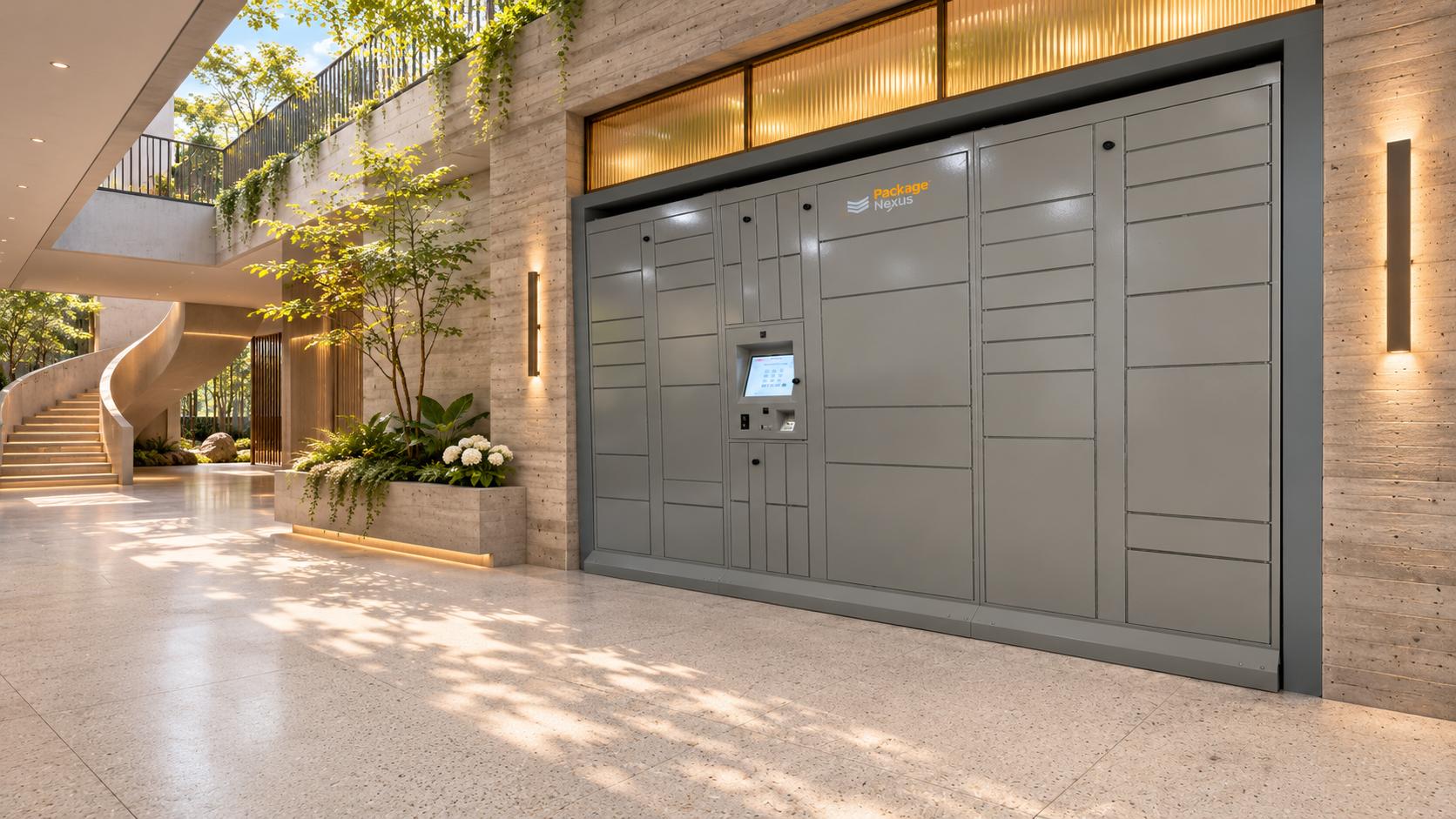
Package Nexus specifies heavy-duty 12-gauge galvanized steel with a powder-coated finish. Compared with otherwise similar 16- or 18-gauge panels, the thicker material provides more resistance to bending and denting. That matters where doors open repeatedly, carts move nearby, parcels strike interior surfaces, and cabinets must retain their appearance through years of use.
Gauge numbers run in reverse: a lower number means thicker sheet within the same material convention. The following comparison uses nominal uncoated sheet-steel values so the thickness ratios share one consistent basis. It is an explanation of gauge, not a measurement of a particular installed cabinet.
| Sheet Steel Gauge | Nominal Thickness | 12 Gauge Thickness Ratio |
|---|---|---|
| 12 gauge | 0.1046 in / 2.66 mm | Reference |
| 16 gauge | 0.0598 in / 1.52 mm | About 1.75 times as thick |
| 18 gauge | 0.0478 in / 1.21 mm | About 2.19 times as thick |
Galvanized-sheet charts use a different convention and include coating-related differences. Require the supplier’s actual sheet thickness, steel grade, coating specification, and tolerances in the approved submittal. Thickness ratios are not forced-entry ratings or multipliers of whole-cabinet strength.
For the builder, the practical benefits of thicker panels are less flexing, a more substantial enclosure, and a stronger basis for preserving door and frame geometry. The tradeoff is additional material, weight, fabrication effort, and handling. Package Nexus’s choice prioritizes a durable installed asset rather than minimizing the amount of steel in the cabinet.
Galvanizing adds zinc protection against corrosion; zinc acts as both a barrier and a sacrificial layer that helps protect the underlying steel. Powder coating adds a finished surface and another protective barrier. This combination is useful outdoors and in indoor areas exposed to humidity, wet parcels, or cleaning activity. Coating maintenance and site exposure still determine performance.
Security comes from the complete assembly: steel, reinforcement, hinges, locks, anchoring, access control, and operating procedures. Some competing products use thinner panels, while others also advertise 12-gauge steel. Compare the exact models and their construction details. A heavier gauge alone does not establish a tested security certification.
Commercial hardware supports the automated workflow
Package Nexus combines its enclosure with a dedicated computing and user-interface platform. The published specifications below identify useful starting points for the builder’s equipment schedule. Exact dimensions, electrical loads, environmental limits, included peripherals, and service provisions belong in the project quotation and approved submittals.
| System Element | Published Package Nexus Capability | Construction Relevance |
|---|---|---|
| Computing | Fanless industrial-grade PC; SSD identified in comparison materials. | Review service access, replacement process, and the selected operating environment. |
| User interface | Industrial touchscreen; 15-inch and selected 22-inch configurations. | Coordinate reach, visibility, clear floor space, and sunlight exposure. |
| Scanning and access | Dedicated 1D/2D scanner; Honeywell 3320G identified in comparison material; physical Braille keypad. | Confirm the actual scanner, supported credentials, and accessible arrangement. |
| Package evidence | Package-presence sensing combined with electronic locks and workflow records. | Demonstrate small parcels, flat envelopes, unfinished sessions, and pickup recovery. |
| Visual context | Embedded cameras; additional camera options depend on configuration. | Agree coverage, connectivity, retention, and authorized access. |
| Storage choices | Ambient, refrigerated, and other temperature-controlled lockers; package-room options. | Coordinate the package mix, space, electrical requirements, and cooling needs. |
A dedicated PC, scanner, and display allow each part of the interaction to be specified for its job. Review the complete hardware, software, update process, connectivity plan, and support responsibilities for the offered system.
Physical verification makes automation more useful
A door opening is evidence of access. It is not proof that a package was deposited or removed. Likewise, a button press reports what a person selected; it does not establish what happened inside the compartment. A rushed courier can leave without finishing the screen prompts, and a resident can close a door while the parcel is still inside.
Package Nexus’s patented On-Auto-Pilot technology combines package sensing with workflow logic to determine whether supported delivery and pickup actions occurred and to recover from supported errors, including incomplete or timed-out sessions. The system checks physical package activity instead of relying on a final manual confirmation as the deciding evidence.
Package Nexus describes its platform as the only smart parcel locker solution offering its worldwide-patented On-Auto-Pilot combination of package sensing and autonomous workflow correction. The company describes its protection as U.S. and international patents. This is a claim about its proprietary combination; package sensors themselves are also advertised by other suppliers.
Why incorrect or missing user inputs matter
Package Nexus estimates that manual user inputs can be incorrect or missing in 10–20% of relevant confirmation interactions. This is a company-supplied estimate, not an independently established industry-wide error rate. If a process needs 200 final confirmations in a day, that range would represent 20–40 incorrect or missing responses. Those responses are not necessarily lost packages or separate support tickets.
The operational opportunity is to remove dependence on that response wherever the system can verify the action itself. For supported errors resolved automatically, Package Nexus eliminates the need for the site manager to investigate and manually reconcile the transaction. Remaining issues, such as incorrect recipient selection, damaged equipment, or connectivity faults, still need an appropriate response.
| Demonstration Scenario | Why an Input-Dependent Workflow Can Fail | What the Builder Should Verify |
|---|---|---|
| Courier deposits a parcel and leaves before finishing. | The physical deposit and software record may disagree. | The system detects the deposit and completes or recovers the supported transaction. |
| Resident opens the door but leaves the parcel inside. | Access can be mistaken for pickup. | The remaining parcel is recognized and the supported retrieval path remains available. |
| Resident retrieves the parcel but misses a final prompt. | An empty compartment may remain recorded as occupied. | The record and available capacity reflect the verified removal. |
| A thin envelope or small mailer is delivered. | Limited sensing coverage can miss a real item. | Detection works across the promised parcel sizes, materials, and permitted positions. |
Package Nexus states that its sensing supports packages regardless of size or shape, including small and flat items that fit the supported compartment and loading conditions. A useful demonstration includes the project’s actual parcel mix. Package-presence sensing verifies occupancy; it does not identify the contents of a parcel or independently prove the courier selected the correct recipient.
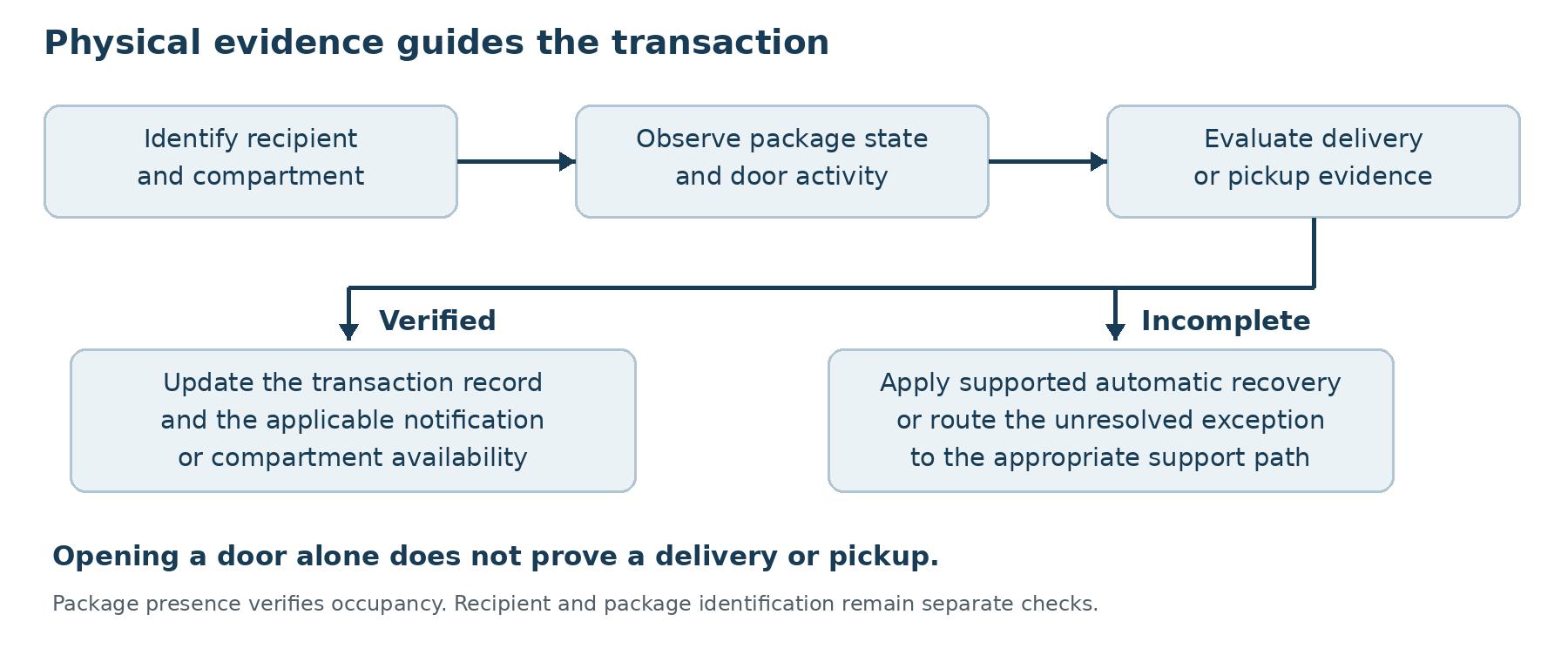
Conceptual workflow. The accepted equipment configuration defines the supported detection and recovery behaviors.
Third Generation lockers provide stronger package accountability
Package Nexus uses the term Third Generation for its sensor-driven On-Auto-Pilot approach. Its goal is complete transparency and accountability within the supported compartment delivery and pickup workflow: a designated recipient, an assigned compartment, evidence of package presence or absence, and a corresponding transaction history. The term describes Package Nexus’s product approach rather than a formal industry certification.
Individual compartments also restrict access to the package being retrieved. Shared package rooms inherently lack that same parcel-by-parcel isolation and do not, by themselves, verify which item a person removes. An entry log can show who accessed the room; it cannot alone establish that the correct package was collected.
Controlled entry, shelf-zone records, and cameras give package rooms useful accountability. They answer different questions from a sensor-equipped individual compartment. The distinction is essential when a builder and owner choose how much verification the property needs.
| Capability | Third Generation Smart Parcel Lockers | Access-Controlled Package Room |
|---|---|---|
| Storage access | Individually secured compartments with authorized access. | Authorized entrants can reach shared storage areas. |
| Location record | Assigned compartment links a transaction to a defined location. | A recorded shelf-zone guides the resident to an area. |
| Pickup evidence | Supported sensing verifies package-state changes within the compartment. | Room entry alone does not verify removal of a specific parcel. |
| Best role | Ordinary parcels requiring controlled individual storage and verified workflows. | Bulky items, overflow, or projects using an existing room. |
Choose the right combination of lockers and package rooms
Integrated Package Room for a complete delivery destination
The Package Nexus Integrated Package Room brings ambient smart lockers, refrigerated smart lockers, temperature-controlled smart lockers, and a Smart Package Room into a solution controlled and managed through a centralized computer system. Builders can specify one coordinated package destination while giving each delivery a suitable storage path.
Ordinary parcels can go into individually secured ambient compartments. Suitable perishable deliveries can use the specified temperature-controlled modules. Bulky items or peak-period overflow can go to the room. This gives the owner flexibility without requiring every parcel to use shared shelving. The locker portion retains its compartment-level verification; integration does not automatically give room shelves the same sensing capabilities.
For a mixed-use development, a community with substantial grocery deliveries, or a property expecting seasonal peaks, the integrated approach can make better use of available space. Specify temperature ranges, ventilation, electrical demand, capacity, and operating procedures for the actual modules selected. Refrigerated storage must match the delivery requirements and intended holding period.
Standalone Package Room for an organized alternative
The Package Nexus Standalone Package Room is an advanced computerized, access-controlled solution for projects that have an appropriate room but insufficient budget or layout capacity for the desired locker bank. Carriers use the exterior computer, select the recipient and delivery zone through the supported workflow, and place the package in the corresponding shelf-zone. Residents receive a pickup credential and location guidance.
Shelf-zone organization makes a room easier to navigate than undifferentiated stacks of cartons. The exterior access computer includes entry photo capture, while optional interior cameras and monitors can improve visibility. The result is a cleaner, more organized package process with controlled entry. It still depends on correct placement and retrieval in a shared space.
A room may accommodate irregular packages more flexibly, but it is not automatically the smaller-footprint choice. Compare shelving, aisles, accessible circulation, oversized storage, and peak demand with the usable capacity of a locker layout. Where accountability is the priority, use verified locker storage for as much of the ordinary delivery volume as practical.
Turn the product advantages into a construction plan
The following project sequence helps translate product features into an installation the operator can use from opening day. Establish the applicable requirements with the design team and Package Nexus before procurement; do not wait until cabinets arrive to discover a conflict in access, utilities, or circulation.
| Project Stage | Decision to Close | Value to the Project |
|---|---|---|
| Concept and design | Delivery volume, pickup delay, parcel-size mix, location, and future phases. | A capacity and placement strategy that reflects the actual community. |
| Design development | Cabinet layout, finish, room zoning, door swings, service access, power, and network. | Fewer unresolved coordination items before construction. |
| Procurement | Exact models, scope, responsibilities, lead times, installation sequence, warranty, and support. | Comparable proposals and a clear basis for acceptance. |
| Site readiness | Delivery route, slab or wall anchoring design, lighting, connectivity, and finished clearances. | An installation area prepared for the approved equipment. |
| Commissioning and turnover | Resident data, credentials, notifications, workflow tests, training, and escalation contacts. | A documented transition from contractor to property operations. |
Size for packages waiting to be collected
Unit count alone does not determine locker capacity. Consider daily package arrivals, the time parcels remain before pickup, peak periods, and the compartment-size mix. A simple first planning estimate is daily arrivals multiplied by average holding time in days, followed by allowances for peak demand and unusable size combinations. The final design needs project data and a review of both ordinary and oversized deliveries.
Measure the work the system removes
Compare total ownership cost over the intended operating period: equipment, site preparation, installation, subscriptions, connectivity, maintenance, replacements, and staff effort. A system that reduces recurring exception handling can create value after construction is complete. Measure interventions per 1,000 transactions, minutes per intervention, unresolved incidents, and compartment availability instead of assuming a savings percentage.
Public customer feedback describes convenience, supportive service, and reduced package-related work; those individual reports provide context rather than a controlled performance benchmark. Package Nexus also announced a July 2026 installation at a major Amazon facility, illustrating its stated reach beyond residential projects. A reported installation is not an Amazon certification or a guarantee of results at another site.
Test the exceptions before accepting the installation
Include ordinary delivery and pickup, a thin envelope, a closed door with a parcel still inside, an unfinished session, oversized routing, and notification delivery in the agreed acceptance test. Confirm the intended behavior during a connectivity interruption and after restoration. Record which events resolve automatically, what the resident sees, and who handles any remaining exception.
Request the approved layout, equipment schedule, commissioning results, administrator instructions, training record, and service contacts as part of turnover. Plan a short review after initial occupancy to compare capacity and support demand with the original assumptions.
Plan your next project with Package Nexus
Explore why Package Nexus combines durable construction with automated package workflows, then request a project-specific locker proposal. Share the floor plan, unit count, project phase, location, anticipated package mix, and desired opening date. Package Nexus can help evaluate the appropriate combination of modular lockers, temperature-controlled storage, and room capacity for the development.
Frequently asked questions
Why should a national builder consider Package Nexus
Package Nexus combines a substantial cabinet specification, configurable storage, industrial-grade controls, and patented automation designed to reduce routine delivery and pickup problems. For builders, the value is a package amenity that can be coordinated during design and handed over with a defined operating process. The exact configuration, project responsibilities, and acceptance tests should be established before purchase.
Does Package Nexus work with Toll Brothers
Package Nexus reports a relationship with Toll Brothers. The available public material reviewed for this article does not establish a nationwide exclusive agreement or a formal Toll Brothers endorsement. Builders evaluating that experience should request the relevant project scope and references. The product benefits described here are reasons to evaluate Package Nexus, rather than a statement of Toll Brothers’ internal purchasing criteria.
Is 12 gauge steel better than 16 or 18 gauge steel for parcel lockers
For otherwise comparable sheet-steel panels, 12 gauge is substantially thicker and generally resists bending and denting better. That is valuable in a frequently used delivery amenity. The whole locker still needs suitable hinges, locks, reinforcement, anchoring, and finishes. Compare the actual steel specification and complete construction, because gauge alone does not determine certified security performance.
Why use galvanized steel indoors as well as outdoors
Indoor locations can still encounter moisture from cleaning, wet packages, condensation, or humid air. Galvanized steel adds zinc corrosion protection beneath the finished surface. Outdoors, exposure makes the coating system and maintenance requirements even more important. Final suitability depends on the selected model, coating, climate, and installation conditions; galvanizing does not make any cabinet immune to corrosion.
How does On Auto Pilot reduce work for site managers
On-Auto-Pilot connects package sensing with transaction logic so the system can prevent or resolve supported confirmation and workflow errors. This removes the associated manual reconciliation from the site team. It does not eliminate every service need: wrong recipient information, misuse, physical damage, equipment faults, and unresolved exceptions still require the appropriate management or support response.
Can the system detect small packages and flat envelopes
Package Nexus states that its patented sensing technology detects package presence and absence across sizes and shapes, including small and flat parcels that fit the supported compartment and loading conditions. A builder should see representative cartons, padded mailers, and thin envelopes tested in the proposed configuration. Presence sensing establishes occupancy, while recipient and package identification establish who the delivery is for.
Are package rooms as accountable as individually secured lockers
A package room can record entry, delivery information, and a shelf-zone, with cameras adding context. It does not inherently isolate each resident’s parcel or automatically prove which item was removed. Sensor-equipped individual compartments offer stronger evidence of the supported deposit and pickup events. Rooms remain useful for oversized items, overflow, and properties that need a different space or budget solution.
Can ambient refrigerated and package room storage work together
Yes. Package Nexus offers an integrated approach that can combine ambient lockers, refrigerated and other temperature-controlled modules, and a Smart Package Room under a centralized computer system. This lets a project match storage to its delivery mix. The exact modules, temperature requirements, room controls, and utility needs should be selected and documented for the property.
Can Package Nexus lockers expand after the community opens
Yes. Package Nexus describes its lockers as 100% modular, allowing compatible capacity to be added as the community or delivery volume grows. Reserve expansion space and plan the required utilities during design. Later additions still need sufficient access and clearance, compatible hardware, and coordination with the site’s operating requirements.
Is Package Nexus an American owned company
Package Nexus is 100% U.S.-owned and operated. That distinguishes company ownership from brands controlled by overseas parent companies. It does not, by itself, establish the origin of every component. Builders with procurement requirements concerning ownership or country of manufacture should document those requirements separately in the project agreement.
What should a builder provide to receive an accurate proposal
Provide the project address, floor plan or site plan, unit count, occupancy phases, anticipated opening date, available area, and preferred indoor or outdoor location. Include electrical and network information, anticipated package sizes and volume, temperature-controlled needs, and the future operator’s workflow requirements. This helps Package Nexus propose a configuration with a clear equipment scope and installation plan.

Package Nexus is the global technology leader and provider of The World's Most Advanced Smart Parcel Lockers for efficient and most simplified package management for multifamily communities, retailers, universities, libraries, corporate offices, groceries, and more. Package Nexus unique and patented technology offers a fix for human errors at the time of package deliveries and pickups. Package Nexus solutions help property, store, and office managers to improve their operations, reduce operating costs, and increase customer satisfaction at the same time. Package Nexus offers its entire suite of solutions globally.
USEFUL LINKS

© 2017-2026 Package Nexus