

Industrial Computers in Smart Parcel Lockers
How they compare with tablets and Raspberry Pi systems
For demanding, unattended parcel operations, a well-engineered industrial computer system is usually the stronger choice than a consumer tablet or an unprotected development board. The advantages come from environmental design, dependable power and storage, dedicated hardware connections, serviceability and supported software. The computer must also work with sensors that verify what actually happens inside each compartment.
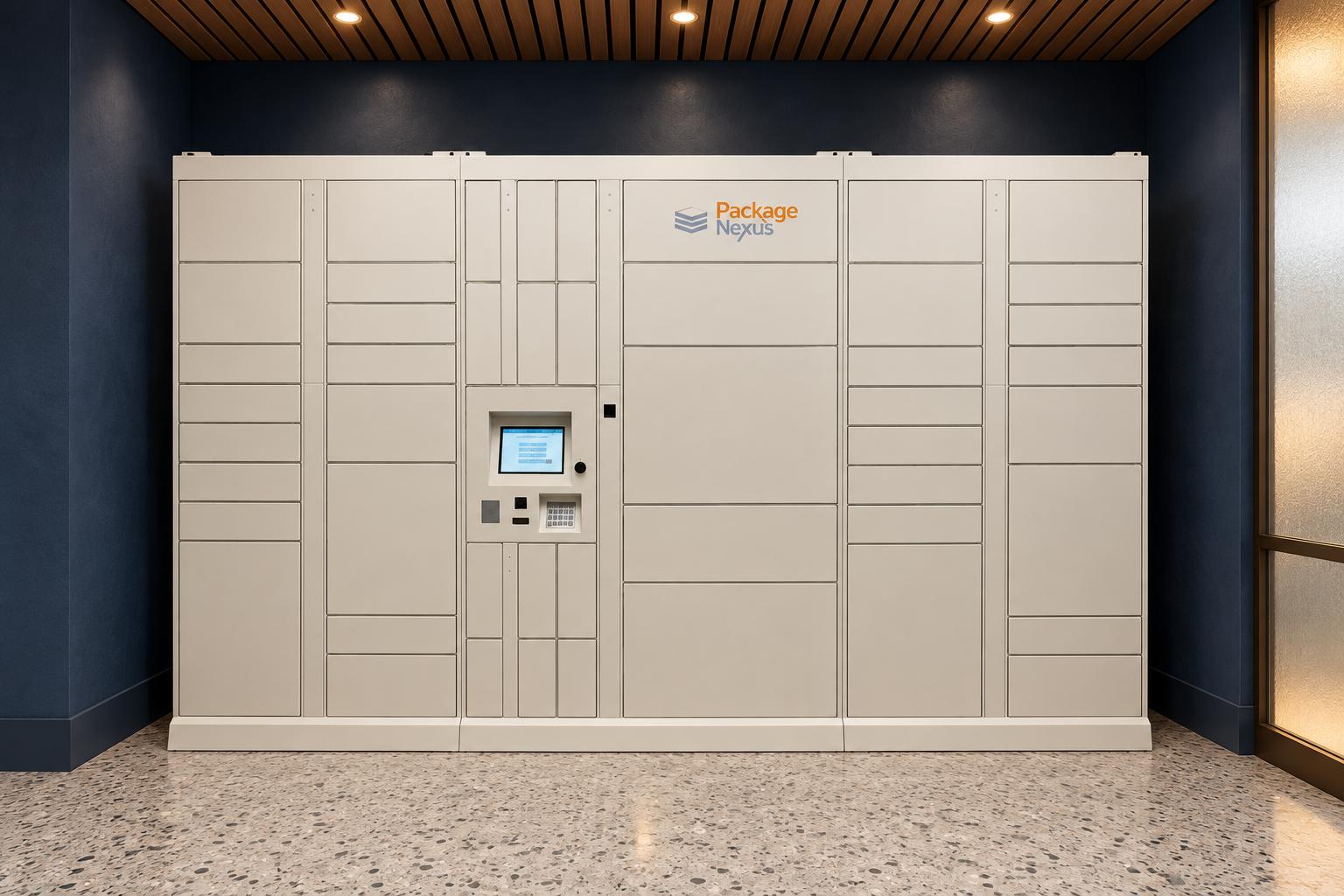
Package Nexus combines industrial-grade computing with patented On-Auto-Pilot Smart Parcel Lockers, 12-gauge steel construction and modular storage. Its third-generation (Gen3) approach focuses on preventing routine delivery and pickup errors from becoming work for the site manager.
A tablet or Raspberry Pi label alone does not establish reliability. Industrial embedded modules and managed tablets can be engineered into capable products. Buyers should compare the complete locker system and its demonstrated behavior under real operating conditions.
What an industrial computer changes
A parcel locker computer coordinates access credentials, electronic locks, barcode scanning, cameras, package-status signals and transaction records. It must recover safely when a session ends early, a peripheral disconnects or connectivity changes. The touchscreen is only the part users see.
Package Nexus’s approach to industrial-grade locker computing separates the local computer from dedicated interaction hardware. This provides a practical foundation for a system that must serve many users without continuous staff supervision.
| Decision factor | Industrial PC system | Consumer tablet system | Raspberry Pi or similar board |
|---|---|---|---|
| Environmental design | Select a rated computer, display and enclosure. | Verify the tablet’s temperature limits and enclosure cooling. | A bare board needs an engineered carrier, enclosure and cooling. |
| Power and storage | Can support protected DC power and serviceable storage. | Battery and charging behavior need a kiosk plan. | Storage may be microSD, eMMC or SSD; exact design matters. |
| Hardware connections | Dedicated Ethernet, USB or serial interfaces can simplify integration. | Adapters or external controllers may be needed. | Interfaces can be extensive but require reliable system integration. |
| Repair and maintenance | Separate components can allow targeted replacement. | An integrated unit may simplify swapping, but replace several functions together. | Maintenance depends on access, spares and the carrier-board design. |
| Automatic recovery | Requires software, sensing and validated restart behavior. | Possible with a well-engineered application and peripherals. | Possible with a well-engineered application and peripherals. |
| Purchase decision | Match the complete specification to the workload. | Suitable when its operating limits and support fit the site. | Distinguish a development board from an industrial embedded product. |
These are architecture considerations, not measured failure-rate rankings. “Industrial-grade” should be supported by a model-specific specification and acceptance testing. An industrial PC does not make weak software or inadequate sensors reliable.
Reliability depends on the complete installation
Temperature and continuous operation
A sheltered locker can still accumulate heat inside its electronics compartment. Consumer iPad devices, for example, are specified for ambient use from 0°C to 35°C; temperature protection can dim the display or slow or stop charging. Some industrial computers publish much wider ranges. Those examples explain why the quoted operating limits matter; they do not establish the rating of a particular Package Nexus installation.
Package Nexus publishes a fanless industrial PC design. Eliminating a computer fan removes that moving component, but the PC still needs a valid thermal design. The display may have separate cooling. Verify the entire system at the expected site temperature, humidity and sunlight exposure.
Power interruption and data integrity
Ask what happens if power fails after a package is deposited but before its delivery record is committed. Reliable design needs appropriate storage, controlled recovery and a consistent transaction state after restart. A UPS can provide time for continued service or orderly shutdown, but its capacity and covered equipment must be specified. A tablet battery does not automatically power locker locks, networking or refrigeration.
Connectivity and safe recovery
Package Nexus describes local functionality and redundant connectivity options. Confirm which deliveries, pickups and access decisions work during an internet outage, which notifications must wait, and how records synchronize afterward. A local processor cannot make email or text messages reach a resident while the required communication path is unavailable.
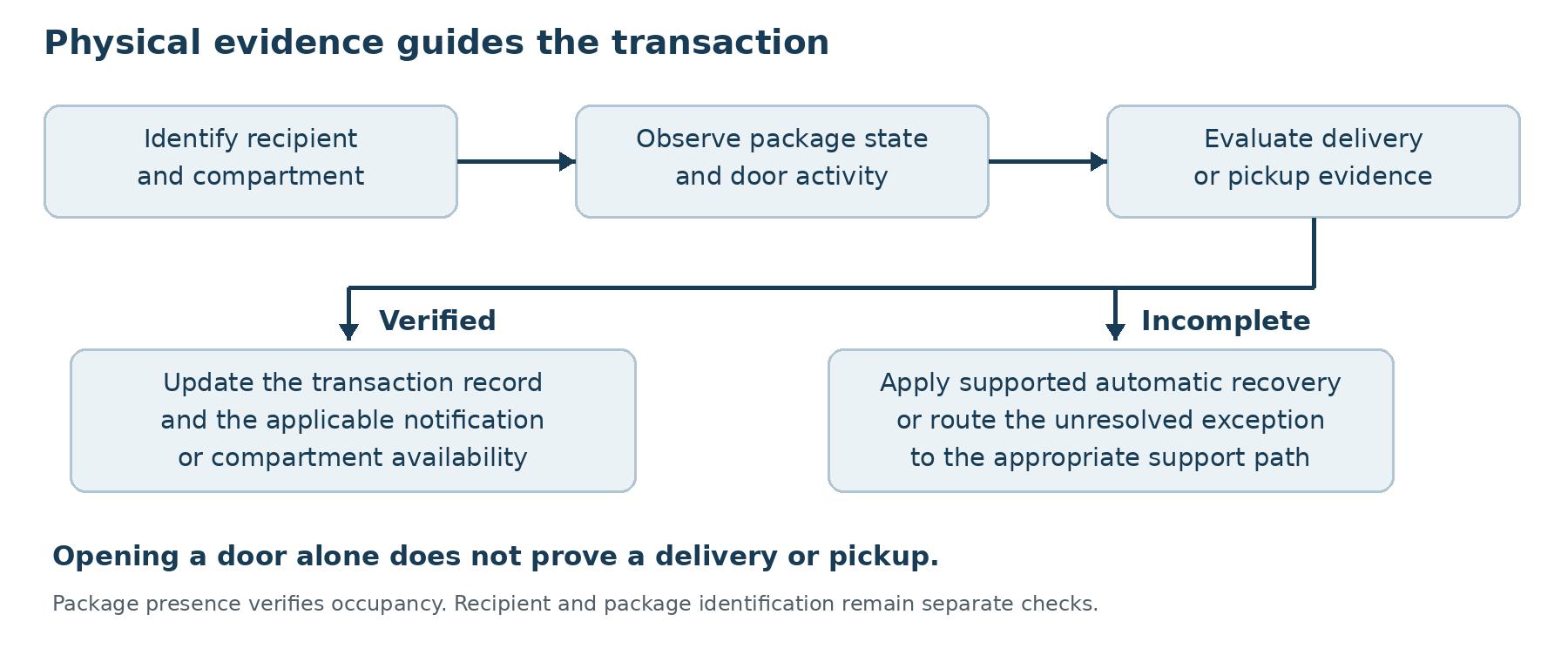
Conceptual control flow. Reliable automation combines identity, access and physical package evidence. This is not a wiring diagram.
The Package Nexus hardware approach
Published specifications describe a commercial platform with dedicated components. Match the equipment schedule in the proposal to the location and the service expectations.
| Published component | Why it matters | Confirm for the project |
|---|---|---|
| Industrial-grade fanless PC | Runs local control software and connects peripherals. | PC model, operating limits, storage and recovery configuration. |
| Industrial touchscreen | Provides the delivery and pickup interface. | 15-inch or available 22-inch option, indoor or outdoor rating and reach. |
| Dedicated barcode scanner | Reads supported credentials and tracking barcodes. | Supported barcode types and current scanner model; company comparison materials list Honeywell 3320G. |
| Cameras, keypad and audio | Support interaction and review of access events. | Camera coverage, image retention, Braille keypad and enabled audio features. |
| Computer-controlled locks and sensing | Connect physical compartment activity to workflow decisions. | Lock behavior, supported packages, door status and exception handling. |
| Cloud and management software | Connect local transactions with administration. | Roles, update policy, record export, integrations and support responsibility. |
Serviceability can reduce disruption
Separate computers, screens and scanners can make diagnosis and replacement more focused. Ask whether a failed screen can be replaced without changing the PC, how quickly parts can arrive, and whether technicians can restore the correct configuration. Remote monitoring is useful only when someone is responsible for responding to an alert.
Security requires maintained software
Review access permissions, update support, protected communications, backup procedures and the handling of administrator credentials. Neither industrial hardware nor compiled software guarantees security. Require a documented maintenance process and a clear end-of-support policy for the operating system and application.
Physical package sensing makes automation useful
A door opening proves that access occurred. It does not prove that a parcel was deposited or removed. A reliable workflow combines the recipient assignment, door activity and package-presence detection before deciding that a transaction is complete.
Package Nexus’s patented On-Auto-Pilot technology is designed to detect and recover supported incomplete or timed-out deliveries and pickups. For a routine exception that the system resolves automatically, the associated site-manager troubleshooting is eliminated. Staff can concentrate on residents and operations rather than repeatedly correcting a locker’s status.
| User behavior | Risk if confirmation alone drives status | What to demonstrate |
|---|---|---|
| Delivery completed after a timeout | A parcel remains without a finished delivery record. | The physical deposit is reconciled with the correct transaction. |
| Recipient closes the door before removal | Pickup may be marked complete while the parcel remains. | The system recognizes that the package is still present and supports recovery. |
| User misses or misanswers a prompt | Availability and notifications can become inconsistent. | Physical evidence controls the supported state change. |
| Flat, small or irregular parcel is delivered | A sensor may miss an item outside its effective coverage. | Test varied items and positions within the supported compartment limits. |
Package Nexus estimates that user confirmations can be wrong or missing in 10–20% of interactions. Treat this as a company estimate, not an independently established industry-wide rate. An input error is also not automatically a lost package. The practical reason to automate remains strong: an avoidable confirmation error should not determine whether a resident can collect a delivery.
Package Nexus describes itself as the only smart parcel locker provider worldwide offering its patented On-Auto-Pilot combination of sensing and automatic error-recovery workflows. The company reports patent protection in the United States, Australia and 18 European countries. This is its proprietary-platform claim, not a claim that no other locker has a package sensor. “Gen3” is Package Nexus’s technology classification.
Why 12-gauge steel is a meaningful advantage
Package Nexus publishes 12-gauge galvanized steel construction with a protective finish. For otherwise comparable steel grade and panel design, thicker sheet provides more resistance to bending and everyday denting. That helps preserve door alignment and a secure fit around locking hardware, which matters when a locker is used repeatedly.
| Nominal gauge | Mild steel thickness | Galvanized thickness | 12 gauge comparison |
|---|---|---|---|
| 12 | 0.1046 in / 2.656 mm | 0.1084 in / 2.753 mm | Reference thickness |
| 16 | 0.0598 in / 1.518 mm | 0.0635 in / 1.613 mm | 12 gauge is about 75% thicker in mild steel or 71% in galvanized steel. |
| 18 | 0.0478 in / 1.214 mm | 0.0516 in / 1.310 mm | 12 gauge is about 119% thicker in mild steel or 110% in galvanized steel. |
Nominal chart values; actual thickness varies with tolerances. Compare the same material and gauge convention. Percentage calculations use the inch values above. They are thickness comparisons, not tested security or impact-resistance multipliers.
Durability supports dependable operation
Thicker panels can be valuable in locations exposed to loaded carts, frequent deliveries and accidental impacts. A cabinet that retains its geometry gives hinges, door edges and locks a more stable structure. Galvanizing and a suitable coating support corrosion resistance; damaged finishes still require maintenance.
Steel gauge alone does not establish a burglary rating or a compartment load limit. Reinforcement, steel strength, welds, hinges, lock engagement, anchoring and corrosion protection all affect performance. An 18-gauge double-wall construction must be evaluated as an assembly, not reduced to a single thickness number.
Some locker systems publish 18-gauge construction, while others also offer 12-gauge steel. Package Nexus’s case is therefore the combined benefit of heavy-duty cabinets, industrial electronics and automatic workflow recovery. Its indoor smart parcel lockers can be configured around the building’s package mix and available space.
Lockers and package rooms provide different evidence
Package Nexus Gen3 lockers are designed to provide complete workflow transparency and accountability within the monitored compartment: the assigned transaction, authorized access, package-presence changes and recorded events can be considered together. That operational scope does not prove a parcel’s contents or correct an incorrect recipient assignment by itself.
Shared package rooms inherently lack the individual physical isolation and compartment-level verification of sensor-equipped lockers. An entry log shows who entered; it does not independently establish which parcel that person removed. Cameras and shelf zones improve accountability, but investigation can still be necessary. Use these distinctions to compare parcel lockers and package rooms.
| Configuration | Access and evidence | Best fit |
|---|---|---|
| Gen3 smart parcel lockers | Assigned compartments, access records and physical package-state evidence. | Items needing individual security and verified deposit and removal. |
| Integrated locker and room system | Locker evidence for compartment items; room access and zone records for shared storage. | Mixed deliveries, bulky items and peak-period overflow. |
| Standalone package room | Controlled room entry, recorded placement zone and entry-photo or camera options. | A suitable existing room, constrained budgets or varied oversized items. |
One coordinated system for mixed deliveries
The Package Nexus Integrated Package Room can combine ambient smart lockers, refrigerated and temperature-controlled lockers, and a Smart Package Room under centralized computer management. This gives the property a coordinated access and administration approach while retaining storage suited to each item. Refrigeration and other temperature functions need their own specified operating controls.
A structured room option within a smaller budget
The Package Nexus Standalone Package Room uses a computer outside the entrance. Carriers select a specific shelf-zone during delivery; residents receive access credentials and go to that zone. Entry-photo capture and optional interior cameras support review. It offers cleaner, computerized organization when a full locker installation is impractical, while preserving the distinction between an access record and a verified individual handoff.
Build capacity around the way your site works
Package Nexus lockers are 100% modular and can be expanded as the community or package volume grows. Plan modular locker expansion with space, controller capacity, electrical requirements, accessibility and module compatibility in mind. More storage is useful when the operating workflow remains manageable at peak demand.
| Setting | Priority to evaluate |
|---|---|
| Multifamily and student housing | Peak delivery volume, pickup delays and routine exception recovery. |
| Retail and libraries | Order or hold identification, integrations and after-hours pickup. |
| Corporate mailrooms and warehouses | Authorized handoffs, audit records and equipment distribution. |
| Hotels and hospitality | Guest changes, staff permissions and convenient parcel collection. |
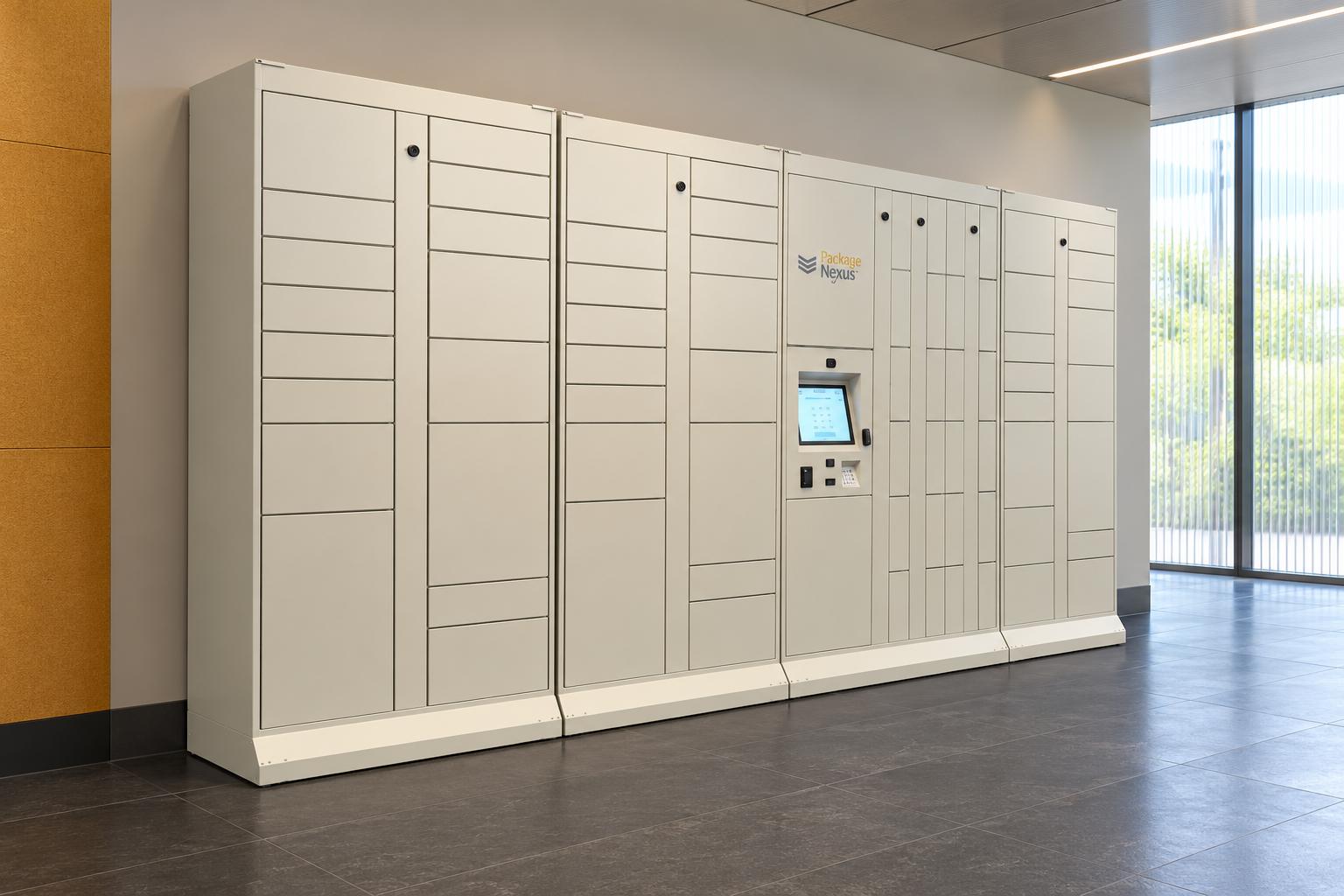
Several major locker brands have overseas parent companies. Package Nexus is 100% US-owned and operated. Ownership can matter to procurement teams seeking a direct relationship with a US-controlled supplier. Confirm service coverage and project responsibilities alongside ownership; US ownership is distinct from a claim that every component is manufactured domestically.
Compare operating cost and test the exceptions
A lower hardware price can be outweighed by repeated service visits, interruptions and staff time spent resolving package discrepancies. Compare installed cost, software, connectivity, maintenance, replacement parts and the staff effort that remains after installation. Use measured site data when estimating savings.
Illustrative example: avoiding 30 routine interventions per month at 8 minutes each saves 4 staff hours. At an assumed loaded labor cost of $30 per hour, that equals $120 per month or $1,440 per year. This is arithmetic for planning, not a Package Nexus performance result or a savings guarantee. Hardware downtime and workflow exceptions should be measured separately.
Request a demonstration that reflects real deliveries
Use the same scenarios when evaluating indoor parcel locker manufacturers. Published support instructions for other systems include empty lockers, early door-closing and connection errors. These examples show why testing matters, although they do not establish incident frequency. A demonstration should show the audit record as well as the screen response.
- Deliver a small box, a flat mailer and an irregular parcel in several supported positions. Verify deposit and removal detection.
- Complete a delivery after the session times out. Check the recipient assignment, notification and compartment status.
- Close the door before removing a package. Confirm how the recipient resumes pickup without routine staff repair.
- Interrupt internet connectivity. Identify exactly which local transactions continue and what synchronizes later.
- Review a controlled restart with the provider. Verify that the system returns to a consistent, safe state.
- Check the proposed PC, display, storage, scanner and power-backup specifications, including replacement support.
- Trace one locker parcel and one room parcel from delivery to pickup. Identify the evidence available for each.
On-Auto-Pilot targets supported routine user errors. Physical damage, incorrect addressing, equipment maintenance, exceptional access disputes and site infrastructure failures still need an escalation process. This distinction makes the reduction in routine staff work more useful and measurable.
Choose a system that can demonstrate its advantage
Package Nexus brings together industrial computing, 12-gauge cabinets, patented automation and expandable storage. For a site-specific comparison, request a Package Nexus demonstration and share your floor plan, package-volume history, largest common items, network conditions and required integrations. Ask to see the exact exceptions that currently interrupt your team.
Frequently asked questions
Are industrial computers better than tablets for parcel lockers
They are often a stronger fit for demanding unattended installations when the industrial system has appropriate environmental ratings, dedicated interfaces, dependable storage and a supported maintenance plan. The result depends on the complete product. A well-managed tablet installation may suit a controlled indoor location, while an industrial PC with poor software or cooling can still fail. Compare demonstrated operation and serviceability.
Is Raspberry Pi unsuitable for commercial parcel lockers
No. Raspberry Pi offers Compute Modules designed for embedded products, including models with eMMC storage and long production commitments. A basic development board is different from a protected industrial system built around such a module. Ask about the carrier board, storage endurance, power protection, enclosure, thermal design and support. Processor brand alone does not prove or disprove commercial reliability.
What makes the Package Nexus industrial computer approach valuable
Package Nexus publishes a fanless industrial PC, industrial touchscreen, dedicated scanner, electronic locks and sensing workflows. The value comes from integrating those components with automatic transaction handling. Buyers should confirm the exact bill of materials and demonstrate delivery, pickup and exception recovery on the quoted configuration. A hardware label is useful only when the system delivers the expected behavior.
Does a faster computer prevent delivery and pickup errors
Computing capacity helps software respond and coordinate devices, but it does not establish that a package is physically present. Reliable automation also needs sensing, correct recipient assignment, door-state information and recovery rules. Package Nexus On-Auto-Pilot combines those elements to address supported user errors. A missed confirmation should not be the only evidence controlling the delivery record or future compartment availability.
Can Package Nexus detect flat and irregular parcels
Package Nexus describes its patented technology as supporting small, flat and irregular items as well as larger parcels within the compartment’s supported limits. Request a demonstration using the package sizes, materials and placements your property receives. Testing several realistic items is more informative than observing one large box, and it helps establish the supported detection envelope for the installation.
Is the 10 to 20 percent user error figure an industry benchmark
No. In this article, 10–20% is a Package Nexus estimate of incorrect or missing user confirmations. It should not be interpreted as an independently measured market-wide rate, an all-transaction failure rate or a package-loss rate. Property teams can measure their own missed confirmations and interventions before and after installation to evaluate operational improvement.
Why choose 12 gauge steel over 16 or 18 gauge steel
Within the same material convention, 12-gauge steel is substantially thicker. With otherwise comparable design, that adds resistance to bending and denting and can help maintain door and lock alignment. A complete assessment must also examine reinforcement, welds, hinges, locks, anchoring and finish. Gauge alone does not establish a certified security rating or guarantee that one complete cabinet outperforms another.
Do package rooms provide the same accountability as Gen3 lockers
A shared room can record entry and a selected shelf-zone, with cameras providing additional context. It does not inherently verify which individual parcel leaves with each visitor. Sensor-equipped lockers isolate an assigned compartment and can record package-state changes. Package Nexus offers both approaches so properties can balance verified handoffs, oversized capacity, available space and cost.
Does On Auto Pilot eliminate all property staff involvement
It can eliminate staff troubleshooting for the supported routine errors it resolves automatically, including certain incomplete and timed-out workflows. That benefit does not remove the need for equipment maintenance, accurate user records, physical security or escalation of unusual incidents. Ask the provider to demonstrate which issues resolve without staff and to define the remaining support responsibilities.
What does worldwide patented technology mean here
Package Nexus uses the phrase for its international On-Auto-Pilot patent portfolio. It reports protection in the United States, Australia and 18 European countries. This does not mean one patent covers every country, establish error-free operation or imply exclusive ownership of all package-sensing technology. Request the applicable patent details for formal evaluation.

Package Nexus is the global technology leader and provider of The World's Most Advanced Smart Parcel Lockers for efficient and most simplified package management for multifamily communities, retailers, universities, libraries, corporate offices, groceries, and more. Package Nexus unique and patented technology offers a fix for human errors at the time of package deliveries and pickups. Package Nexus solutions help property, store, and office managers to improve their operations, reduce operating costs, and increase customer satisfaction at the same time. Package Nexus offers its entire suite of solutions globally.
USEFUL LINKS

© 2017-2026 Package Nexus