


Parcel Lockers vs Package Rooms in Apartments
A practical guide to package security, verified pickup, storage capacity and staff workload
For apartments, smart parcel lockers are the stronger fit when the priority is individually secured storage and a verifiable delivery-to-pickup workflow. Package rooms offer flexible space for bulky deliveries and overflow, but shared shelves do not inherently provide the same package-by-package isolation or verification. Many communities benefit from combining sensor-equipped lockers with an access-controlled room.
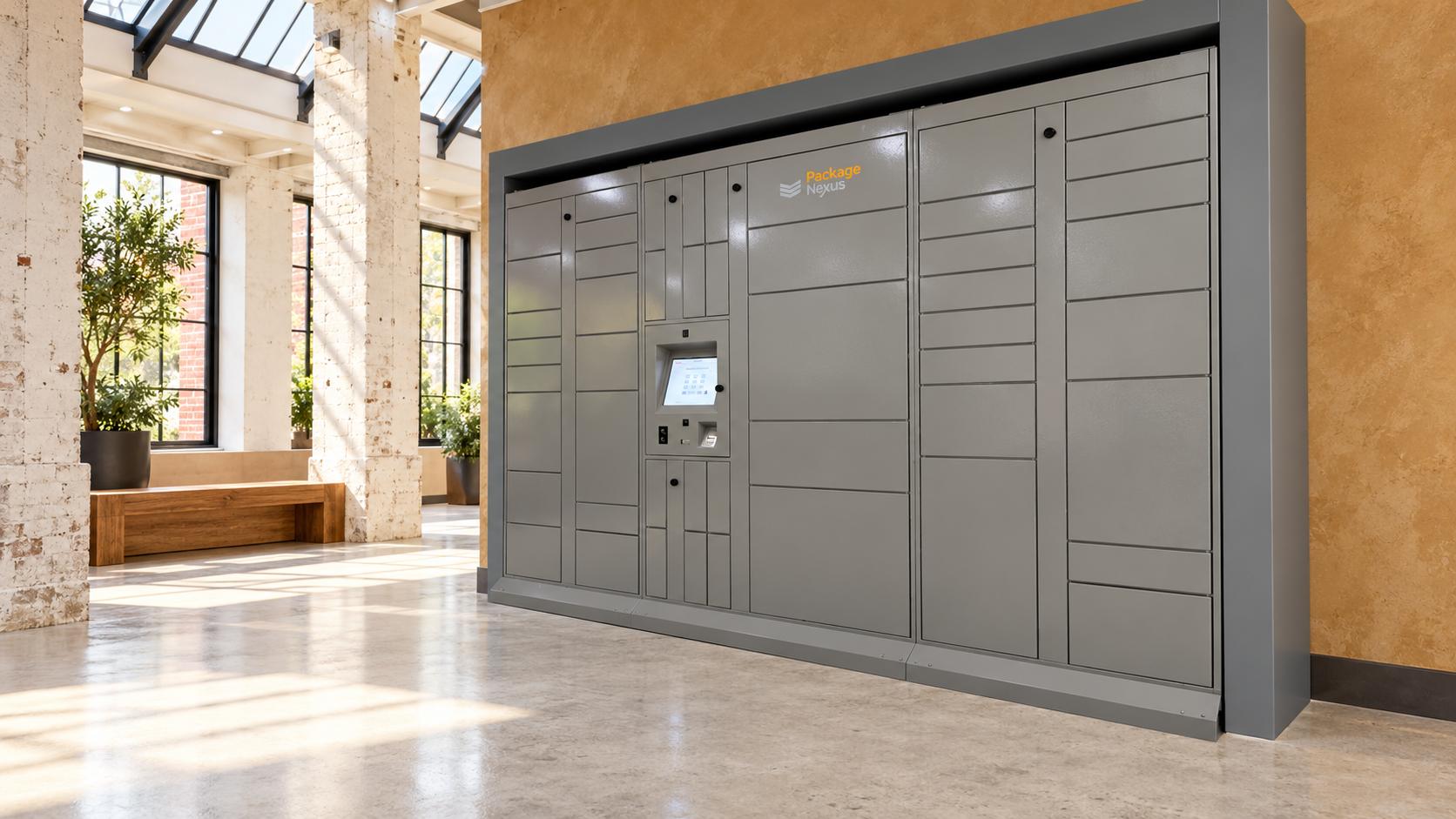
Package Nexus offers all three configurations: Patented On-Auto-Pilot Smart Parcel Lockers, a Standalone Package Room and an Integrated Package Room. The right choice starts with the evidence your property needs when someone asks, “Where is my package?” It also considers the packages you receive, the space you have and how much work should remain with your onsite team.
How parcel lockers and package rooms differ
Electronic parcel lockers secure deliveries inside assigned compartments. A courier registers a delivery, the system provides access to an appropriate compartment and the resident receives pickup credentials. The strength of the record depends on how the system verifies that the package was actually deposited and later removed.
An apartment package room secures a shared storage area. A traditional room may depend on staff to log and distribute packages. An access-controlled room can automate entry, delivery registration and resident notifications. More advanced rooms may also add package-specific tracking. These are materially different operating models.
When evaluating smart parcel lockers for apartments, compare the complete workflow with the specific room technology being proposed. A camera, an electronic door and a “delivered” status each provide useful information, but they do not necessarily prove the same event.
| Decision Factor | Sensor-Equipped Lockers | Access-Controlled Shelf Room |
|---|---|---|
| Access boundary | Assigned compartment | Shared storage room |
| Physical package status | Presence and absence can be sensed in the compartment | Entry logs alone do not establish an individual parcel’s status |
| Recipient separation | Other residents’ parcels remain behind separate doors | People inside can usually reach multiple residents’ parcels |
| Oversized deliveries | Must fit an available compartment | Flexible shelves or a planned oversized-item bay |
| Capacity constraint | Available compartments in the required size mix | Usable shelf space, safe circulation and retrieval time |
| Routine work | Can automate verification and supported exceptions | Depends on registration, placement discipline and tracking capability |
| Growth | Add compatible modules and plan clearance | Reconfigure shelves or add suitable room space |
An integrated configuration uses each storage type for the packages it handles well. Standard parcels can use individual lockers, while larger or irregular deliveries go to the room through a defined process.
Why individual package accountability matters?
A useful package record connects the intended recipient, delivery event, storage location, authorized access and actual pickup. If one of those links is missing, staff may need to review footage, inspect shelves or contact the courier and resident to reconstruct what happened.
Package rooms inherently lack the isolation created by individual locker doors. A room entry log can establish that a credential was used. A shelf-zone entry can indicate where a courier intended to place a parcel. Neither fact, by itself, proves that the correct parcel remained there or was collected by its intended recipient.
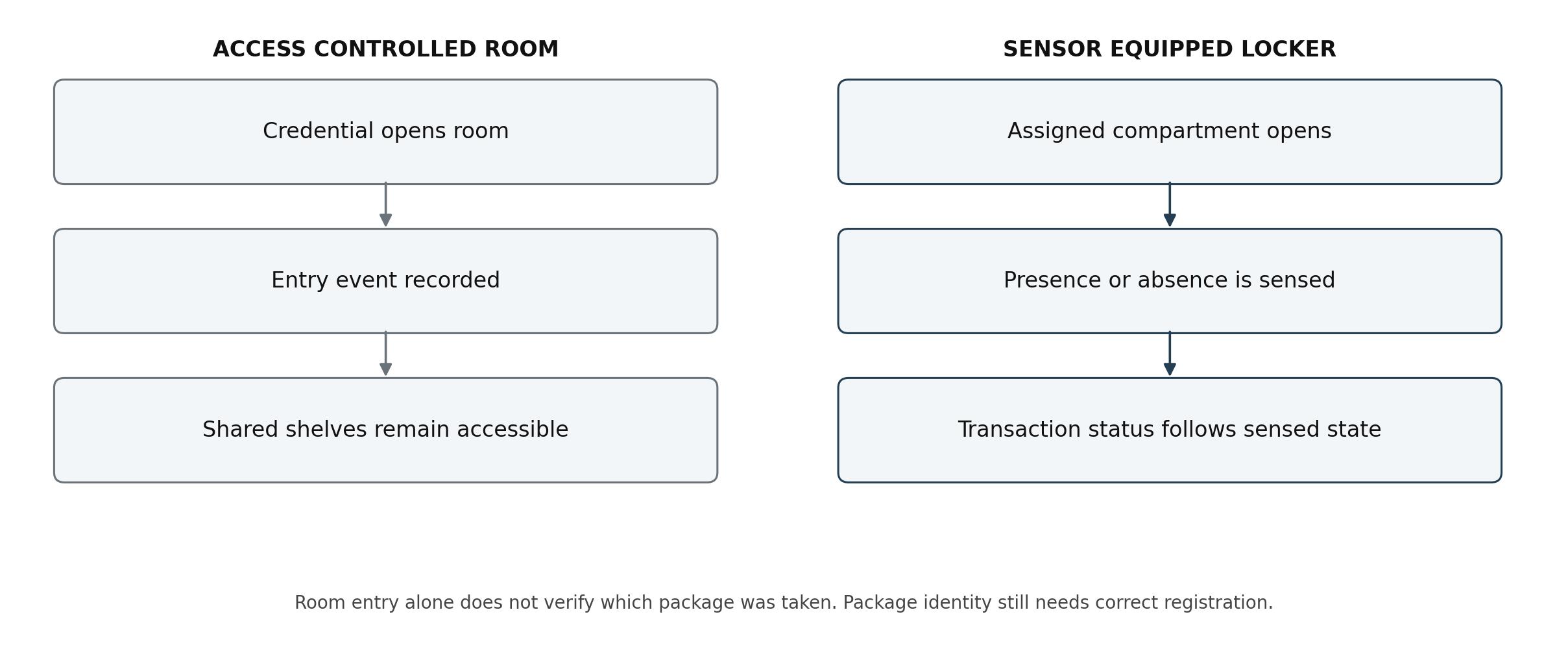
Package Nexus describes its third-generation approach as complete transaction transparency and accountability: an assigned compartment, recorded access and sensed package presence or absence work together. “Third generation” is Package Nexus’s description of its technology; the practical benefit is the additional physical evidence behind the transaction record.
That evidence helps communities reduce lost or stolen packages and investigate discrepancies more efficiently. It does not identify the contents of a box or correct an incorrectly registered recipient by itself. Correct registration, credential control and appropriate installation remain essential.
Some advanced package rooms use computer vision or other item-level tracking. Those capabilities should be demonstrated directly. Shared access to shelves still differs from opening only the compartment assigned to a resident.
Why sensing is better than a confirmation button?
A user can press “yes” without completing a delivery, remove a parcel without finishing the screen prompts, or walk away when a session times out. A door can open and close while its contents remain unchanged. Software that treats these actions as proof can create a record that no longer matches the physical compartment.
Package Nexus estimates that manual confirmations can be incorrect or missing in 10–20% of interactions. This is a company-supplied estimate, not an independently established industry-wide error rate. Even a lower rate can generate avoidable work when a community handles many deliveries.
| Event to Test | Risk in an Input-Dependent Process | Value of Physical Verification |
|---|---|---|
| Courier opens an empty compartment but deposits nothing | A delivery may be marked complete without a package | Checks whether a deposit actually occurred |
| Courier deposits a parcel and leaves before finishing | A package may remain unregistered or lack a completed transaction | Supports recovery of an unfinished delivery |
| Resident opens the door and leaves the parcel inside | A pickup confirmation may invalidate access prematurely | Checks whether the compartment is still occupied |
| Resident removes the parcel but misses the final prompt | An empty compartment may remain unavailable | Supports accurate release of usable capacity |
| Flat envelope or small soft mailer is delivered | A sensor with limited coverage may miss the item | Tests detection across the promised package range |
Package Nexus’s patented On-Auto-Pilot technology combines sensing with workflow logic designed to prevent or resolve supported delivery and pickup errors without onsite staff intervention. The company states that its sensors detect packages across sizes and shapes, including small and flat items. Buyers should test those capabilities with their own representative parcels.
Package Nexus describes itself as the only smart parcel locker provider offering its worldwide-patented On-Auto-Pilot combination of package sensing and automatic workflow correction. Its January 2026 announcement reports patent protection in the United States, Australia and 18 European countries. The differentiation rests on the specific patented system and demonstrated workflow.
Why 12 gauge steel matters for apartment lockers
Package Nexus specifies heavy-duty 12-gauge steel in its comparison materials. When otherwise similar panels use the same steel grade and construction, 12-gauge material provides substantially more thickness than 16- or 18-gauge steel. That matters in a shared amenity exposed to repeated use, package handling and occasional impact.
| Gauge | Standard Sheet Steel (inches and millimeters) | Galvanized Sheet Steel (inches and millimeters) |
|---|---|---|
| 12 | 0.1046 in | 2.657 mm | 0.1084 in | 2.753 mm |
| 16 | 0.0598 in | 1.519 mm | 0.0635 in | 1.613 mm |
| 18 | 0.0478 in | 1.214 mm | 0.0516 in | 1.311 mm |
Nominal gauge-chart values. Actual delivered thickness depends on material, specification and mill tolerances. Ask which components use the stated gauge and request decimal thickness in the quotation.
For standard sheet steel, 12 gauge is approximately 75% thicker than 16 gauge and 119% thicker than 18 gauge. For the galvanized values shown, the differences are approximately 71% and 110%. These percentages compare sheet thickness, not the tested security or service life of complete locker systems.
Where the extra material helps
- Resistance to bending and denting. Greater thickness can help a comparable panel withstand everyday knocks and deformation, protecting both appearance and fit.
- A more substantial physical barrier. More steel must be deformed or penetrated in an attempted attack. The result also depends on door edges, locks, hinges, welds and anchoring.
- Preservation of alignment. Panels that resist deformation can help doors and locking components remain properly aligned after physical stress.
- Long-term operating value. Avoiding damage can reduce repair disruption and keep compartments usable. Actual maintenance savings depend on site conditions and the complete assembly.
Thicker steel adds material weight, handling requirements and cost. A purchasing decision should account for those costs alongside durability. Corrosion protection depends on coatings, preparation, exposure and maintenance; steel thickness alone is not a weatherproofing specification.
Compare 12-gauge Package Nexus construction with any proposed 16- or 18-gauge alternative on a like-for-like basis. Request component specifications and relevant test evidence rather than assuming a gauge number establishes a burglary rating or makes a locker impossible to damage.
When a standalone package room makes sense?
A Package Nexus Standalone Package Room can turn suitable existing space into an organized, computerized delivery destination. It is particularly useful when a property has a constrained capital budget, limited space for locker banks, or a package mix that includes bulky and irregular items.
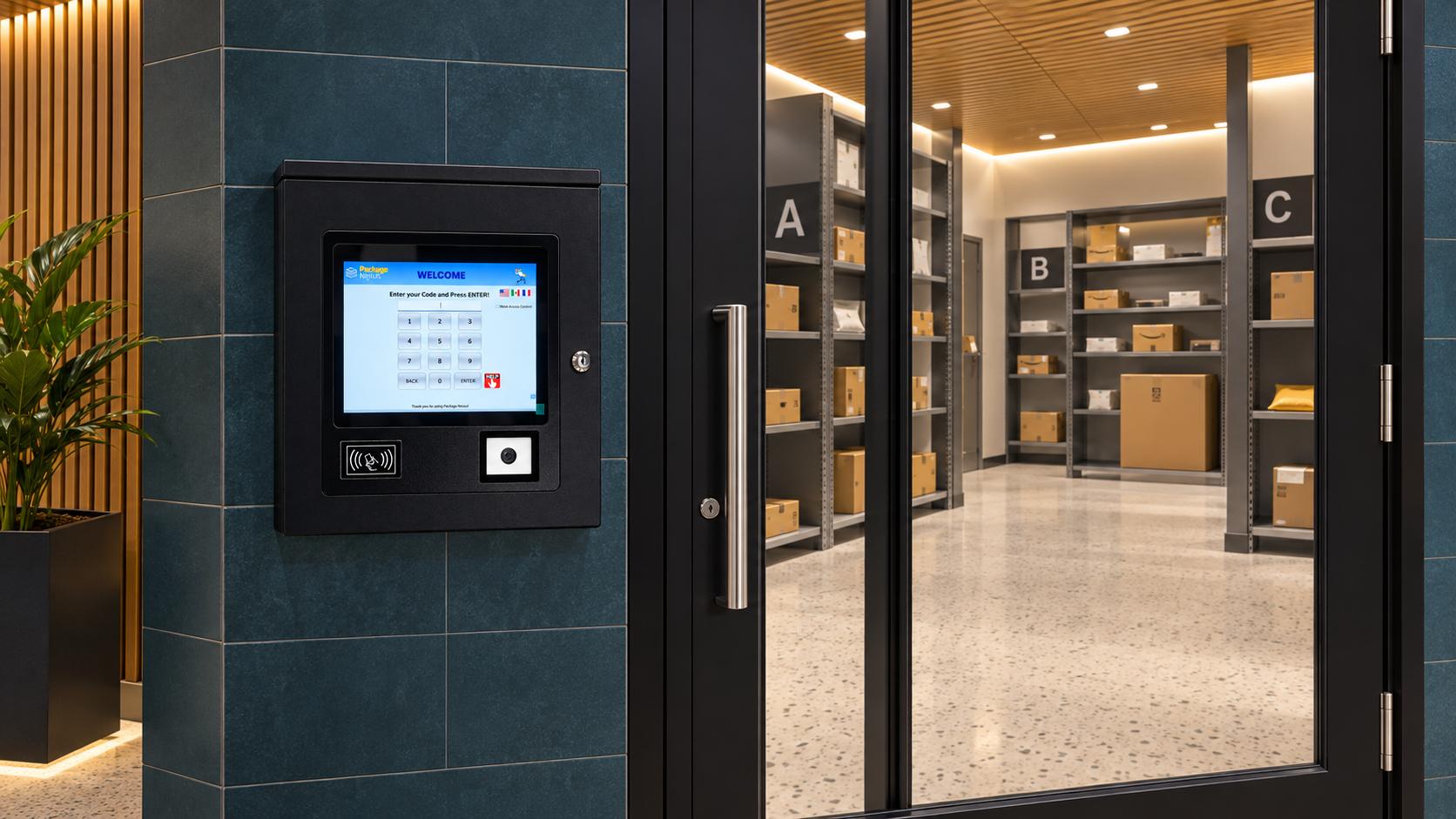
The access computer sits outside the entrance. A courier uses the delivery workflow, selects a shelf zone and places the parcel in that area. The resident receives a unique pickup code and goes to the recorded zone. Clear labels reduce searching and make the room easier to operate than an unmanaged collection of shelves.
Package Nexus lists an embedded entry camera, access records and optional interior cameras and monitors for the standalone solution. These tools support review and oversight. Their visibility remains different from independently sensing the contents of each individually secured locker compartment.
A room succeeds when its organization stays usable during peak demand. Plan shelf depths, reachable storage, clear aisles, an oversized-item area, carrier instructions and a process for aged packages. A shelf-zone selection helps residents find an item; it does not physically prevent someone from moving that item to another shelf.
How an integrated system handles mixed deliveries?
The Package Nexus Integrated Package Room combines flexible room storage with the stronger separation of individually secured lockers. Package Nexus describes a centralized computer system that can manage ambient smart lockers, refrigerated smart lockers, other temperature-controlled lockers and a Smart Package Room within one coordinated installation.
| Delivery Need | Recommended Storage Path | What the Property Gains |
|---|---|---|
| Standard boxes, envelopes and small parcels | Ambient smart locker of a suitable size | Individual access and sensor-supported transaction status |
| Large or irregular cartons | Designated zone in the package room | Flexible storage when a compartment is unsuitable |
| Eligible chilled deliveries | Configured refrigerated locker | Secured holding at the selected temperature setting |
| Other temperature-sensitive deliveries | Appropriately configured temperature-controlled locker | A handling option matched to the item and operating policy |
| Seasonal overflow | Planned locker and room routing | A defined alternative to leaving parcels in the lobby |
A centralized system can simplify carrier routing, recipient records and administration. It does not automatically give an open shelf the same package-state verification as a sensor-equipped compartment. Record which evidence is available for each storage destination and make the overflow workflow clear to carriers.
Choose the installation for the building
Package Nexus indoor parcel lockers can serve a lobby, mailroom or dedicated amenity area. Package Nexus outdoor parcel lockers can preserve interior space when the site has an appropriate exterior location, power, connectivity and access. Confirm environmental requirements, anchoring and accessibility for the selected design.
Package Nexus temperature-controlled smart lockers add options for deliveries that need a different holding environment. Select the configuration and collection policy for the actual items being accepted. A standard ambient locker or room should not be treated as refrigerated storage.
Expand as the community grows
Package Nexus states that its lockers are 100% modular and can be expanded as the community or package volume grows. Reserve space and service capacity for additional compatible towers. Expansion still requires site planning, safe access, available utilities and confirmation of the system configuration.
Compare capacity and the full operating cost
Unit count alone is not enough to size a package system. Measure arrivals by day, parcel dimensions, time until pickup, peak-season demand and the share of deliveries needing oversized or temperature-controlled storage. A room’s floor area and a locker bank’s door count are incomplete capacity measures.
A simple capacity planning example
Assume a property receives 80 eligible locker parcels per day and the average parcel remains for 1.5 days. The average stored load is approximately 120 parcels. A 25% planning allowance produces 150 parcel positions. This is an illustrative starting point, assuming one parcel per compartment; size mix, delivery bunching and resident behavior can require a different layout.
For rooms, plan usable shelf volume and retrieval access together. Stacking more boxes into the same space can increase search time and obstruct movement. For lockers, accurate pickup status helps release compartments promptly, but sensing cannot create new physical capacity when residents leave parcels uncollected.
Calculate the cost of work that remains
To reduce package management costs, compare installed equipment, room conversion, recurring software and support, maintenance, staff time, connectivity, temperature-control energy use and future expansion. Apply the same time horizon and operating assumptions to every proposal.
| Illustrative Monthly Assumption | Calculation | Result |
|---|---|---|
| Parcels handled | 3,000 | 3,000 parcels |
| Baseline staff exceptions | 3,000 × 4% | 120 cases |
| Target staff exceptions | 3,000 × 1% | 30 cases |
| Time avoided at 8 minutes per case | 90 × 8 ÷ 60 | 12 hours |
| Labor value at a loaded rate of $30 per hour | 12 × $30 | $360 per month |
These assumed rates are separate from the company’s 10–20% manual-input estimate. An input mistake is not necessarily a staff support case. The example illustrates a method, not a Package Nexus savings guarantee; annualized labor value is $4,320 before recurring costs, and time released is not necessarily a reduction in payroll spending.
Measure the property’s actual exceptions and time per case before and after installation. Include interruptions, footage review, resident callbacks and physical searches so the comparison reflects the work the leasing office experiences.
Choose the configuration your team can operate
| Property Priority | Strong Starting Configuration | Reason |
|---|---|---|
| Individual package protection and a clear pickup record | On-Auto-Pilot Smart Parcel Lockers | Separates resident access and verifies supported package-state changes |
| A usable existing room and constrained initial budget | Standalone Package Room | Adds organized zones, computerized entry and resident notifications |
| Frequent oversized items and standard parcels | Lockers with an Integrated Package Room | Combines compartment accountability with flexible overflow storage |
| A growing community or phased development | Modular lockers with a reserved expansion area | Adds capacity as demand develops |
| Mixed ambient and chilled deliveries | Integrated system with appropriate temperature-controlled modules | Routes different delivery types into suitable holding environments |
Ask for a live demonstration of exceptions
Bring a small envelope, a soft mailer, a standard box and a large carton to the evaluation. Ask the provider to show what happens when a courier deposits nothing, leaves after depositing a package, or lets a session time out. Then open a pickup compartment without removing the parcel and repeat the process after removing it. Review the resulting status and records.
For the package room, test a misplaced shelf-zone item and an incomplete registration. Ask what is detected automatically, what is only recorded and which situations still require a person. Review the recovery process for an outage, an access problem and a damaged door.
Keep routine troubleshooting out of the leasing office
Package Nexus’s On-Auto-Pilot design is intended to resolve common, supported delivery and pickup errors at the point of interaction. That reduces the recurring need for site managers to reconcile routine transaction mistakes. Property teams still manage resident data, delivery policies, unusual exceptions and physical maintenance.
Package Nexus states that it is 100% U.S.-owned and operated and provides U.S.-based support. For buyers who value domestic ownership and a direct operating relationship, that is a meaningful procurement consideration. Ownership and operation are distinct from the country of manufacture of every component.
Share your floor plan, delivery volume, package-size mix and current staff workload, then request a Package Nexus quote. Ask for a demonstration of the patented sensing workflow and a layout showing the appropriate balance of ambient lockers, temperature-controlled storage and package-room capacity.
Frequently asked questions
Are parcel lockers better than package rooms for apartments
Parcel lockers are usually the stronger option when individual access and a reliable package-level transaction record are the priorities. A room is useful for flexible storage, oversized parcels and properties with suitable existing space. Package Nexus offers both, so the recommendation can follow the property’s package mix rather than requiring every delivery to use the same storage format.
Are package rooms secure
An access-controlled room is more protected than an unattended lobby, and entry records and cameras can support investigations. Residents inside the room can usually reach shared shelves, however. Individual lockers add a separate physical barrier around stored parcels. Room security depends on credential management, door behavior, camera coverage, organization and the tracking capabilities actually installed.
Does a room entry code prove that a resident collected a package
No. It establishes that the credential was used to access the room. Establishing which parcel was removed requires additional evidence, such as package-specific tracking, a verified handoff or reviewable footage. A locker system that senses a change from occupied to empty adds physical package-state evidence within the assigned compartment, while correct recipient registration remains necessary.
Why should a locker sense packages instead of asking users to confirm
People can skip prompts or select an answer that does not match what happened. Package sensing gives the workflow another source of evidence before it completes a transaction or releases capacity. Package Nexus combines this verification with its On-Auto-Pilot logic to address supported exceptions, including unfinished deliveries and pickups that do not follow the expected screen sequence.
Do all electronic lockers provide the same accountability
No. Electronic access, door-position sensing and package-presence sensing are different capabilities. Ask whether the system detects small envelopes, soft mailers and partially completed pickups, and whether it acts on those observations automatically. The most useful comparison is a live test of difficult transactions and the records they produce, rather than the presence of a touchscreen or mobile app.
What does Package Nexus mean by worldwide patented technology
Package Nexus uses the phrase to describe international patent protection for its On-Auto-Pilot platform. The company’s January 2026 announcement identifies the United States, Australia and 18 European countries. Patent rights apply in the jurisdictions where they are granted and maintained. The company’s exclusivity statement concerns its patented combination of technology and workflows; procurement teams can request the relevant patent details.
More questions about apartment package systems
Why is 12 gauge steel preferable to 16 or 18 gauge
For comparable steel and panel construction, 12 gauge provides substantially more material thickness. That can improve resistance to bending, denting and physical deformation. It also adds weight and cost. Evaluate the complete door and cabinet construction, locking hardware, finish and installation; a thicker sheet does not by itself establish a tested forced-entry rating.
How does the Package Nexus shelf zone workflow work
The courier begins at the computer outside the room, selects a delivery zone and places the package in that area. The resident receives a unique pickup code and retrieves the parcel from the recorded zone. Clear shelf labels make packages easier to locate. Successful operation still depends on accurate registration and placement, because a selected zone does not physically constrain the parcel.
Can lockers and a package room share one system
Yes. Package Nexus offers an Integrated Package Room configuration alongside its smart lockers, including ambient, refrigerated and other temperature-controlled options managed through a centralized computer system. Confirm the precise equipment, software integration and workflows in the proposal. Individual compartment verification and shared-room access records should remain clearly distinguishable within the operating process.
Can the locker system expand later
Package Nexus describes its lockers as 100% modular, allowing compatible modules to be added as demand grows. Plan the future footprint during the initial design so added towers do not obstruct circulation or pickup access. Expansion timing, available power, connectivity and installation conditions should be reviewed when the property is ready to add capacity.
Which option costs less over time
A room can have a lower initial cost when suitable space already exists, while lockers may reduce manual package handling and transaction troubleshooting. Building work, software, support, staffing and maintenance can change the result. Compare total cost over the same period using the property’s measured staff workload and real quotations instead of assuming one format is always less expensive.

Package Nexus is the global technology leader and provider of The World's Most Advanced Smart Parcel Lockers for efficient and most simplified package management for multifamily communities, retailers, universities, libraries, corporate offices, groceries, and more. Package Nexus unique and patented technology offers a fix for human errors at the time of package deliveries and pickups. Package Nexus solutions help property, store, and office managers to improve their operations, reduce operating costs, and increase customer satisfaction at the same time. Package Nexus offers its entire suite of solutions globally.
USEFUL LINKS

© 2017-2026 Package Nexus