


What do I need to know before buying a smart parcel locker?
A practical guide to capacity, automation, installation, durability and long-term value
Before buying a smart parcel locker, determine how many packages it must hold, where it will operate, whether deliveries require temperature control, and how the system verifies delivery and pickup. Then compare installation requirements, accessibility, security, support and total ownership cost. The most useful locker is one that keeps packages moving without making your team manage every handoff.
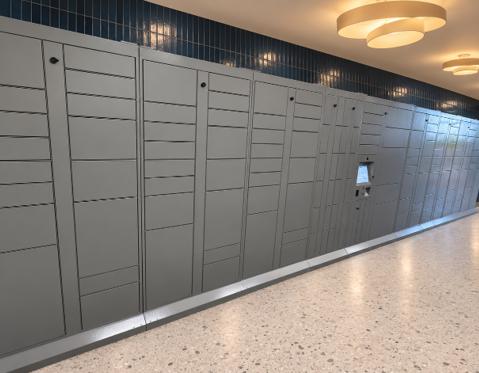
Package Nexus combines indoor and outdoor configurations, ambient and temperature-controlled storage, and patented On-Auto-Pilot workflows. The company reports that a package can be delivered to its smart locker in only 5 seconds. Actual timing depends on the configured workflow, recipient selection and package handling; request a timed demonstration for your use case.
For multifamily owners, developers and facilities teams, the opportunity extends beyond secure storage: a well-planned system can free staff time, reduce leasing-office clutter and provide convenient 24/7 deliveries and pickups wherever building access permits.
Start with the handoff and the location
Choose a location people can actually use
A locker is a shared delivery destination. Couriers need a clear route to it, and recipients need convenient, safe access after normal business hours. A system behind a locked leasing-office door cannot deliver a true 24/7 experience, even when its electronics operate continuously.
Choose indoor smart parcel lockers for lobbies, mailrooms, corridors or suitable garage areas when they fit everyday resident circulation. Check doorway dimensions, delivery access, usable floor space, door swings and the space people need while collecting parcels. Keep emergency routes clear and have the project team review accessibility and structural requirements.
Choose outdoor parcel lockers when exterior access improves convenience or preserves interior space. Evaluate sun exposure, wind-driven rain, drainage, anchoring, lighting, ground conditions and local temperature extremes. Outdoor performance must be specified for the complete system, including its screen and electronics—not merely the metal cabinet.
Separate ambient storage from temperature control
Ambient lockers secure ordinary parcels without actively maintaining a refrigerated, frozen or heated storage condition. Weather resistance protects the enclosure; it does not establish a safe storage temperature for perishable contents.
Package Nexus offers temperature-controlled smart lockers, including hot, cool and frozen options, alongside ambient compartments. An appropriately configured Temperature-Controlled Tower can support groceries, prepared meals and other temperature-sensitive deliveries indoors or outdoors. Request the precise temperature range, operating environment, monitoring method, alarms, cleaning requirements and response to power loss for the quoted model.
| Decision | Best starting point | Confirm before ordering |
|---|---|---|
| Indoor or outdoor | Access route and available space | Environmental specification, utilities and installation drawing |
| Ambient or controlled | Storage needs of actual deliveries | Temperature range and handling procedure |
| 24/7 access | Independent carrier and recipient entry | Entry credentials, lighting and after-hours support |
| Compartment mix | Parcel dimensions and dwell time | Usable internal dimensions and peak occupancy |
Make these decisions together. An outdoor location with excellent carrier access may need different electrical preparation and temperature-control provisions than an interior mailroom.
Buy verified handoffs and fewer interruptions
How automatic verification changes the experience
To understand how indoor smart parcel lockers work, follow a single package: the courier identifies its recipient, deposits it into a compartment, and the resident receives pickup instructions. An authorized pickup opens the assigned door. The critical buying question is what proves that the package was actually deposited or removed.
A question such as “Did you deliver? Yes/No” records a person’s response. Physical sensing provides a different kind of evidence. Package Nexus’s patented On-Auto-Pilot technology uses package sensing and software to guide supported delivery and pickup workflows, reconcile compartment status and recover from common transaction interruptions. The company describes detection of small, flat and larger items that fit the compartment.
Package Nexus estimates that manual confirmations can be wrong or missing in 5–15% of relevant interactions. This is a company-supplied estimate, not an independently measured industry error rate or a package-loss statistic. It explains why verifying the physical event can be more useful than adding another confirmation screen.
What third generation means
Package Nexus positions itself as the only provider of its worldwide-patented 3rd Generation On-Auto-Pilot Smart Parcel Locker technology. The company states that its relevant U.S. and international patents expire in 2040. “Third generation” is Package Nexus’s framework for sensing-led automation, not an industry-wide certification; international patent protection is jurisdiction-specific.
The company describes its approach as delivering complete transparency and 100% accountability by grounding supported transaction completion in sensed package activity rather than Yes/No confirmations. Buyers should interpret this as the design objective for traceable handoffs, not a guarantee against every loss, outage or incorrect recipient selection.
| Demonstration scenario | Evidence to request |
|---|---|
| Deposit a small flat item | Presence is detected and the delivery record is correct. |
| Walk away before completing the session | Supported timeout recovery preserves the correct package status. |
| Open a door without removing the package | The system does not incorrectly make an occupied compartment available. |
| Leave a door open | The system guides or flags the exception; show who receives any escalation. |
| Review the completed transaction | Package, compartment, event time and authorized access can be traced. |
For parcel lockers for communities without onsite managers, these recovery tests are especially valuable. Fewer routine exceptions can mean fewer calls, fewer investigations and fewer trips to the property. Staff still need an escalation path for misaddressed parcels, damaged equipment and other exceptional events.
Specify hardware for continuous commercial use
Look beyond the touchscreen
Package Nexus lists an industrial-grade fanless PC, a separate industrial touchscreen, Braille keypad, cameras, barcode reader and speakers. Its public materials identify a 15-inch display and the Honeywell 3320G scanner; confirm current component models in the final proposal. Dedicated components can support serviceability because a single peripheral may be replaced without replacing the entire control system.
Industrial-grade electronics are intended for demanding operating conditions and repeated commercial use. Their practical advantage depends on documented temperature ratings, component quality, ventilation, power protection and parts availability. A consumer tablet may have a lower purchase price, but its replacement cycle and environmental limitations deserve scrutiny in a 24/7 installation. No computer category alone guarantees a particular service life.
Evaluate the enclosure and the outdoor details
Package Nexus specifies heavy-duty 12-gauge galvanized steel with a protective powder-coated finish. At comparable steel specifications, 12-gauge sheet is thicker than 16- or 18-gauge sheet, supporting greater rigidity and resistance to denting. Galvanizing adds zinc protection against corrosion. Overall durability also depends on hinges, locks, seams, coating condition and installation.
For outdoor projects, Package Nexus offers an exterior-oriented design, outdoor monitors, LED lighting inside every compartment, a canopy with LED lighting, motion sensors and security cameras. Compartment lights help users locate small items at night; canopy lighting improves visibility at the kiosk. Confirm which features are included in the selected configuration.
| Package Nexus feature | Buyer benefit | Specification to request |
|---|---|---|
| Industrial PC and dedicated peripherals | Continuous-use design and component servicing | Operating ratings and replacement support |
| 12-gauge galvanized steel | Rigid enclosure and corrosion protection | Material and finish specification |
| Outdoor monitor and lighting | Usable interface and visibility at night | Sunlight readability and included lighting |
| Braille keypad and audio | More inclusive interaction options | Full accessible journey demonstration |
| Cameras and event records | Additional evidence during an investigation | Coverage, retention and administrator permissions |
| Modular towers | Capacity can grow with demand | Expansion layout, compatibility and pricing |
Review Package Nexus technology together with the project specification. Accessibility must address the full route, controls and usable compartments; a Braille keypad alone does not establish that an entire installation meets every requirement.
Plan capacity and a premium resident experience
Size for occupancy rather than unit count alone
A community with frequent same-day pickups needs a different layout from one where packages remain for several days. Record daily deliveries, peak weeks, package dimensions and collection delays before choosing the compartment mix. Oversized deliveries need a defined alternative rather than an improvised pile beside the lockers.
A useful first-pass planning estimate is daily parcel volume multiplied by average days in storage. For example, 80 parcels per day held for 1.5 days implies about 120 occupied compartments on average when each parcel uses one compartment. This is an illustrative calculation, not a sizing recommendation: add headroom for peaks, size mismatches and unavailable compartments, then validate with real operating data.
Package Nexus describes its lockers as 100% modular and expandable as community size or package volume grows. Reserve physical space for additional towers and confirm compatibility, utilities and installation access in the original plan. Expansion is most economical when the site is prepared for it.
Make the amenity feel like part of the property
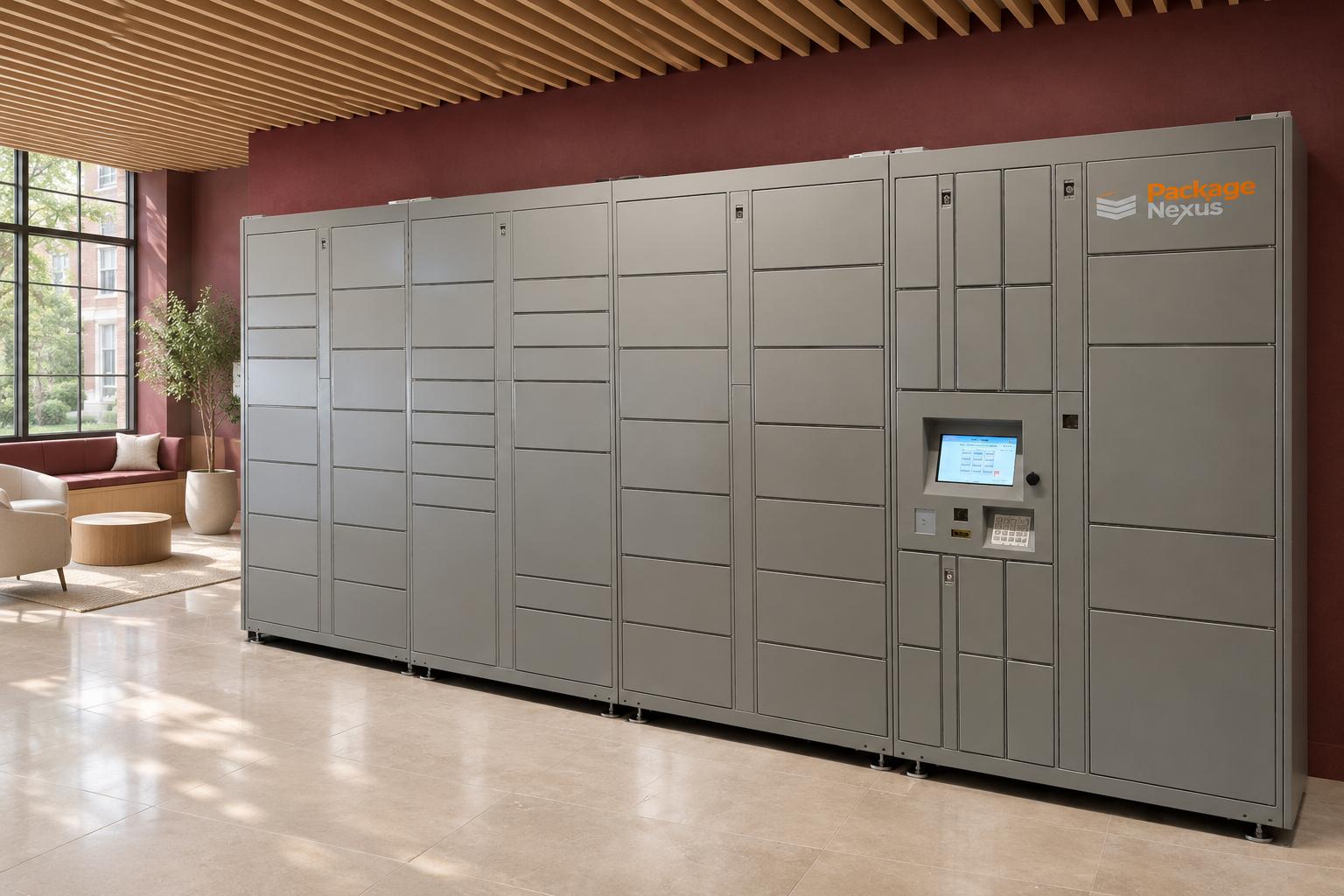
For high-end and luxury communities, the best system combines dependable self-service with a clean, customized appearance. Package Nexus offers configurable finishes and layouts, touchless pickup options and indoor, outdoor and temperature-controlled configurations. A deliberate placement can remove visible package clutter from the leasing office and improve the arrival experience without sacrificing circulation space.
Review Package Nexus for apartments and condos when planning the resident experience. Demonstrate pickup with residents who have different mobility, vision, language and technology needs. Confirm what “touchless” means in the offered workflow, including whether the screen, door or another surface must still be touched.
Compare operating value and vendor commitments
Compare actual configurations from every provider
When comparing Package Nexus with Luxer One, Parcel Pending, Amazon Hub, Package Concierge or another provider, use the same package samples and exception scenarios. Package Nexus’s comparison page characterizes competing workflows as more dependent on user confirmation. Treat those classifications as the company’s comparison framework and verify each current model directly.
Avoid assuming that competitors lack outdoor options, customization, tracking or heavy-gauge steel. Luxer One, for example, currently advertises indoor and outdoor systems, 12-gauge steel and customizable units. The more meaningful distinction to test is whether physical package detection drives transaction completion and automatic recovery in the configuration being quoted.
Calculate the cost of running the system
Request a five-year ownership model covering equipment, freight, site preparation, installation, subscriptions, connectivity, integrations, support, maintenance and replacement parts. Add the staff time still needed for exceptions and the cost of expansion. Compare equivalent configurations rather than a basic ambient cabinet with a complete outdoor refrigerated system.
A simple labor illustration shows why automation matters: avoiding 20 minutes of routine package work per day at an assumed loaded labor cost of $30 per hour represents $3,650 of annual staff capacity. That is not a Package Nexus savings claim or necessarily a payroll reduction; replace the assumptions with measured time and local costs.
Turn service promises into written terms
Ask who answers support requests after hours, which faults require an onsite technician, how quickly replacement parts can arrive, and what remains operational during network or power interruptions. Confirm notification behavior, data synchronization and manual recovery procedures in a demonstration rather than assuming offline operation.
For integrations, specify how resident or employee records are imported, how changes are synchronized and how departures are deactivated. Review administrator permissions, data retention, security documentation, update practices and data export at contract end. Secure hardware is only one part of a dependable service.
Package Nexus states that it is 100% U.S.-owned and operated, with U.S.-based support. This can be relevant to buyers seeking an accessible domestic business relationship, but it is distinct from a claim that every component is manufactured in the United States.
Move from requirements to an approved installation
The smart locker installation process should translate the package profile into a compartment schedule, location review, site survey and approved drawing. Confirm power, connectivity, finish, mounting, delivery access, training and go-live responsibilities before placing the order. Include a real delivery-and-pickup acceptance test.
Where the highest operational opportunities appear
The strongest projects start with a recurring handoff problem and a measurable target. Package Nexus can configure solutions across markets; the examples below are planning opportunities, not measured customer outcomes.
| Market | High-impact opportunity | Measure after launch |
|---|---|---|
| Multifamily and luxury housing | Move routine deliveries out of the leasing office and offer after-hours collection | Staff minutes, exceptions per 1,000 transactions, pickup delay |
| Communities without onsite managers | Reduce visits caused by incomplete package transactions | Site visits, unresolved exceptions, remote resolution rate |
| Retail and groceries | Provide convenient order pickup with matched storage conditions | Collection wait, pickup completion, storage dwell time |
| Libraries and campuses | Extend convenient collection beyond staffed desk hours | After-hours collections and compartment turnover |
| Corporate mailrooms | Separate recipient collection from mailroom staffing | Handoff time, inventory accuracy and collection delay |
| Hotels | Organize guest deliveries without continuous front-desk handling | Desk interruptions and successfully matched pickups |
| Warehouses and service operations | Create controlled handoff points for parcels or suitable equipment | Uncollected items and transaction traceability |
Require proof of the workflow that matters to you
An apartment parcel workflow does not automatically establish suitability for a library reservation system, hotel guest turnover or employee equipment returns. Confirm the exact application, authentication and integration requirements with Package Nexus. Food-related projects also need a defined storage and handling process.
A buying decision that rewards better technology
Choose the system that makes your actual operating day simpler. For Package Nexus, the strongest case combines patented sensing-led workflows, heavy-duty construction, dedicated industrial electronics, flexible storage conditions and modular expansion. These features address both the visible resident experience and the less visible staff workload behind it.
To request a smart parcel locker quote, share your floor plan, delivery counts, package-size mix, pickup patterns and desired indoor or outdoor location. Include temperature-controlled storage needs and the exception scenarios you want demonstrated. That gives Package Nexus a concrete basis for proposing the right configuration.
Frequently asked questions
What should I check first before buying a smart parcel locker?
Start with the packages and the handoff: daily volume, peak occupancy, package sizes, pickup delays and who can access the location. Then test how the locker verifies delivery and removal. These factors determine whether a system will relieve staff workload or simply move the same exceptions to a new screen.
Can smart parcel lockers accept deliveries and pickups 24/7?
Yes, a suitably configured system can support round-the-clock self-service. Actual availability also depends on building entry rules, carrier access, lighting, power and connectivity. Place the lockers where authorized users can reach them outside office hours and establish an after-hours support process.
How quickly can a courier deliver to Package Nexus?
Package Nexus reports that a package can be delivered in only 5 seconds. This is a company-reported capability, not a guarantee for every transaction or an entire courier stop. Ask for a timed demonstration using the expected recipient-selection process and representative package sizes.
Can Package Nexus lockers be installed outdoors?
Yes. Package Nexus offers outdoor parcel lockers with construction and component options intended for exterior use. Review the exact environmental specification, screen, lighting, canopy, anchoring and utility requirements for your location. An outdoor-rated ambient locker does not automatically refrigerate its contents.
Do I need refrigerated lockers for grocery deliveries?
If the intended deliveries require chilled, frozen or heated storage, choose compartments specified for those conditions. Package Nexus offers temperature-controlled options that can be combined with ambient storage. Confirm operating ranges, monitoring, collection time limits and procedures for temperature excursions or outages.
How many compartments should an apartment community buy?
Use delivery volume, package dimensions and dwell time rather than relying only on the number of apartments. Review seasonal peaks and plan an oversized-item process. Package Nexus’s modular approach allows future expansion, but the initial layout should reserve the space and infrastructure needed to add capacity.
What makes Package Nexus On-Auto-Pilot different?
Its patented sensing and software guide supported workflows using physical package activity. The objective is to complete or correct transactions without treating a Yes/No response as the only proof of delivery or pickup. Ask to see small-item detection, incomplete sessions and pickup-without-removal scenarios in a live demonstration.
Will the lockers eliminate every need for a site manager?
Automation can remove routine confirmation-related troubleshooting from the manager’s day, which is particularly valuable at remotely managed communities. It does not eliminate every operational responsibility. Incorrect recipient choices, oversized deliveries, hardware damage and unusual disputes still need a clear escalation process.
Why do industrial electronics and 12-gauge steel matter?
Industrial electronics can be selected for continuous service, environmental tolerance and replaceable peripherals. Thicker steel contributes to cabinet rigidity, while galvanizing and the finish help resist corrosion. Evaluate the complete design, maintenance plan and component support rather than treating one specification as a guarantee of longevity.
Are Package Nexus lockers suitable for luxury multifamily properties?
They are a strong fit when a property values convenient collection, orderly shared spaces and automated accountability. Customizable finishes and layouts can complement the architecture, while touchless pickup options reduce routine kiosk interaction. The final design should balance appearance with accessibility, carrier access and peak package capacity.
What do the patent and third-generation claims mean?
Package Nexus describes itself as the only provider of its worldwide-patented third-generation On-Auto-Pilot approach and reports relevant patent expiration in 2040. These are company statements and terminology. Buyers seeking patent-level verification should request the applicable patent numbers, jurisdictions and current status.
What should be included in a smart locker quotation?
Ask for the exact compartment schedule, hardware, software, installation scope, recurring charges, support terms and expansion plan. Outdoor and temperature-controlled options should have their own specifications. Include integration, training, outage behavior and acceptance testing so the proposed solution can be evaluated as a complete operating system.

Package Nexus is the global technology leader and provider of The World's Most Advanced Smart Parcel Lockers for efficient and most simplified package management for multifamily communities, retailers, universities, libraries, corporate offices, groceries, and more. Package Nexus unique and patented technology offers a fix for human errors at the time of package deliveries and pickups. Package Nexus solutions help property, store, and office managers to improve their operations, reduce operating costs, and increase customer satisfaction at the same time. Package Nexus offers its entire suite of solutions globally.
USEFUL LINKS

© 2017-2026 Package Nexus