
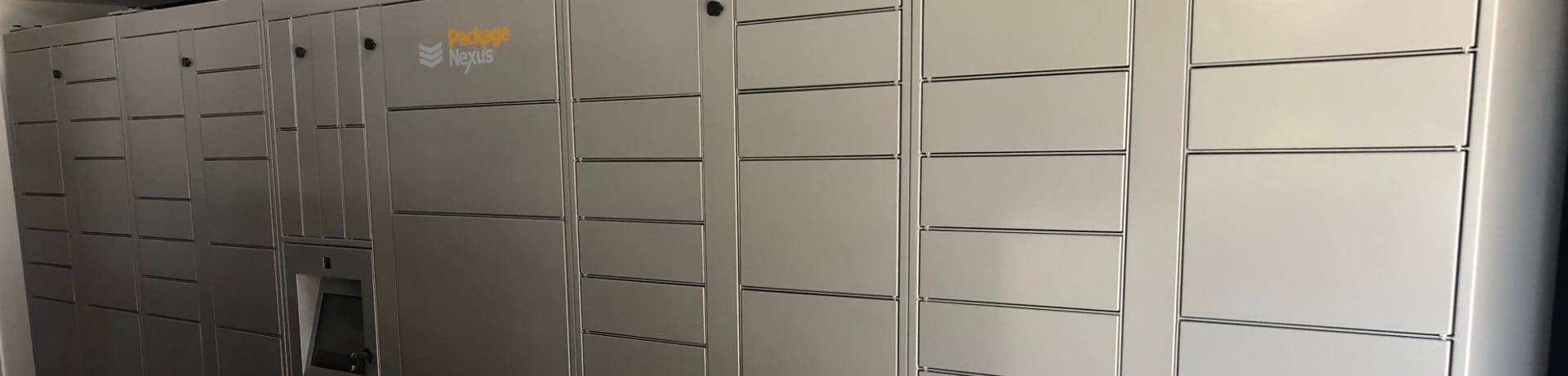

Why Package Nexus Uses 12 Gauge Galvanized Steel for Smart Parcel Lockers
Package Nexus uses extra heavy-duty 12-gauge galvanized steel for its indoor and outdoor smart parcel lockers because the enclosure must remain dependable through years of deliveries, door operation, accidental impacts, and changing environmental conditions. Thicker steel supports a more rigid cabinet and greater resistance to deformation. Galvanizing adds zinc protection against corrosion, while an industrial powder-coated finish adds another protective layer and a finished appearance.
Those choices increase material use, fabrication effort, and handling costs for Package Nexus. We make that investment because a locker is a working asset: residents need access to their parcels, and property teams need equipment that does not continually demand their attention. Construction quality becomes especially valuable when it is paired with technology that verifies what happened during delivery and pickup.
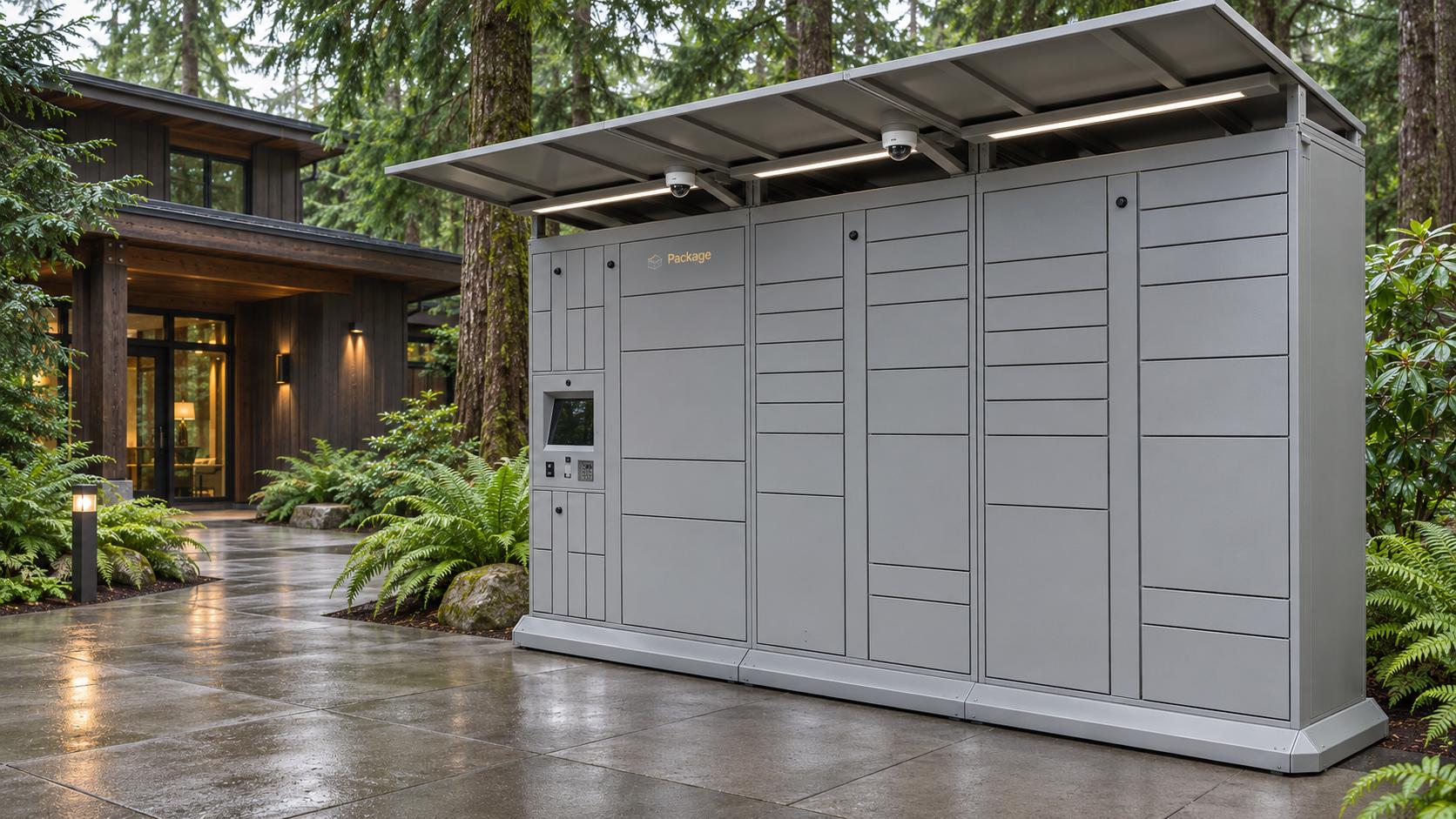
A durable enclosure supports a dependable service
Package Nexus combines heavy-duty construction with Patented On-Auto-Pilot Smart Parcel Lockers. The aim is to protect the physical package, preserve accurate transaction records, and remove avoidable work from the property team. The value comes from the complete system: steel, finish, locks, sensors, industrial computing, software, and a suitable installation.
How 12 gauge compares with 14 16 and 18 gauge
Within the same steel gauge convention, a lower gauge number indicates a thicker sheet. The difference is substantial: nominal 12-gauge galvanized sheet is approximately 38% thicker than 14 gauge, 71% thicker than 16 gauge, and 110% thicker than 18 gauge.
| Galvanized Sheet Gauge | Nominal Inches | Nominal Millimeters | How Much Thicker 12 Gauge Is |
|---|---|---|---|
| 12 | 0.1084 | 2.753 | Reference thickness |
| 14 | 0.0785 | 1.994 | About 38% |
| 16 | 0.0635 | 1.613 | About 71% |
| 18 | 0.0516 | 1.311 | About 110% |
Nominal galvanized sheet values, not measurements of a particular locker. Actual thickness, base-steel thickness, coating designation, and permitted tolerances should be confirmed in the project specification. Uncoated steel uses different nominal values.
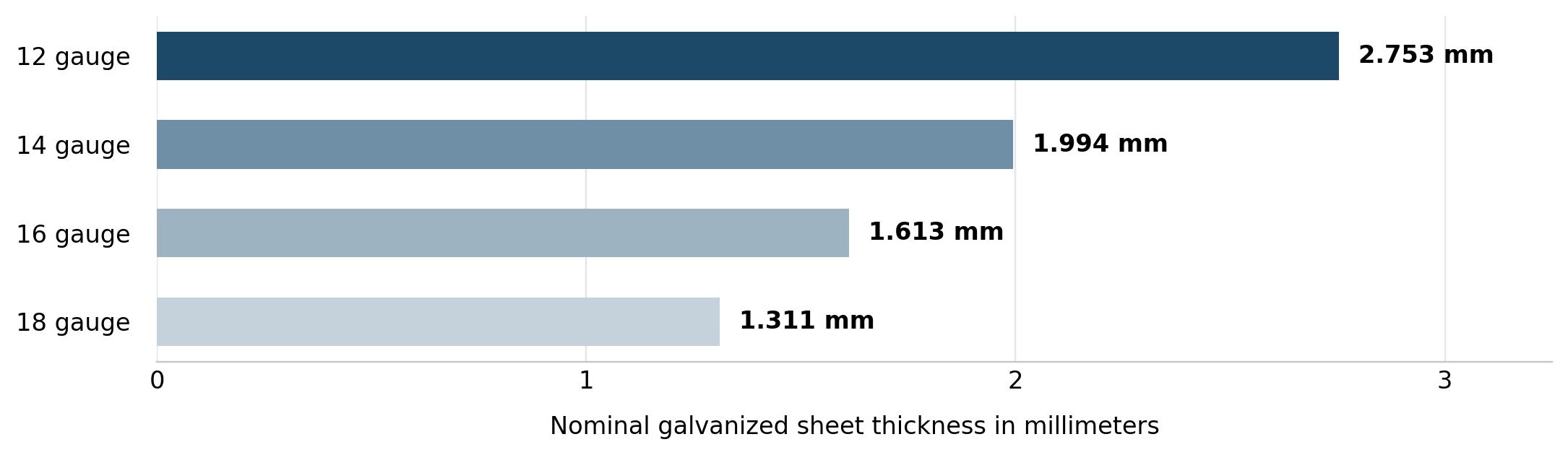
A consistent galvanized-sheet comparison. Greater thickness is not a measured percentage improvement in theft resistance.
What the additional steel contributes
For comparable materials, panel dimensions, and construction, thicker steel resists bending and local deformation more effectively. That matters around door edges, lock mountings, and cabinet surfaces exposed to daily use. A door or frame that stays aligned is less likely to develop interference that makes closing or latching difficult.
The advantages become more pronounced when comparing 12 gauge with 16- or 18-gauge sheet. Nevertheless, a complete locker also depends on formed edges, reinforcement, hinges, welds, fasteners, and anchoring. A reinforced thin-panel assembly cannot be evaluated by gauge alone, and 12 gauge by itself does not establish a certified forced-entry rating.
Why galvanizing matters as much as steel thickness
Steel thickness and corrosion protection solve different problems. A thick unprotected panel can still rust. Galvanizing places a zinc coating on the steel to help protect it from moisture and oxygen. Zinc also provides sacrificial protection: under suitable conditions, it corrodes preferentially to protect nearby exposed steel at small scratches or cut edges.
This protection has limits. Zinc does not repair a dent, replace missing coating, or protect an indefinitely large damaged area. Exposure, coating thickness, fabrication details, and maintenance all affect performance. That is why Package Nexus pairs galvanized steel with an industrial powder-coated finish and why the finish should be inspected after installation and during service.
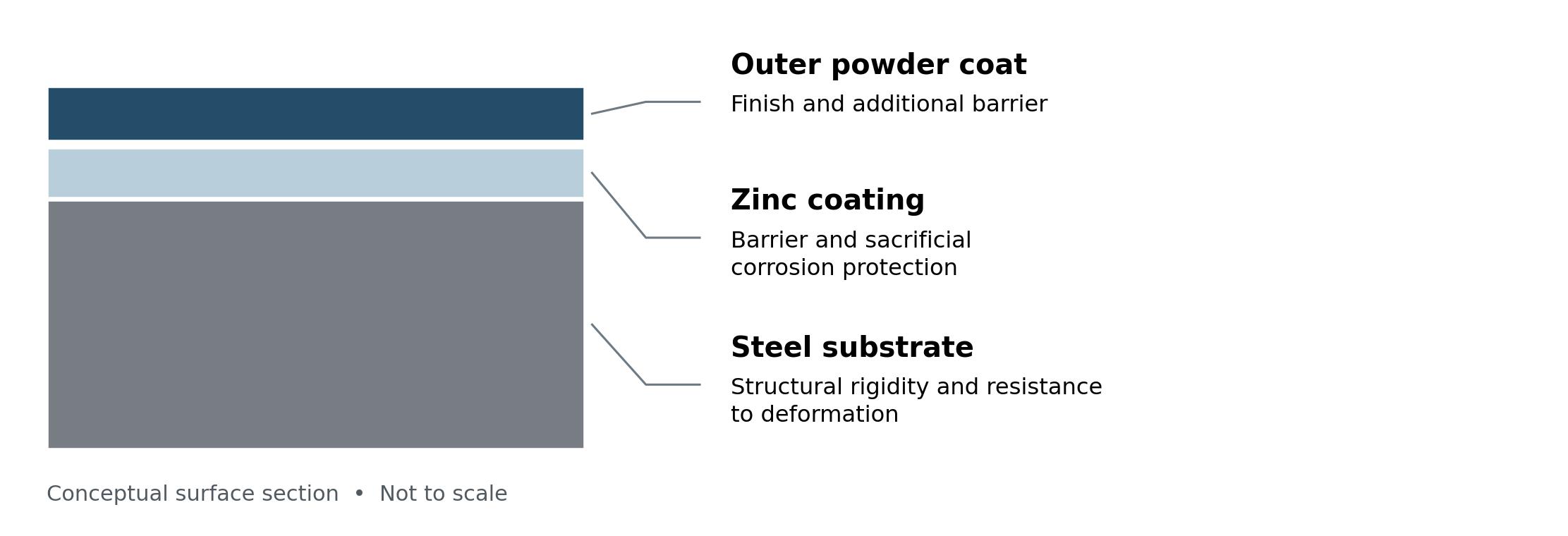
A conceptual surface section, not to scale. Final zinc and powder-coating thicknesses depend on the specified manufacturing process.
Powder coating provides another protective layer
A properly prepared and cured powder coating provides color, a cleanable surface, and an additional barrier against exposure. The zinc layer remains important if the outer finish is locally damaged. The performance of the two coatings depends on appropriate surface preparation, compatible materials, and coverage at corners, seams, and fabrication details.
Galvanized sheet that is cut and welded requires attention to exposed edges and affected areas. It should not be assumed that a completed locker has been dipped after fabrication or that every joint has identical coverage. A project submittal should identify the actual coating process and treatment of fabrication damage.
Outdoor exposure needs a complete design
Package Nexus outdoor smart parcel lockers bring corrosion-resistant construction together with weather-oriented equipment and installation planning. Rain, irrigation, humidity, deicing salts, and coastal exposure place different demands on the finish. Good drainage, appropriate shelter, suitable fasteners, and the documented operating limits remain essential. Galvanizing improves corrosion resistance; it does not by itself make an enclosure waterproof or temperature controlled.
Why indoor lockers also benefit from heavy duty galvanized steel
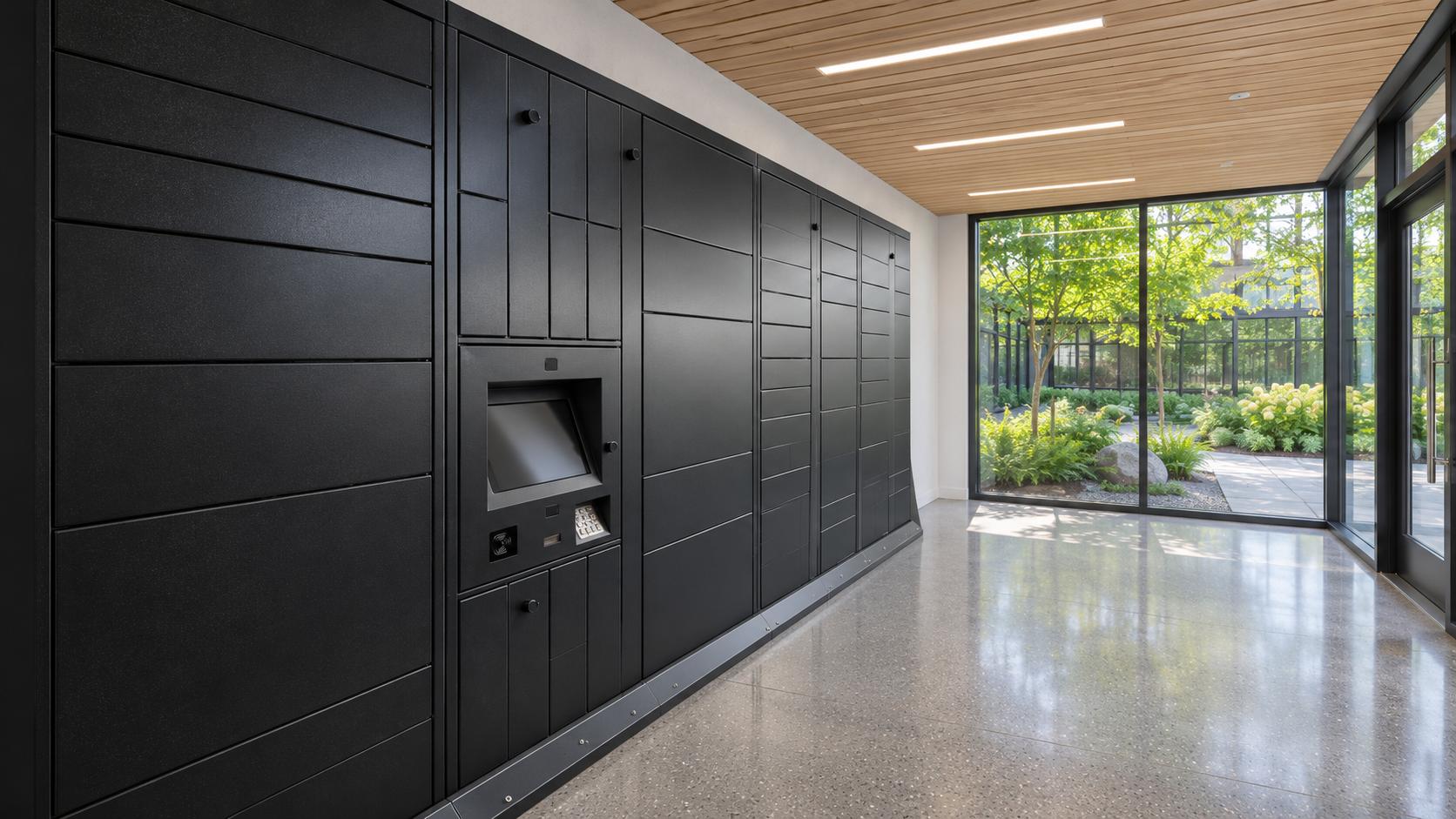
Indoor does not mean lightly used. A busy mailroom may see delivery carts, bulky boxes, repeated door cycles, cleaning equipment, wet parcels, and occasional impacts throughout the day. Garages and semi-enclosed corridors can also experience humidity and condensation. Choosing substantial steel and corrosion protection addresses these everyday operating conditions before damage becomes a maintenance issue.
Maintaining door alignment and usable capacity
A damaged door can remove a compartment from service even when the software works correctly. A rigid enclosure provides a stable foundation for doors and locking components, helping the system withstand ordinary use. Keeping more compartments available supports efficient package turnover and reduces the need to redirect deliveries.
Preserving the appearance of a shared amenity
Lockers are often visible to residents, customers, employees, and prospective tenants. Dents, rust staining, and damaged finishes can make a functioning installation look neglected. The construction used in indoor smart parcel lockers supports a professional appearance alongside practical durability. Careful handling and suitable cleaning remain part of protecting that investment.
For buildings evaluating an exterior location, the same discussion should include outdoor parcel locker security, access, lighting, drainage, and the surrounding approach route.
Why Package Nexus accepts a higher manufacturing cost
Using heavier sheet requires more material for the same panel area. It also adds weight to shipping and installation, increases forming and handling demands, and requires manufacturing processes suited to the thicker material. Galvanizing, surface preparation, and powder coating add their own production steps. These are real costs even when they are not visible in the finished locker.
Our reason for accepting them is the cost of operating the system over time. A less expensive cabinet can become a poor investment if repeated damage, corrosion, unavailable compartments, or service visits create recurring expense. A durable enclosure can help avoid those costs. The amount saved depends on the site and should be evaluated using actual repair history and service terms, not an assumed universal payback period.
Owners should compare acquisition and installation, maintenance, software and support, staff time, unavailable capacity, and eventual replacement. Heavier steel is an investment in the physical asset; automated workflows address the administrative burden. Both contribute to the value of the system.
Industrial components support the construction
Package Nexus publishes the following hardware capabilities. Confirm the current model and selected configuration in the project submittal.
| Component | Published Capability | Practical Purpose |
|---|---|---|
| Cabinet and finish | Heavy-duty 12-gauge galvanized steel and industrial powder coating | Rigidity and corrosion protection |
| Computer | Industrial-grade fanless PC with SSD | Dedicated platform for locker operations |
| User interface | 15-inch industrial touchscreen | Clear delivery and pickup interaction |
| Scanner | Dedicated industrial 1D and 2D barcode reader | Barcode-based workflows and pickup |
| Package sensing | Presence and absence monitoring | Evidence for delivery and retrieval status |
| Supporting features | Cameras, physical Braille keypad, audio prompts, compartment lighting | Visibility and usable interaction |
The specified scanner, camera coverage, accessibility configuration, environmental limits, dimensions, and installation requirements should be documented for the actual order. Accessibility depends on the complete installation, including the approach route and reach ranges.
Strong steel needs accurate delivery and pickup records
A locked door protects a parcel only while the parcel is actually inside. A successful delivery record should reflect a deposit, and a completed pickup should reflect removal. Opening a door, entering a code, or pressing a confirmation button does not establish either fact by itself.
Package detection and verification connect the physical compartment to the software record. Package Nexus develops its third-generation lockers around sensing and automated responses, including small, thin, flat, and irregular parcel workflows within the system’s supported detection envelope. Demonstrations should include those difficult items and different placements inside the compartment.
Patented automation addresses incomplete transactions
Package Nexus describes its third-generation system as the only smart parcel locker solution with its worldwide-patented On-Auto-Pilot technology for verifying package activity and completing supported delivery and pickup workflows. The company describes this as US and international patent protection. The distinction is the proprietary combination of sensing and workflow recovery; the presence of a sensor alone does not establish equivalent functionality.
Patented On-Auto-Pilot technology is designed to detect and address common departures from the expected sequence. In supported cases, it removes the need for a site manager to investigate and manually repair the transaction.
| What Happens | Why Manual Confirmation Can Fail | What Verification Adds |
|---|---|---|
| Courier deposits a parcel and leaves before finishing | A real delivery may remain unregistered | Presence data supports completion of the delivery workflow |
| Delivery is reported but the compartment is empty | An alert can conflict with the physical contents | Presence checks help prevent a false occupied status |
| Recipient opens the door but leaves the item | Code entry can be mistaken for collection | Continued presence distinguishes access from removal |
| Recipient removes the item but misses the final prompt | A vacant compartment can remain unavailable | Absence data supports completion and capacity release |
Why the 10 to 20 percent input estimate matters
Package Nexus estimates that user inputs can be wrong or missing in 10–20% of interactions in confirmation-dependent workflows. This is a company estimate, not a published industry-wide failure rate or a lost-package rate. It illustrates why transaction logic should use physical evidence rather than depend entirely on a hurried user’s response.
Automation can eliminate staff involvement for errors it resolves. Network outages, physical damage, wrong-recipient selection, and unresolved exceptions can still require assistance. Comparing smart versus electronic parcel lockers therefore means examining the work left for staff after a real-world mistake.
Choose the right combination of lockers and package rooms
Package Nexus offers Patented On-Auto-Pilot Smart Parcel Lockers, an Integrated Package Room, and a Standalone Package Room. Each improves a different part of package handling. Selecting the right combination begins with package sizes, available space, budget, delivery volume, and the level of transaction evidence the property needs.
Individually secured lockers provide stronger package accountability
Package Nexus third-generation lockers are designed to provide complete transparency and accountability for supported compartment transactions: who was assigned access, which compartment was involved, whether a package was present, and whether it was removed. Here, complete refers to the supported locker workflow; it does not mean that sensing verifies a shipping label, the contents of a sealed box, or every possible human error.
A shared shelf room inherently lacks the physical separation of individual compartments. An entry log shows that someone entered; it does not by itself prove which parcel was deposited or taken. Cameras and shelf zones improve visibility, but shared access alone cannot provide the same package-level verification. Additional tracking technology may improve a particular room, so its actual capabilities should be evaluated.
| Decision Factor | Sensor-Equipped Lockers | Access-Controlled Shelf Room |
|---|---|---|
| Storage boundary | Assigned individual compartment | Shared storage area |
| Evidence of package status | Presence and removal can be sensed | Entry logs and zone records do not independently prove item removal |
| Oversized deliveries | Limited by selected compartment dimensions | Flexible floor and shelf storage within room limits |
| Typical priority | Parcel separation and verified transactions | Flexible capacity and organized access |
An integrated system handles a broader package mix
The Package Nexus Integrated Package Room combines ambient smart lockers, refrigerated and temperature-controlled lockers, and a Smart Package Room under a centralized computer system. A property can secure routine parcels in compartments, provide suitable controlled-temperature storage where needed, and direct oversized or overflow deliveries to room storage. The room portion retains the shared-access limitations described above.
A standalone room makes existing space more useful
The Package Nexus Standalone Package Room places a computer at the entrance, controls access, and lets the carrier choose a specific shelf-zone for the delivery. Residents receive pickup credentials and can locate the indicated area more easily. Entry photography and optional interior cameras add context for investigations. For a suitable existing room and a constrained locker budget or footprint, this offers cleaner, computerized organization and self-service access.
Where durable construction and automation create value
| Setting | Operational Need | Relevant Package Nexus Approach |
|---|---|---|
| Multifamily and student housing | Frequent deliveries and convenient resident pickup | Durable cabinets, verified transactions, flexible capacity |
| Retail | Order pickup and repeated customer interaction | Individually assigned compartments and self-service handoff |
| Libraries | Holds and item collection outside staffed hours | Appropriate compartment sizes and supported library workflows |
| Warehouses and service teams | Parts, supplies, or equipment exchanges | Rugged storage with configured tracking and access |
| Hotels | Guest and staff delivery coordination | Recipient-specific access and a defined pickup location |
| Corporate mailrooms | Employee parcels and internal distribution | Centralized records and independent collection |
These are configuration opportunities, not claims that every feature or integration is included in every installation. Package mix and operating procedures determine the right design.
Expand capacity as the community grows
Package Nexus lockers are 100% modular and can be expanded as the community or package volume grows. Planning for modular locker expansion allows a property to begin with current needs and add compatible towers later. Reserve usable floor area and review power, connectivity, circulation, accessibility, and system compatibility when planning each phase.
Durability also matters when expansion occurs years after the original installation. Protecting the original cabinets helps preserve their usefulness while new capacity is added. Accurate occupancy records help ensure that physically empty compartments return to service promptly.
Work with a US owned and operated company
Package Nexus is 100% US-owned and operated. For buyers who prioritize US ownership, that provides a clear starting point for supplier selection and an ongoing relationship with the company responsible for the solution. Ownership, manufacturing origin, component sourcing, and data-hosting location are separate procurement questions; one should not be inferred from another.
Evaluate the complete system before selecting a supplier
Ask to review the steel and finish specification, door and lock construction, installation requirements, and supported environmental limits. Then test a thin parcel, an unfinished delivery, a pickup where the item stays inside, and a completed removal with no final confirmation. Review exactly what the resident and manager see.
To plan the right combination of durable cabinets, verified workflows, and room storage, request a project-specific quote from Package Nexus. Include your expected package volume, available space, exposure conditions, and expansion goals so the proposal can address the full operating requirement.
Frequently asked questions
Why does Package Nexus use 12 gauge steel when thinner steel costs less
The additional steel supports greater rigidity and resistance to deformation under comparable conditions. Package Nexus accepts the added material and manufacturing burden because the enclosure is expected to support repeated use over time. The intended customer benefit is a durable working asset with less exposure to damage-related disruption, rather than simply a lower initial material cost.
How much thicker is 12 gauge than 14 16 or 18 gauge steel
Using nominal galvanized-sheet values, 12 gauge is about 0.1084 inch or 2.753 millimeters thick. It is approximately 38% thicker than 14 gauge, 71% thicker than 16 gauge, and 110% thicker than 18 gauge. These percentages compare sheet thickness under the same convention. They do not quantify the security, service life, or load rating of a finished locker.
Why use galvanized steel if the lockers are already powder coated
The coatings perform complementary jobs. Powder coating adds a finished outer barrier, while zinc provides corrosion protection beneath it and can protect nearby exposed steel at small damaged areas. Performance depends on preparation, coating quality, exposure, and maintenance. Zinc is valuable because an outer finish can be scratched during installation or daily use.
Do indoor package lockers need corrosion protection
Yes. Indoor lockers can encounter damp parcels, cleaning moisture, humidity, and condensation, particularly in garages or semi-enclosed spaces. Galvanized steel provides an additional corrosion-resistance measure in those conditions. Thicker construction separately helps address carts, impacts, and repeated operation. Neither eliminates the need for proper cleaning and timely repair of damaged finishes.
Does 12 gauge galvanized steel make a locker theft proof or waterproof
No. It contributes to a stronger, more corrosion-resistant enclosure, but security also depends on doors, locks, hinges, cabinet assembly, anchoring, and access control. Weather protection depends on the full enclosure and installation. Ask for the selected model’s documented performance and environmental limits; do not treat a gauge number as a certification or a guarantee against all exposure.
How does On Auto Pilot reduce work for property managers
Package Nexus combines sensor feedback with automated transaction logic to complete or correct supported delivery and pickup workflows. When it resolves a missed confirmation or an unfinished transaction, the manager does not have to reconstruct and manually repair that event. Assistance can still be necessary for equipment damage, connectivity problems, incorrect recipient information, or exceptions outside the supported automation.
Can sensors detect thin envelopes and unusually shaped packages
Package Nexus describes sensing intended to detect small, flat, and varied parcels within its supported compartment configurations. A useful demonstration tests thin envelopes, padded mailers, and irregular shapes in different positions, including a timed-out session. The practical question is whether the complete system accurately records deposit and removal for the items your property receives, not merely whether the hardware includes a sensor.
Are package rooms as accountable as individual smart lockers
A room can provide access control, shelf-zone organization, and camera records. Those features are valuable, but entering a shared space does not itself verify a particular parcel’s pickup. Individually secured, sensor-equipped compartments provide a more direct connection between authorized access and a change in package presence. Compare any additional item-tracking technology in the proposed room before assuming equivalent verification.
When should a property choose a standalone or integrated package room
A standalone room can be suitable when an existing room offers flexible storage and the property needs a computerized access workflow within its space or budget constraints. An integrated solution makes sense when routine parcels, oversized deliveries, and temperature-sensitive items need different storage arrangements. Package Nexus can coordinate those options, while the property should understand how each area records package activity.
Can the lockers expand later and is Package Nexus US owned
Package Nexus lockers are 100% modular, allowing compatible modules to be added as demand grows, subject to installation space and technical requirements. Package Nexus is also 100% US-owned and operated. Buyers should document the planned expansion path, support responsibilities, and the selected system’s manufacturing and data arrangements in the proposal rather than treating ownership as a substitute for those details.

Package Nexus is the global technology leader and provider of The World's Most Advanced Smart Parcel Lockers for efficient and most simplified package management for multifamily communities, retailers, universities, libraries, corporate offices, groceries, and more. Package Nexus unique and patented technology offers a fix for human errors at the time of package deliveries and pickups. Package Nexus solutions help property, store, and office managers to improve their operations, reduce operating costs, and increase customer satisfaction at the same time. Package Nexus offers its entire suite of solutions globally.
USEFUL LINKS

© 2017-2026 Package Nexus