

Rethinking Food Access with Smart Food Lockers
More flexible food pickup for communities, campuses, retailers and residential properties
Smart food lockers are secure, self-service compartments that connect food delivery with convenient collection. With the right mix of ambient and temperature-controlled storage, they can help food banks, universities, grocers and residential communities make food available beyond staffed operating hours.
The opportunity is larger than automating a handoff. A well-planned locker program gives people more control over when they collect food, preserves privacy and helps operators understand whether an order was actually delivered and retrieved. Indoor and outdoor installations can support 24/7 deliveries and pickups wherever site access and program policies permit.
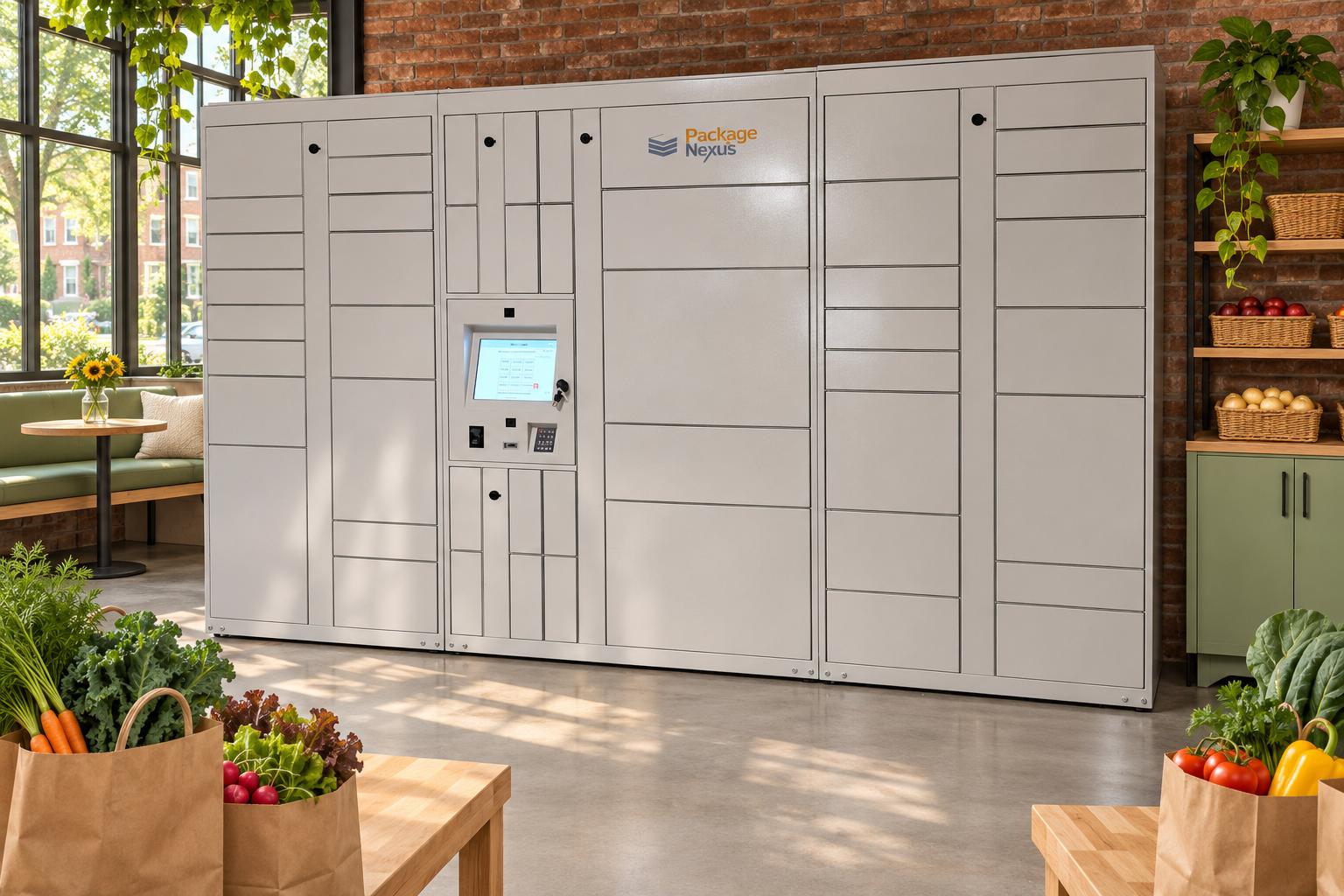
Package Nexus brings patented On-Auto-Pilot technology to this opportunity. The company reports that delivering a package to a Package Nexus Smart Locker can take only five seconds under its demonstrated workflow. Actual food-order loading time depends on order size, recipient selection and the configured process.
Why food access needs a more flexible handoff
A food program can have enough inventory and still be difficult to use. A parent may be working during distribution hours. A student may have class when a pantry is staffed. A caregiver may need to collect groceries after an appointment. Moving the final handoff into a secure locker can separate the organization’s packing schedule from the recipient’s pickup schedule.
This flexibility should complement human support. Lockers do not replace food sourcing, eligibility assistance, nutrition guidance or delivery services for people who cannot travel. Their strongest role is to make an existing food network easier to reach and operate.
Evidence from community and campus programs
A May 2026 University of Arkansas for Medical Sciences report describes a pilot with a faith-based pantry in Fayetteville. Participants ordered groceries online and used temperature-controlled lockers with 24/7 access. UAMS reported that 75% of participants increased their fruit and vegetable intake, alongside improvements in stretching grocery budgets and fewer access barriers. These are reported pilot findings, not proof that every locker installation will produce the same outcomes. The report does not identify this as a Package Nexus deployment.
In November 2026, Harry Chapin Food Bank announced a refrigerated locker program at The Joseph Project 863 in Clewiston. The initial installation has 16 compartments and offers approximately 20 pounds of food per order during designated pickup hours. A second planned site would bring the combined total to 32 compartments. This example demonstrates an operational model, not a Package Nexus customer reference or a universal 24/7 service promise.
Parcel Pending’s campus-food article describes refrigerated lockers supporting Bunker Hill Community College’s DISH program. This illustrates market adoption of discreet campus pickup; it should not be presented as evidence of Package Nexus performance. Click n Collect also discusses order-ahead and community pickup models, emphasizing flexibility and privacy.
Where the opportunity is strongest
| Setting | Food access opportunity | Success measure |
|---|---|---|
| Food banks and pantries | Extend collection beyond staffed distributions | Completed pickups outside normal hours |
| Universities and colleges | Offer discreet collection near daily student routes | Repeat use and fewer missed pickups |
| Housing communities | Receive grocery and meal deliveries near home | Resident adoption and staff time per order |
| Retail and community partners | Create convenient neighborhood collection points | Pickup completion and cost per fulfilled order |
| Workplaces and healthcare partners | Support shift workers and food-support programs | Reliable collection across different schedules |
Match each food order to the right storage
Ambient parcel lockers and refrigerated food lockers serve different needs. Shelf-stable groceries can use suitable ambient compartments; perishables require a validated temperature-controlled configuration. A weather-resistant outdoor cabinet does not, by itself, refrigerate its contents.
Package Nexus offers temperature-controlled smart lockers alongside ambient lockers, with hot, cool and frozen options described on its product page. Specify the required holding conditions, food packaging, capacity and operating environment for the selected tower. Do not assume that every tower supports every temperature mode.
| Storage type | Typical application | Specification priority |
|---|---|---|
| Ambient | Shelf-stable, packaged pantry goods | Dry, clean storage within the food’s labeled conditions |
| Refrigerated | Chilled groceries, dairy and prepared foods requiring cold holding | Validated cold holding and temperature monitoring |
| Frozen | Foods supplied and distributed frozen | Specified frozen-storage performance throughout the pickup window |
| Heated | Prepared meals requiring hot holding | Validated hot holding, short collection windows and suitable packaging |
Food protection requires an operating plan
The FDA Food Code generally specifies cold holding at 41°F or below and hot holding at 135°F or above for foods requiring time and temperature control for safety, subject to stated exceptions. The applicable requirements depend on the jurisdiction and operation. A vendor’s advertised temperature range is not a substitute for a food-safety plan.
Define who checks food at loading, how temperature records are reviewed, which alerts require action, and when an uncollected order must be removed. Include cleaning, spill response, allergen labeling, recalls, power interruptions and a method to prevent release of food that may be unsafe. Confirm which monitoring and lockout functions are available in the proposed system.
Click n Collect’s refrigerated-locker guide provides useful context on monitoring, access control and remote management. Its published temperature ranges describe that supplier’s offerings; they are neither Package Nexus specifications nor universal safe-holding limits.
Convenience without digital exclusion
Provide a supported alternative for people who lack a smartphone, reliable data service or email access. Plan assisted enrollment, clear pickup instructions, authorized caregiver collection and a reachable help contact. Braille controls can support access, but accessible routes, reach ranges, screen usability and compartment placement also require project-specific review.
Plan indoor and outdoor food pickup around real journeys
Indoor smart parcel lockers fit pantries, grocery pickup areas, residential lobbies and shared community facilities. Indoor placement can simplify weather protection, but a locked building entrance can limit after-hours access. Review how deliveries enter the site, where recipients wait and whether carts or mobility aids can reach the assigned compartments.
Outdoor smart parcel lockers can extend service beyond a building’s opening hours and create neighborhood collection points. Package Nexus describes outdoor construction using 12-gauge galvanized steel, suitable exterior designs and outdoor monitors. Its company-supplied feature list also includes LEDs inside every compartment, a canopy with LED lighting, motion sensors and security cameras. Confirm the selected configuration in the project specification.
Choose a location with a safe approach, clear sightlines, adequate lighting, convenient loading access and the required electrical and network connections. Review drainage, sun exposure, weather extremes and refrigeration ventilation. Outdoor temperature-controlled lockers need both an appropriate exterior design and the thermal performance required for the food.
Why verified delivery and pickup matter for food
For food distribution, a notification should represent a real deposit, and a completed pickup should represent actual removal. An incorrect status can mean a wasted trip for a recipient, an order left behind or an occupied compartment assigned again. The technology behind the workflow therefore matters as much as the appearance of the cabinet.
The Package Nexus On Auto Pilot approach
Package Nexus describes its patented On-Auto-Pilot technology as the foundation of its third-generation smart parcel lockers. Sensors and software verify supported delivery and pickup events and guide the workflow, rather than relying on a person’s answer to prompts such as “Did you deliver? Yes/No” or “Did you pick up? Yes/No.” Its comparison page describes automated recovery for common user errors and transaction interruptions.
The company positions Package Nexus as the only third-generation smart parcel locker system with its worldwide-patented On-Auto-Pilot approach. Package Nexus states that its U.S. and international patents extend to 2040. “Third generation” and “only” describe the company’s positioning; the reviewed materials do not provide an independent market-wide classification or patent-by-patent expiry verification.
Package Nexus also estimates that manual user inputs can be wrong or missing in 5–15% of interactions. This company-supplied estimate explains its emphasis on physical verification; it is not an independently established industry-wide error rate. The practical advantage is a record grounded in sensed package activity, with fewer routine confirmation steps.
Transparency should be defined in operational terms
Package Nexus describes its objective as complete transparency and 100% accountability for the delivery-to-pickup workflow. For a food operator, that means connecting the order, recipient, compartment and supported physical events in a useful record. It should not be interpreted as a guarantee of zero downtime, correct food contents or automatic food-safety compliance.
On-Auto-Pilot can remove the need for managers to supervise normal transactions and can reduce troubleshooting of supported user errors. Staff still have essential responsibilities for loading, sanitation, exception handling, maintenance and food protection. This distinction allows organizations to plan realistic staffing while benefiting from automation.
Compare the actual workflow
Organizations evaluating Luxer One, Parcel Pending, Amazon Hub, Package Concierge and Package Nexus should test the exact model and software being proposed. Package Nexus’s comparison materials characterize conventional workflows as more dependent on user confirmations. Demonstrate a deposit without confirmation, a session timeout, an empty-compartment attempt and a package left behind. Avoid assuming that every competing model has identical behavior or lacks 24/7 access, security or attractive design.
Commercial hardware and a better residential experience
Food lockers operate in a demanding environment: repeated door cycles, heavy grocery bags, frequent cleaning and, outdoors, changing weather. Package Nexus combines a heavy-duty enclosure with industrial electronics and a modular architecture, making it a compelling option for organizations planning long-term use.
| Package Nexus feature | Operational value | Project detail to confirm |
|---|---|---|
| 12-gauge galvanized steel | Cabinet rigidity and corrosion protection | Finish, anchoring, site exposure and care requirements |
| Industrial-grade fanless computer | Dedicated control platform for commercial operation | Service access, component support and environmental ratings |
| Touchscreen and Braille keypad | Guided interaction and additional input options | Accessible placement and supported user journeys |
| Cameras, barcode readers and speakers | Identification, guidance and transaction review | Exact devices, retention policy and supported credentials |
| Modular towers | Capacity can grow with demand | Space, power, compatibility and thermal requirements |
Package Nexus’s comparison page identifies industrial-grade computing, indoor and outdoor touchscreens, cameras, a Braille keypad, speakers and a Honeywell 3320G barcode scanner. Its indoor-workflow page lists a 15-inch touchscreen, RFID and cloud connectivity. These are published platform details; the final bill of materials should govern the installation.
Industrial hardware can offer advantages in serviceability, interfaces and environmental design. A consumer tablet’s durability depends on its model, enclosure and duty cycle, so a universal lifespan comparison would be misleading. Buyers should compare operating ratings, maintenance access and support terms rather than assume every tablet-based system will fail early.
Food convenience for high end and luxury multifamily communities
For luxury multifamily communities, the locker experience is part of the arrival experience. Custom finishes, coordinated layouts and appropriate climate-controlled or outdoor-rated options can create an amenity that looks intentional while keeping grocery bags and parcels out of the leasing office. Supported touchless pickup options can reduce kiosk interaction; confirm the exact steps and any door contact required.
The strongest fit combines convenient access, individually secured storage, high-security tracking and reliable event verification. Package Nexus’s focus on automated workflows offers a persuasive advantage where residents expect fast service and managers want fewer package-related interruptions.
Package Nexus states that it is 100% U.S.-owned and operated. Its lockers are described as 100% modular and expandable as the community or delivery volume grows. Plan compatible additional towers, footprint and utilities early so that future expansion is straightforward. U.S. ownership should not be confused with a claim that every component is manufactured domestically.
Build a food locker program that can demonstrate value
Start with a specific access problem
Select a pilot site where missed pickups, restricted hours or repeated staff handoffs are already measurable. Interview intended users about travel, privacy, language, packaging and preferred collection times. A convenient location is valuable only if people can reach it when they need it.
Size capacity by order dwell time
Estimate daily orders, the average time an order occupies a compartment and the number of compartments each order needs. Separate chilled, frozen and ambient demand: one household order may need several compartments. Allow capacity for peak demand, delayed collection and cleaning.
Illustrative planning calculation: 40 orders per day × 0.5 day average dwell time × 1.5 compartments per order = 30 occupied compartments on average. Adding a 25% planning buffer gives 37.5, rounded up to 38 compartments. This is a planning example, not a Package Nexus capacity recommendation; temperature mix and peak demand may require more.
Set responsibilities before launch
Agree who prepares and labels each order, who loads it, how the recipient is identified, how pickup instructions are issued, and who responds when food is uncollected or equipment needs attention. Test notification failures, forgotten credentials and authorized caregiver collection. Set achievable response times and provide a visible support route.
Measure access and operating effort together
| Measure | Why it matters |
|---|---|
| Completed pickups and missed-pickup rate | Shows whether the handoff is working |
| Share collected outside staffed hours | Tests whether longer access addresses a real need |
| Staff minutes per fulfilled order | Captures loading, support, cleaning and exception work |
| Dwell time and occupancy by temperature zone | Reveals capacity bottlenecks |
| Discarded orders and temperature exceptions | Tests food-protection performance |
| User feedback and assisted-pickup requests | Identifies access barriers and training needs |
Evaluate total cost across equipment, installation, connectivity, software, energy, cleaning, maintenance and food logistics. Do not count all previous staff time as savings: some work moves from the pickup desk to packing and restocking. Expand only after the pilot demonstrates reliable service and a sustainable operating model.
Plan the next step with Package Nexus
Share your food mix, expected daily orders, desired pickup hours and proposed location with Package Nexus. Review temperature-controlled smart lockers, outdoor smart parcel lockers and modular expansion as one coordinated plan. Request a food locker consultation to define the right configuration and test the intended delivery and pickup workflow.
Frequently asked questions
What are smart food lockers
Smart food lockers are electronically controlled compartments used to stage food for authorized self-service pickup. A program assigns an order to storage, provides pickup instructions and records the handoff. Depending on the selected equipment, compartments may be ambient, refrigerated, frozen or heated.
How do food lockers improve access
They let organizations prepare and load orders during working hours while recipients collect within a broader access window. This can reduce scheduling conflicts and provide more private collection. The benefits depend on placement, food availability, clear instructions and accessible alternatives for people who cannot use the standard process.
Can people deliver and collect food 24 hours a day
Yes, a suitable installation can support 24/7 deliveries and pickups when the building or outdoor site remains accessible and the program permits it. Food may still have a short collection deadline. Operators should state both the access hours and the order-specific pickup window.
Can smart food lockers be installed outdoors
Yes. Package Nexus offers outdoor solutions and temperature-controlled options. Select equipment for the actual weather exposure and food-holding requirements, then confirm power, connectivity, drainage, ventilation and accessibility. An outdoor ambient locker should never be assumed to provide refrigerated storage.
What is the difference between ambient and refrigerated lockers
Ambient lockers provide secured storage without assuming refrigeration. Refrigerated lockers actively maintain a specified cold environment. Choose storage based on the food’s requirements, and verify performance in the intended location; outdoor air temperature and door-opening frequency can affect the operating demand.
How fast is delivery to a Package Nexus locker
Package Nexus reports a five-second package delivery workflow. Treat this as a company-stated performance claim for the demonstrated process. A multi-bag grocery order, several recipients or separate temperature zones may take longer, so test realistic food orders during the demonstration.
How does On Auto Pilot differ from a confirmation prompt
Package Nexus uses patented sensing and software to verify supported physical delivery and pickup events. This reduces reliance on a person selecting “yes” or “no” after an interaction. Ask to see the exact behavior when a user walks away, a session expires or an item remains in the compartment.
Do food lockers eliminate the need for staff
They can remove the need for a staffed handoff at every pickup and reduce routine transaction troubleshooting. People are still needed for food preparation, loading, sanitation, maintenance and exception response. The goal is to use staff time more effectively while giving recipients greater flexibility.
Are Package Nexus lockers suitable for luxury multifamily communities
They are a strong option for communities seeking a combination of attractive finishes, secure deliveries, verified pickup events and convenient resident access. Ambient compartments can handle ordinary parcels while properly specified temperature-controlled towers support food deliveries. Final design should match the property’s space, demand and service expectations.
Can a locker system expand later
Package Nexus describes its platform as 100% modular, allowing compatible towers to be added as demand grows. Reserve the necessary footprint and plan future electrical and network needs. Food programs should evaluate expansion by temperature zone, not only by the total number of doors.
Can lockers support nutrition and food assistance programs
Yes, they can serve as collection infrastructure for pantry groceries, produce boxes or appropriately handled prepared meals. They do not independently establish clinical benefits or replace a program’s nutrition services. The UAMS pilot is encouraging evidence of potential access benefits, rather than a guarantee for a particular product or population.
How should an organization choose a supplier
Evaluate the proposed equipment against the actual service: food-holding performance, delivery and pickup verification, accessible use, reporting, service response, expansion and total cost. Require a demonstration with your packaging and typical orders. A documented workflow and a clear support plan are more useful than broad promises about automation.

Package Nexus is the global technology leader and provider of The World's Most Advanced Smart Parcel Lockers for efficient and most simplified package management for multifamily communities, retailers, universities, libraries, corporate offices, groceries, and more. Package Nexus unique and patented technology offers a fix for human errors at the time of package deliveries and pickups. Package Nexus solutions help property, store, and office managers to improve their operations, reduce operating costs, and increase customer satisfaction at the same time. Package Nexus offers its entire suite of solutions globally.
USEFUL LINKS

© 2017-2026 Package Nexus